


























Master the Al Fakher Mint flavor with expert packing, heat management, and mixing tips. Discover why this classic shisha remains a global lounge favorite.
You've got a bowl packed, the coals are glowing, and the first few pulls taste clean. Then the mint turns sharp, the throat feel becomes strangely numb, and the flavor loses the fresh character you expected. That change usually isn't a problem with the tobacco alone. With Al Fakher Mint flavour, bowl airflow and heat distribution often decide whether the session tastes crisp or acrid.
Mint also creates a common misunderstanding. A cooling draw can feel smoother without being less intense, and a fruit blend containing mint may taste more balanced without delivering the same mint-led experience as a standalone bowl. The practical answer comes from separating cooling sensation, sweetness, tobacco visibility, and heat response instead of describing every mint product as merely refreshing.
Table of Contents
The Legacy and Profile of Al Fakher Mint
A busy lounge usually needs dependable flavors. Guests ask for a familiar profile, groups want a blend that won't dominate every other bowl, and staff need something that performs predictably when several orders arrive together. Al Fakher Mint has earned that role because it works in more than one format. It can stand alone for a clean, cooling session, or support fruit, citrus, and traditional profiles without automatically turning them into a dessert-style mix.
The flavor also carries commercial and cultural weight. Al Fakher belongs to a brand founded in 1999 in Ajman, United Arab Emirates, and historical accounts identify Mint, Double Apple, and Grape as foundational flavors that helped establish the brand's identity before its range broadened for international consumers. The brand expanded beyond the Middle East into Europe, North America, and other markets by the early 2000s, which helps explain why Mint remains recognizable to hookah smokers in different regions. Historical background on Al Fakher's development places the flavor within that longer progression rather than treating it as a recent seasonal product.
Why a classic flavor still matters
For a retailer, a classic mint SKU does more than fill a space on the shelf. It provides a reference point. Customers can compare a fruit blend against a known cooling profile, while lounge managers can use it to adjust a bowl that tastes too sweet, heavy, or flat.
Independent research offers useful context, but it needs to be interpreted carefully. In a study of hookah flavor perceptions, mint was the most commonly selected individual flavor among participants, chosen by 22% of respondents. The published hookah flavor perception study measured preference for mint as a flavor category, not sales of Al Fakher Mint, global market share, or brand loyalty.
That distinction matters. The result supports mint's broad recognition, but it doesn't prove that every smoker wants a strong icy bowl. In service, some guests prefer a light herbal finish, while others want cooling to dominate the entire draw. The same product can satisfy both groups when the bowl and heat are managed differently.
Practical rule: Treat Al Fakher Mint as a foundational flavor category, not as a one-note novelty.
The profile is best understood as cooling, herbal, and blend-friendly. Sweetness may be present in the overall product experience, but it shouldn't be the main way staff explain the flavor. A good description tells the customer whether the bowl is mint-led, fruit-led with a mint finish, or designed to use mint as a balancing accent.
That language improves ordering decisions. Someone looking for a clean standalone bowl should not receive a fruit-mint blend just because both contain mint. Likewise, a guest who dislikes strong cooling may be better served by a fruit-forward mix where Mint plays a supporting role.
Understanding the Cooling Sensation and Taste Notes
The first technical distinction is between cooling and sweetness. Mint does not merely add a sugary taste to smoke. Mentholated flavor systems create a cooling sensation that changes how the draw feels in the mouth and throat, which can make smoke seem less irritating even when the underlying tobacco and smoke exposure haven't changed.
Published analyses of waterpipe products describe mint or menthol as a secondary flavor alongside fruity or sweet systems in many products. They also identify complex volatile profiles rather than a single compound responsible for the entire experience. Analysis of flavor chemicals in waterpipe products provides the useful operational lesson: a mint product should be evaluated by its cooling intensity and aromatic character, not by sweetness alone.
Reading the bowl through the draw
A well-managed Al Fakher Mint bowl usually develops in stages. Early pulls can emphasize a bright, direct mint note. As the bowl settles, the aroma may become rounder and more herbal, while excessive heat can push it toward dryness, sharpness, or an overwhelming cooling sensation.
That last point catches many smokers out. Cooling can mask some perceived harshness, so a draw may feel smoother while the bowl is already running too hot. If the smoke becomes smoky, acrid, or aggressively numb, don't add more coal to chase thicker clouds. Reduce the heat and let the tobacco recover.
Flavor descriptions should separate four observations:
- Cooling intensity: How strongly the mentholated sensation arrives and how long it remains.
- Mint character: Whether the note feels herbal, green, sharp, or predominantly menthol-like.
- Tobacco visibility: Whether the base remains noticeable beneath the flavor.
- Heat tolerance: How quickly the profile becomes dry, bitter, smoky, or excessively intense.
This framework is more useful than calling every session smooth. “Smooth” describes a sensation, not a complete product profile. A bowl can feel cool and still have a dry finish, or produce dense smoke while losing the clean mint note that made it appealing.
Why standalone Mint mixes easily
Mint works as a modifier because cooling can create contrast. It can lift a sweet fruit, sharpen a soft berry profile, or give a heavy blend a cleaner finish. The trade-off is that mint can also flatten delicate notes if it becomes the loudest component.
Start with the flavor you want guests to identify first. For a mint-led bowl, keep the supporting flavor restrained. For a fruit-led bowl, use Mint as a background accent and judge the result after the mixture has settled, not immediately after combining it.
Mastering Bowl Packing and Heat Management
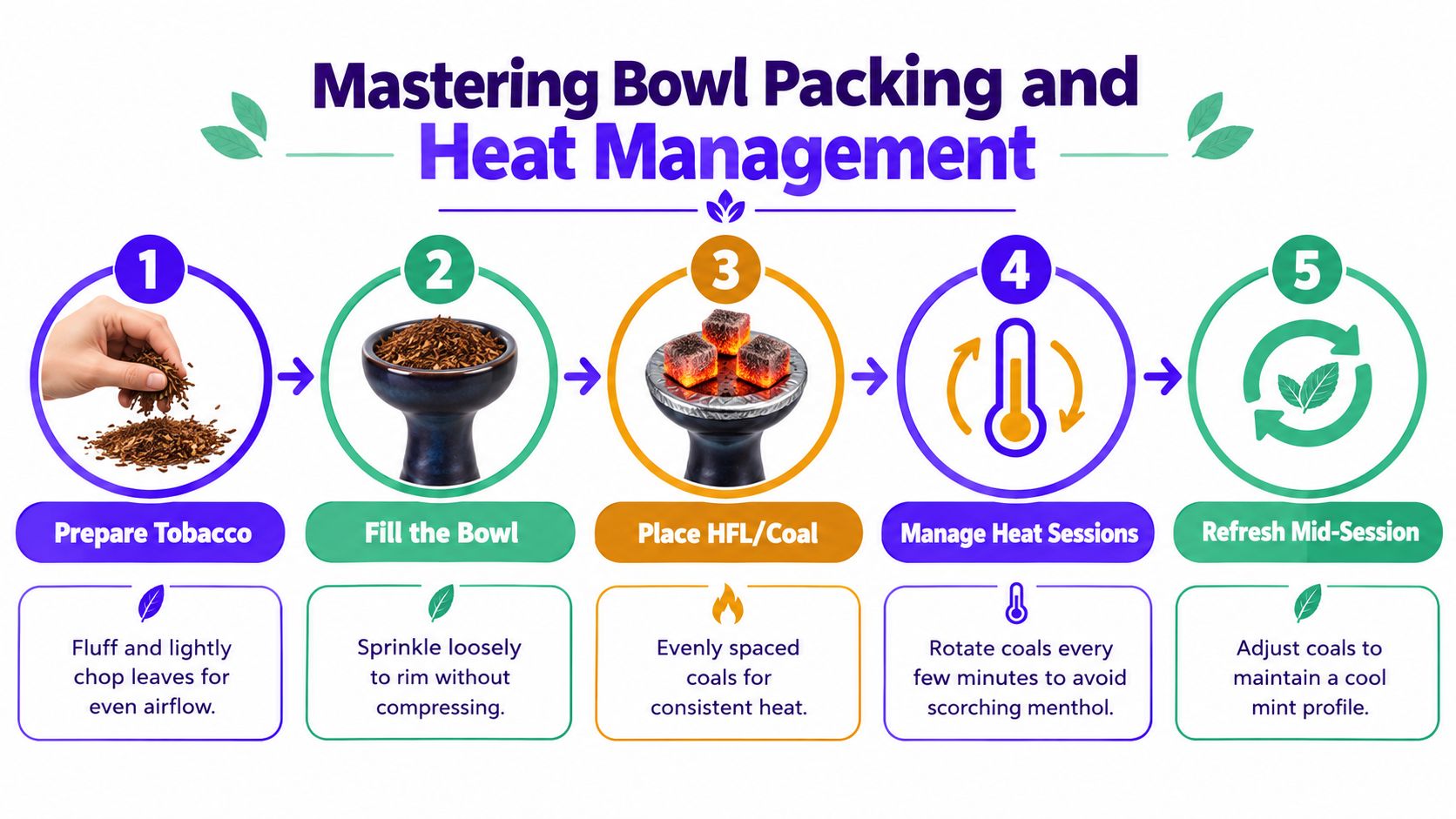
The most reliable Al Fakher Mint sessions start with loose, even preparation. Don't compress the tobacco into a dense plug. Mint needs consistent airflow and an even heat field, while a packed-down bowl can create hot spots that burn one area before the rest has warmed.
Prepare the tobacco evenly
Open the tobacco and distribute the moisture before loading the bowl. If syrup has collected in one area, fold it through gently rather than leaving a wet pocket at the bottom. Fluff the leaves and separate clumps so air can move through the tobacco.
Fill the bowl loosely to the rim or slightly below it, depending on the bowl design and heat-management device. Keep the tobacco from touching foil or a device that transfers direct heat aggressively. The aim is controlled heating, not direct combustion.
Packing rule: A loose bowl gives you room to correct heat. A compressed bowl gives heat fewer ways to escape.
The bowl shape matters, but there isn't one universal setup that works for every hookah. A phunnel-style bowl can help retain liquid in the central area, while a traditional bowl may distribute heat differently across its openings. Whatever the design, an even surface is more important than forcing a particular packing style.
Build heat gradually
Use fully lit natural charcoal or a controlled heat-management device. Partially lit coal can introduce unwanted taste and unstable heat, while tightly grouping all heat over one small area can scorch the mint before the rest of the bowl is ready.
Instrumented waterpipe experiments measured tobacco-head temperatures of approximately 265 to 318°C during a 30-minute session, with the temperature dropping by about 50°C during each draw and recovering between puffs. Waterpipe temperature and emissions research shows why a bowl can alternate between underheated and overheated conditions during normal service.
Place heat across the bowl rather than concentrating it in one spot. Let the bowl warm progressively, then adjust based on the draw, smoke texture, and flavor. Thick smoke alone isn't proof that the mint is performing well. If the flavor has become dry or sharp, the bowl has already given you the more important signal.
Correct an overheating bowl
When Mint turns acrid, remove one heat source or move the coals toward the edge. Pause briefly before taking another pull, because the tobacco head can remain hot after the coal has moved. A gentle purge may clear stale smoke from the base, but it won't repair scorched tobacco.
Rotate or reposition the remaining coals when one area becomes noticeably harsher than another. If the session continues to taste burnt, don't keep chasing recovery with more airflow. Once the flavorants and tobacco have been overheated, the practical solution is often to replace the bowl rather than extend the damage.
The research also found that charcoal contributes substantially to particulate output. One thirty-minute session using a 35-mm charcoal produced approximately 6×10^13 particles, while the charcoal itself contributed roughly 2.4×10^12 particles. These figures are why heat management should be treated as both a flavor-control task and a smoke-exposure consideration, not just a cloud-production technique.
For consistent lounge service, record what works with each bowl and device combination. Note whether the flavor stays herbal, becomes too cold, or dries out after coal movement. That simple log is more useful than copying a heat setup designed for another tobacco, bowl, or charcoal.
Creating Custom Blends and Mixing Ideas
Al Fakher Mint is most useful when you decide what role it should play before mixing. The same flavor can be the main event, a cooling accent, or a bridge between two stronger profiles. Mixing by instinct often produces a bowl where every note competes. Mixing by role produces a more readable session.
Start with the dominant note
For a standalone mint experience, use Mint by itself and focus on heat control. This gives you a baseline for the cooling sensation, tobacco visibility, and finish. Without that baseline, it's difficult to tell whether a blend improved the product or added sweetness.
For fruit blends, choose the fruit first. Watermelon, blueberry, grape, peach, and berry profiles can all move in different directions, so the mint should be added gradually until it lifts the fruit without erasing it. Fruit-forward bowls suit guests who want a refreshing finish but don't want mint to dominate the first draw.
Citrus needs a lighter touch. Lemon and other sharp fruit notes already create brightness, and too much cooling can make the profile feel thin or overly clinical. Add enough Mint to soften the edge, then stop when the citrus remains identifiable.
Build around contrast
The most useful combinations usually pair different sensory functions:
- Sweet fruit with Mint: Watermelon or peach can supply softness, while Mint removes some of the heavy sweetness from the finish.
- Dark fruit with Mint: Grape or berry can create depth, while cooling keeps the bowl from feeling dense.
- Apple with Mint: Two Apples and Mint can combine fruit sweetness, anise character, and a clean cooling accent. Keep the apple profile dominant if the guest wants the traditional character to remain visible.
- Citrus with Mint: Lemon can provide acidity and brightness, while Mint rounds the draw. Reduce the cooling component if the blend starts tasting medicinal.
- Floral notes with Mint: Herbal cooling can support a restrained floral flavor, but delicate aromas disappear quickly under strong menthol.
These are starting directions, not fixed formulas. Product batches, bowl geometry, moisture distribution, and heat all change how a blend presents. Make small test bowls and write down what the customer notices first.
Avoid the “more mint” trap
A stronger mint note isn't automatically a stronger overall session. Cooling can dominate the senses while the fruit, tobacco, or sweetness remains unchanged underneath. If the guest says the bowl feels intense but can't identify the flavor, the blend may need less Mint, not more heat.
This is also where staff language matters. Ask whether the customer wants more cooling, more fruit, or more smoke body. Those requests aren't interchangeable. More coal may increase smoke and harshness without improving the desired flavor.
Use the same bowl, packing method, and heat approach when testing variations. Otherwise, a change in airflow can look like a recipe improvement. A repeatable process lets you decide whether the blend itself works.
A useful lounge menu can describe blends by their dominant note. “Mint-led,” “fruit-led with cooling,” and “citrus with a mint finish” tell guests much more than “fresh” or “refreshing.” That distinction reduces disappointing orders and helps new smokers choose with realistic expectations.
Comparing Standalone Mint to Fruit-Mint Blends
Standalone Al Fakher Mint gives you the clearest view of the product's cooling character. The mint arrives without fruit sweetness competing for attention, and the finish can feel cleaner and more direct. This format works well for guests who want a simple profile, for staff calibration, and for testing whether heat management is preserving the intended flavor.
A fruit-mint blend behaves differently even when it contains a noticeable cooling note. Fruit can soften the first impression, add sweetness, and make the mint feel like a finish rather than the central flavor. That can be more approachable for some guests, but it also makes the product harder to evaluate by description alone.
A practical side-by-side view
| Sensory question | Standalone Al Fakher Mint | Fruit-mint blend |
|---|---|---|
| What arrives first | Mint and cooling are usually the primary cues | Fruit may lead, with cooling following |
| Sweetness | Less dependent on fruit character | Often more noticeable through the fruit component |
| Tobacco visibility | Easier to detect beneath the mint | Can be masked by fruit aroma and sweetness |
| Cooling role | Main flavor structure | Modifier, contrast, or finish |
| Heat failure | Acrid or overly intense mint becomes obvious | Fruit may turn dull or syrupy before the mint fails |
| Best use | Clean bowls, calibration, mint-focused orders | Menu variety and fruit-led sessions |
The comparison should remain sensory. Evidence for one flavored SKU shouldn't be presented as proof about every product that contains mint. An aerosol analysis of Two Apples with Mint, for example, identified glycerol, propylene glycol, and water as primary components and reported machine-generated emissions for that specific blend. It didn't provide a sensory comparison between standalone Al Fakher Mint and other Al Fakher products. The specific product analysis is therefore useful for scope, not for claiming that every Mint SKU performs identically.
Choosing for a menu
Stock standalone Mint when you need a clear, flexible base. It gives staff an easy answer for customers who want cooling without fruit, and it can be used to test a new bowl or heat-management device.
Stock fruit-mint options when your menu needs sweeter, more approachable profiles. A fruit-mint blend can suit a guest who finds a direct mint bowl too narrow, while still providing the cooling finish they associate with mint.
For a lounge, the strongest menu descriptions explain the difference directly. Say whether the fruit leads, whether mint is prominent throughout, and whether the blend finishes cool. Don't promise that mint makes the bowl gentler or safer. It may change perception, but it doesn't remove the characteristics of the smoke.
The question isn't “Which one has more mint?” It's “Which note should the guest recognize first?”
A controlled comparison should assess mint intensity, cooling sensation, sweetness, tobacco visibility, smoke harshness, and mixer performance separately. That approach produces useful recommendations for both home smokers and procurement teams instead of treating every mint-containing product as interchangeable.
Health Perceptions and Regulatory Context
Cooling changes perception, not the fundamental health context of smoking. A mentholated draw can feel less irritating because the cooling sensation softens the experience, but a smoother-feeling session isn't proof that the tobacco smoke is safer or that nicotine exposure is lower.
Health guidance summarized in the available product context states that hookah smoke contains nicotine, carbon monoxide, heavy metals, and other harmful components. It also reports that one hookah session can expose users to nearly nine times the carbon monoxide and 1.7 times the nicotine of a single cigarette. Health and product context for Al Fakher Mint makes the central point clearly: flavoring can alter taste and perceived harshness, but it doesn't remove dependence risk or make smoke harmless.
What mint can and cannot tell you
Mint flavor doesn't reveal the product's exact nicotine content, menthol concentration, or ingredient ratios. Those details require the manufacturer's package specification or laboratory testing. A product listing that reports a nicotine figure is not the same as a measurement of exposure during an actual hookah session.
Heat also matters to what users inhale. Research on waterpipe preparation and heating methods found that bowl setup can change nicotine, menthol, particulate, furan, and carbon-monoxide yields. Cooling the water may change particulate delivery, but it doesn't make the smoke safe.
For responsible service, don't describe Mint as a safer alternative to non-mint tobacco. Describe the sensory effect accurately, provide the required warnings for your market, and avoid turning “smooth” into a health claim.
Check the rules where you sell
Flavor regulation isn't uniform. Mint and menthol may be treated as characterizing flavors, while laws can differ by jurisdiction and may distinguish cigarettes from other tobacco products. Retailers, lounges, and wholesalers should check local rules covering flavor definitions, warning labels, taxation, age restrictions, and permitted sales channels before listing or serving a product.
Package labeling also needs careful handling. Don't infer regulatory status from the flavor name alone, and don't assume that a product available in one market can be sold or served under identical conditions elsewhere. Keep product records current and verify requirements with the relevant local authority or qualified compliance adviser.
For customers, the practical answer to “Does Al Fakher Mint feel smoother or safer?” is straightforward. It may feel smoother because cooling changes sensory perception. It isn't safe just because it tastes cool, and it still involves exposure to tobacco smoke and nicotine when the product contains them.
A good operator protects both flavor quality and customer understanding. Use even packing, progressive heat, and clear menu descriptions. Separate sensory language from health claims, and treat local compliance as a product requirement rather than an afterthought.
If you're choosing Al Fakher Mint for a home setup, lounge menu, or wholesale order, Shop Hookah Tobacco offers Al Fakher tobacco with a selectable Mint option alongside hookahs, charcoal, heat-management devices, bowls, and replacement parts. Visit the store to match the flavor with the equipment and supplies needed for more consistent bowl preparation.