























Choose the right lighter for coal — compare torches, coil burners, and quick-light technique, with safety and maintenance tips for better hookah sessions.
A standard pocket lighter can't reliably light natural coconut hookah coals; they need a coil burner or sustained torch heat, with 8–12 minutes a practical burner benchmark, while quick-light coals are the type a simple flame lighter can handle. If you're holding a flame against a stubborn black cube while your prepared bowl sits waiting, the problem probably isn't your technique.
A useful lighter for coal has to match the charcoal, the lighting station, and the person operating it. The fastest spark isn't necessarily the most useful tool, and an electric plug doesn't make the whole process safe.
Table of Contents
Why the Right Lighter for Coal Matters
You're hunched over a coconut coal, clicking a cheap lighter until your thumb aches. A small patch changes color, but the rest stays black. Moving the flame around feels productive, yet you still don't have a coal ready for the bowl.
That's a tool mismatch. Quick-light charcoal and natural coconut charcoal require different ignition methods, so shopping for a lighter before checking the fuel puts the decision backward.
The practical cost isn't just wasted lighter fuel. An operator who rushes an incomplete batch can end up interrupting service to reheat coals rather than maintaining a steady supply of ready charcoal. At home, the same mistake means spending the opening of a session troubleshooting the lighting setup.
Judge the finished coal, not the first spark
A visible glow tells you that ignition has started. It doesn't establish that the coal is ready to transfer.
The relevant failure modes are uneven heat, self-extinguishing charcoal, and potentially greater smoke and carbon-monoxide exposure when partially ignited coals reach the bowl. The difference between quick-light ignition and the sustained heating natural charcoal requires is covered in this comparison of quick-light and natural charcoal.
Practical rule: Buy the tool that produces a completely ready coal consistently, not the tool that makes the most impressive flame.
Treat a lighting setup as a working station rather than a lighter purchase:
- Fuel compatibility: Establish which charcoal you're using.
- Heating capacity: Choose equipment that can finish the intended batch without crowding.
- Handling space: Leave a clear place for tongs, transfers, and hot equipment.
- Repeatability: Use the same readiness checks instead of deciding by impatience.
That approach matters more than whether a lighter looks powerful in a product photograph. A suitable setup lets you prepare charcoal deliberately, check it properly, and transfer it without improvising around a hot appliance.
Know Your Coal Type Before You Light It
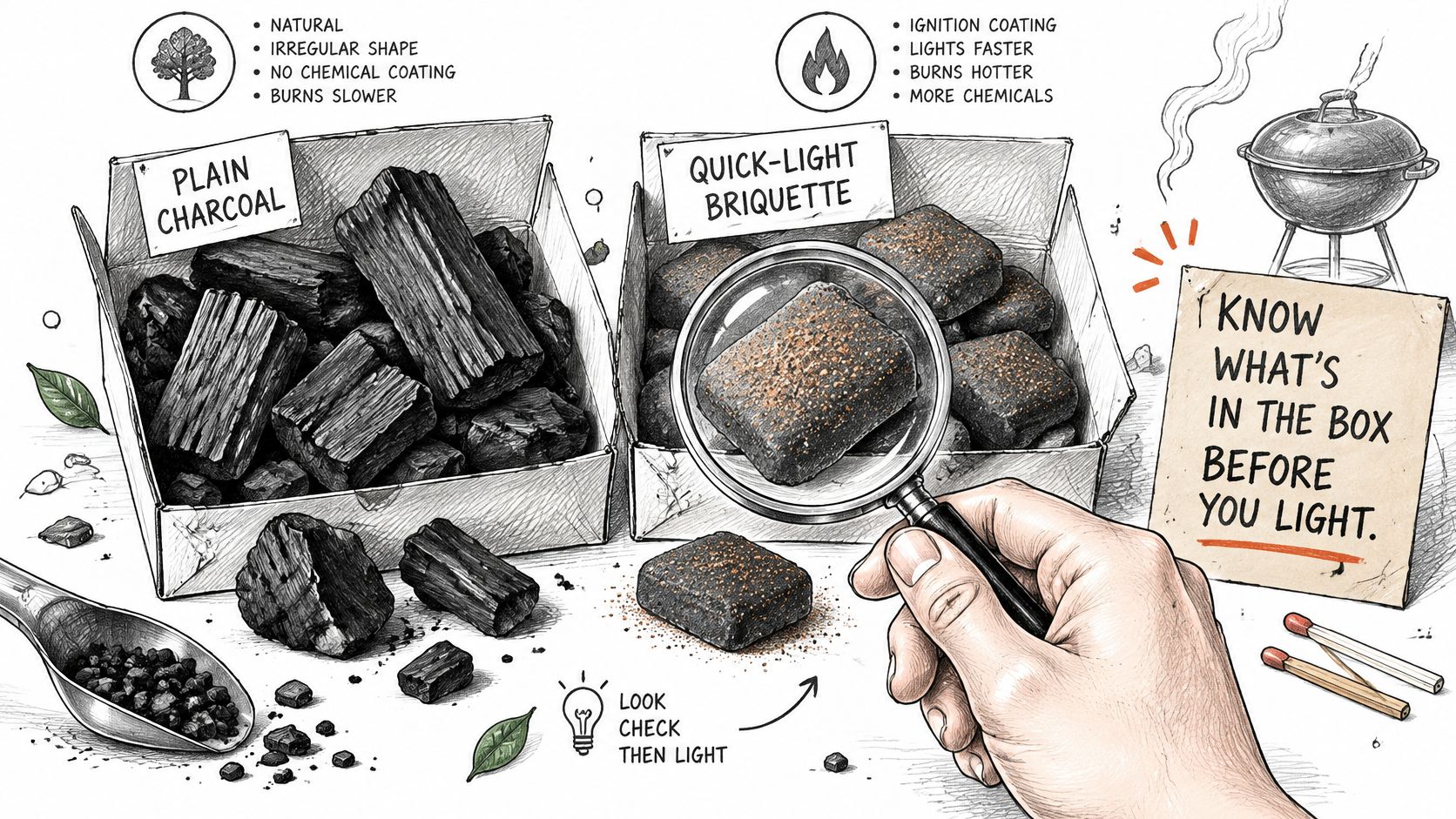
Read the charcoal packaging before opening the lighter. Look for explicit wording such as quick-light, instant-light, or natural coconut charcoal rather than relying on the product's shape.
The physical comparison below is useful, but the manufacturer's identification should settle the question.
Quick-light charcoal uses an ignition coating
Quick-light briquettes have a coating that sustains the initial reaction after contact with a flame. Sparking, visible activity, and a sharp chemical odor are important cues during that process. Don't treat the first flash as evidence that the product is ready for use.
That convenience comes with an emissions trade-off. A reported comparison over 90 minutes measured mean carbon-monoxide output of 3,728 ± 2,028 ppm for quick-light charcoal, versus 1,730 ± 501 ppm for natural charcoal, in the charcoal comparison cited earlier.
Those are test measurements, not a prediction of the concentration in your room. The large variation also matters: a single successful lighting attempt tells you little about the consistency of an entire box.
Natural charcoal needs sustained heating
Natural coconut charcoal doesn't have the quick-light coating that carries ignition across the briquette. A brief flame applied to a corner therefore isn't equivalent to sustained heating across the coal.
Don't use appearance alone to decide which method applies. Treat shape as an inventory clue, not a chemical identification.
- Packaging first: Confirm the labeled charcoal type and follow its lighting instructions.
- Shape second: Use the shape to distinguish products you've already identified, not to classify an unfamiliar coal.
- Visible reaction: Sparking can help confirm the behavior of a labeled quick-light product during normal ignition.
- Odor awareness: Notice persistent chemical odor from a normal working distance. Don't lean over charcoal to smell-test it.
If you've lost the packaging and can't establish what you have, don't build a lighting procedure around a guess. Keep products labeled, especially at a lounge where staff may refill shared storage containers.
The useful distinction isn't “cheap coal versus premium coal.” It's coated charcoal that supports flame ignition versus charcoal that needs sustained external heat.
Comparing Torch Lighters, Utility Lighters, and Coal Burners
Choose equipment by the work it must complete. A pocket-size torch, a long-neck lighter, and a dedicated burner may all start combustion, but they don't offer the same heating pattern, handling demands, or batch capacity.
Coal Lighting Tools Compared
| Tool | Best For | Works on Natural Coconut Coal | Key Limitation |
|---|---|---|---|
| Butane torch lighter | Quick-light ignition and portable flame access | Not a dependable routine choice; sustained heating is needed | Requires continued flame handling and fuel |
| Long-neck utility lighter | Applying flame to quick-light charcoal | No, not reliably | Can start a coating, not heat a natural coal throughout |
| Electric coil burner | Routine natural-coal preparation | Yes | Hot exposed element, electrical requirements, and cooling time |
| Fan-assisted hot-air firelighter | Dedicated solid-fuel ignition | Yes, when designed for the charcoal and application | Requires compatible equipment and controlled hot-air placement |
A torch is useful when portability matters. Its directed flame makes it a practical choice for quick-light products. For natural charcoal, however, preheating a patch with a torch isn't the same as preparing the whole coal.
A long-neck utility lighter gives you reach. It's a reasonable way to apply the initial flame to quick-light charcoal while using tongs, but the longer neck doesn't change the fuel's heating requirements.
For regular natural-coal use, a dedicated coil burner is the straightforward choice. It gives you a repeatable heating position without requiring someone to hold a flame against each piece. Check the appliance's instructions, electrical rating, usable heating area, and permitted operating location before buying.
A fan-assisted hot-air firelighter offers another dedicated approach. Don't assume it will outperform a coil on your charcoal just because its advertising emphasizes speed. Compare complete readiness on the same product, not the time until a corner first glows.
Electric ignition isn't electric hookah heating
An important distinction often disappears from buying guides: an electric burner used to ignite charcoal is not an electric device that replaces charcoal during smoking.
Research summarized by the American Chemical Society on electric hookah heating found approximately 90% lower carbon monoxide and 80% lower polycyclic aromatic hydrocarbons with electric heating, but acrolein was several orders of magnitude higher; particulate matter and nicotine yields were similar.
Those findings don't establish that using an electric coal starter makes the subsequent charcoal-heated session safer. They describe a different heating arrangement.
Removing an ignition flame changes the lighting task. It doesn't remove the hazards of the charcoal you light.
For purchasing, compare flame exposure, electrical requirements, hot-surface handling, portability, and complete ignition time separately. There isn't a meaningful universal winner without identifying the coal and the operating conditions.
How to Light Hookah Coals the Right Way
Prepare the lighting area before energizing a burner or opening a flame. Have the charcoal, suitable tongs, and a clear transfer route ready so you aren't searching for equipment while holding something hot.
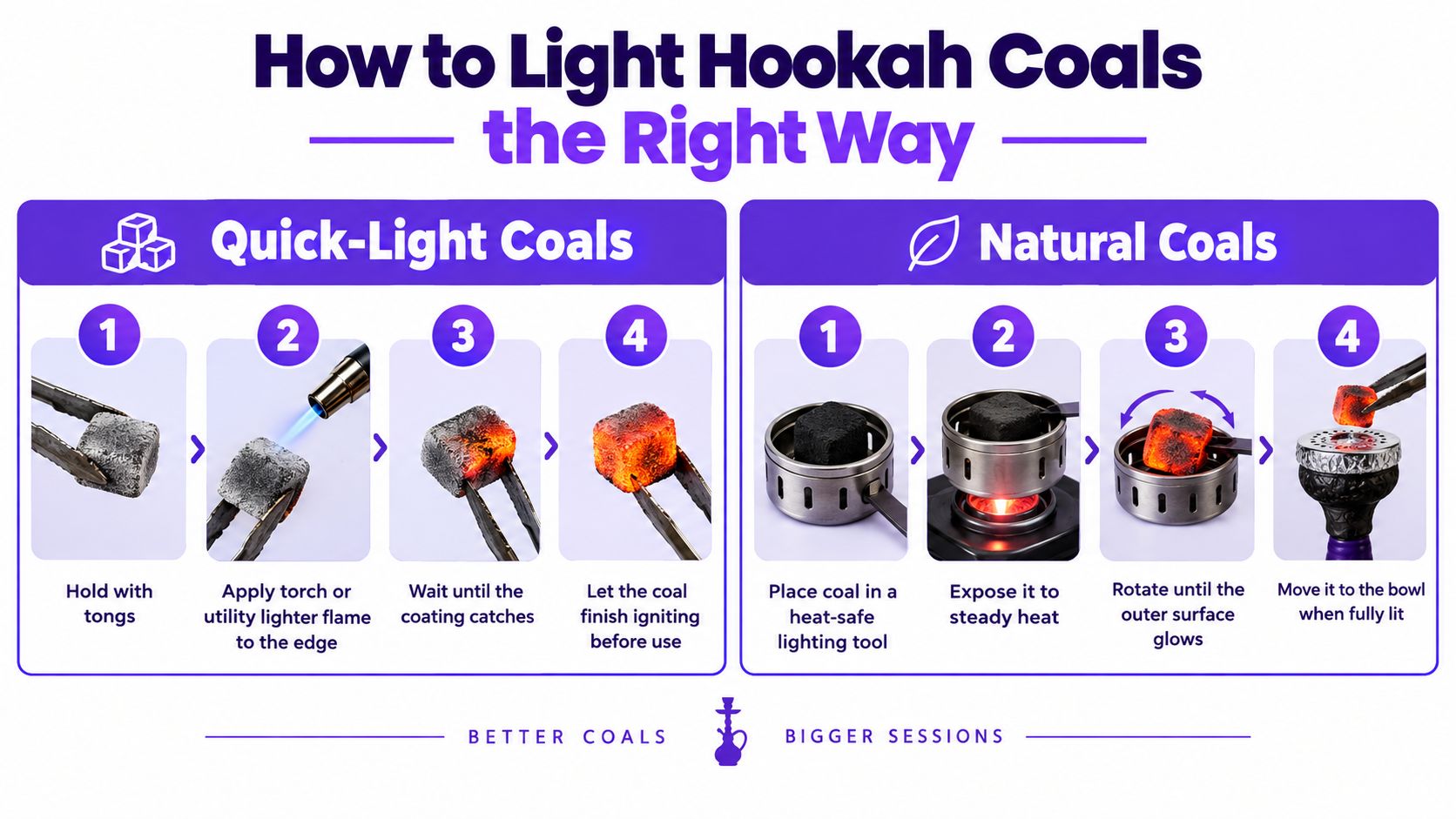
Use the appropriate sequence below as a working reminder.
Lighting quick-light charcoal
- Grip securely: Hold the briquette with suitable charcoal tongs over the designated noncombustible lighting area.
- Apply the flame: Bring a torch or utility-lighter flame to an edge until the ignition coating catches.
- Allow the reaction to finish: Keep the coal away from the bowl while sparking and visible coating activity continue.
- Check before transferring: The sharp chemical odor associated with ignition should have stopped, and the coal should be fully ignited before use.
Don't put a still-reacting briquette on the bowl and expect the opening draws to finish the job. Burn-off belongs at the lighting station, not in the session.
If the coating catches unevenly or the product fails to finish igniting, keep it at the station and reassess it. Don't compensate by putting it on the bowl early.
Lighting natural coconut charcoal
Set a dedicated contact-coil or hot-air firelighter on a stable, noncombustible surface, away from combustible materials. Position the coals so heat can reach multiple faces rather than packing the heating area tightly.
Rotate the coals approximately halfway through ignition. A practical burner benchmark is 8–12 minutes, but geometry, wattage, airflow, ambient conditions, and crowding can change the actual time; readiness requires all faces glowing red-orange with a thin grey-white ash layer, as described in the operating guidance associated with IEC requirements for solid-fuel firelighters.
Inspect the faces that were turned away from the heat. A finished-looking top doesn't excuse a black underside.
Use tongs to rotate and transfer each coal, keeping it over the intended heat-resistant area. If a piece fails the readiness check, leave it at the lighting station for further heating rather than trying to finish it on the bowl.
This video can supplement the written sequence; the readiness checks remain the deciding standard.
Make the transfer deliberate
Move the finished charcoal along the clear route you prepared. Don't carry it while also adjusting a hose, opening packaging, or moving furniture.
For a lounge, treat transfer as a separate task from ignition. Someone should be able to tell which coals are still heating and which have passed inspection without having to guess from their position on a crowded burner.
Safety Habits and Lighter Maintenance That Prevent Accidents
A safe lighting routine starts before the first coal goes on the appliance and ends after the equipment and waste have been dealt with. Buying a different lighter doesn't replace that routine.
All burning charcoal generates carbon monoxide. Light it outdoors where permitted and suitable, or in a controlled, appropriately ventilated area; never assume an ordinary indoor room is an acceptable lighting station.
The hookah evidence collected in the WHO FCTC knowledge database includes a controlled comparison using a 9–10 g quick-light briquette and highlights why charcoal exposure deserves attention even at a small scale. A lighter isn't a substitute for ventilation or a carbon-monoxide alarm.
Use this checklist as a reminder, not as permission to operate in an unsuitable space.
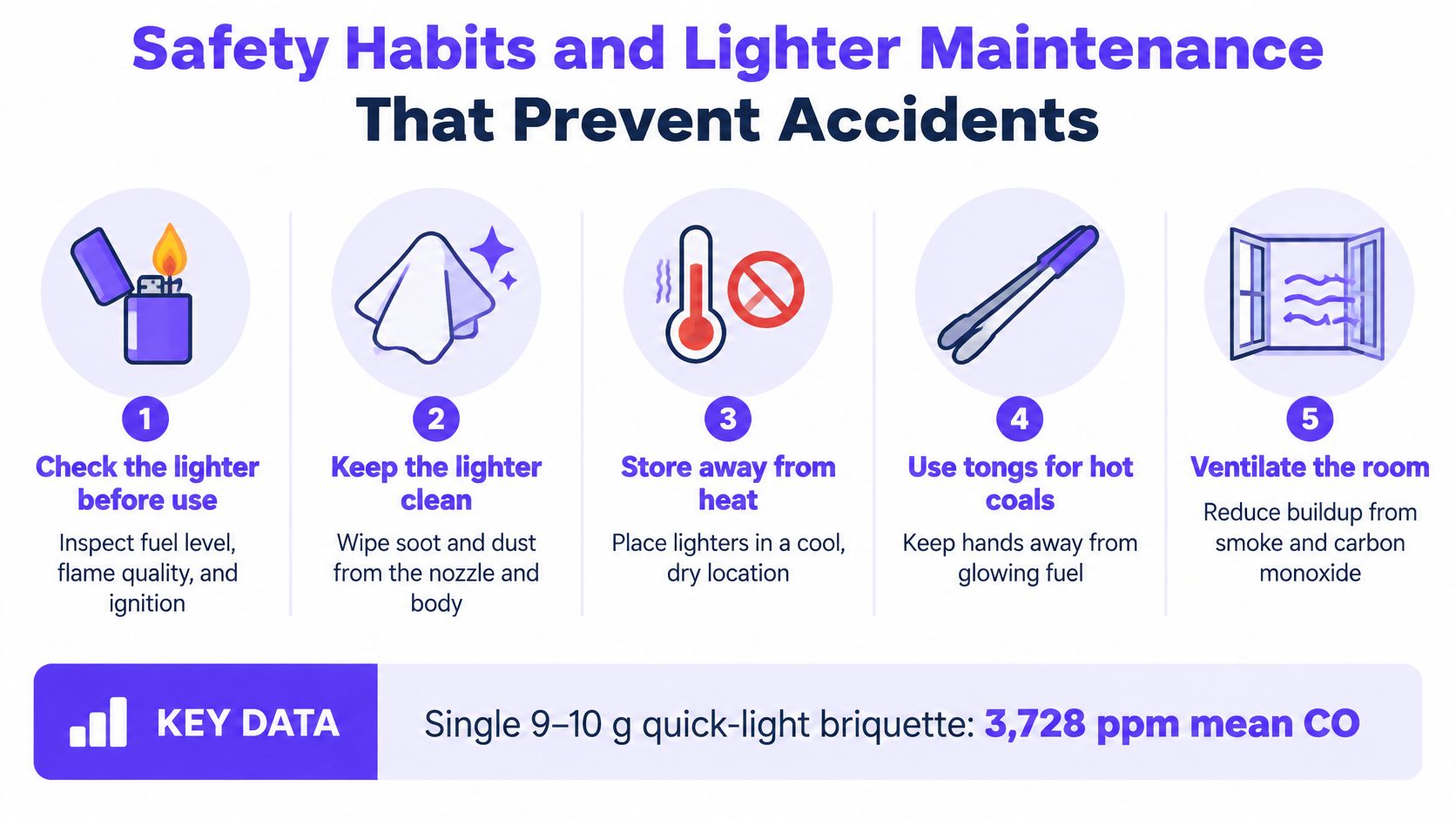
Control the station before maintaining the tool
Keep an operating burner attended. Place it where staff, guests, children, and pets can't accidentally contact the element or disrupt a transfer, and allow it to cool before storage.
Separate fresh charcoal storage from hot-coal handling. Store charcoal dry, and follow the product's storage instructions: fire-safety guidance warns that charcoal can self-ignite under some wet-dry storage conditions. Don't return questionable material to a clean stock container.
For spent charcoal and ash, use a defined extinguishing and disposal procedure. Completely extinguish embers before disposal, and don't treat an unremarkable exterior as proof that waste is safe to handle.
Station standard: The person finishing the batch is responsible for the burner, the transfer area, and the waste, not just the bowl.
Maintain equipment according to its instructions
Maintenance should make operation predictable, not introduce another ignition hazard. Shut equipment down and let it cool before inspection or cleaning.
- Butane torches: Refill only as directed by the manufacturer, away from ignition sources. Purge only if the model's instructions require it; don't apply an improvised universal procedure.
- Torch nozzles: Keep exterior soot and dust under control using the approved method. Don't probe a jet or disassemble a pressurized lighter to cure an unreliable flame.
- Coil burners: Remove loose ash after cooling and disconnecting the appliance. Inspect the cord, plug, and heating assembly, and take damaged equipment out of service.
- Utility lighters: Replace a unit that sputters or won't ignite consistently rather than repeatedly operating it beside a hot batch.
Give lounge staff a measurable procedure
Write down who can operate the station, where hot charcoal may travel, how waste is extinguished, and what happens when equipment fails. Make unattended operation unacceptable rather than relying on everyone to infer the rule.
Validate each burner-and-charcoal combination with the actual charcoal SKU. Record time to full-surface ash coverage, whether a second heating cycle is needed, odor persistence where relevant, and any self-extinguishing after transfer.
Keep operating conditions comparable when testing a new lot. A changed batch size or crowded element can make a product appear inconsistent when the staff have changed the test.
Getting Perfect Coals Every Session
Consistency comes from a repeatable decision, not a stronger lighter. Identify the charcoal, match the equipment, inspect readiness, and complete the handling routine before calling the batch finished.
The most expensive mistake in daily operation is often accepting an incomplete result because the bowl is waiting. Don't let a prepared hookah dictate when charcoal leaves the lighting station. Keep the readiness standard fixed and adjust preparation around it.
Audit the setup you already own
Look at your current station before buying another accessory. Ask whether each item has a defined job and whether you can complete the process without borrowing an unsuitable tool.
- Natural charcoal setup: If a pocket lighter is doing the work, move to a dedicated burner and suitable tongs.
- Quick-light setup: Use a reliable flame source and allow the full ignition process to finish.
- Mixed inventory: Label products clearly and keep their procedures distinct.
- Commercial purchasing: Order charcoal and compatible equipment together, then validate the combination before putting it into routine service.
A heat management device belongs downstream of that process. Don't expect an accessory on the bowl to compensate for charcoal that wasn't ready when it arrived.
Consistency means making the same acceptance decision every time, even when service is busy.
Before your next session, identify the weakest part of your setup: unsuitable ignition equipment, unclear coal labeling, awkward handling, or inconsistent inspection. Fix that specific problem first.
For lounge operators, make the result teachable. A new staff member should be able to follow the written procedure and recognize when a coal needs more heating without asking someone to judge every piece.
Shop Hookah Tobacco offers charcoal, burners, tongs, and heat management devices for assembling a matched coal-lighting setup. Visit Shop Hookah Tobacco to compare supplies for your charcoal type, then choose the equipment you can operate consistently at your lighting station.