





















Compare Coco Nara coals by size, burn time, ash, and lighting, then choose natural flats or quick-lights for bowl and lounge.
The lounge line is simple. Buy natural coconut and the session gets longer, cleaner, and safer. That line is how boxes get sold, not how bowls behave. A coconut label does not prove a long clean burn, and it does not make an indoor room safe. Coco Nara coals earn a light only when the millimeter size, the minutes to a full red face, the ash, the ventilation, and the packaging all check out. Brand copy is not a lab result. If you have lit a lot of coconut coals, you already know a damp cube and a dry cube from the same name can feel like two different fuels.
Table of Contents
Coco Nara Sizes Heat and Ash Specs
A natural coconut label is not a burn-time guarantee. It names a feedstock. It does not tell you the cut, the dryness, or which format is in the sleeve. Order by the spec, not by the adjective.
| Format | Size | How to light | Burn claim | Ash and additives |
|---|---|---|---|---|
| Natural flat | 25 × 25 × 17 mm | Stovetop or electric coil, 5 to 8 minutes to red | Up to 60 minutes | Under 5% ash by volume; no sulfur; not quick-light; no sparks claimed |
| Quick-light round | 33 mm | Lighter or torch, under 1 minute | Up to 60 minutes | Larger heat footprint; quick-light formula, not the additive-free natural flat |
The natural flat is compressed coconut shell. The Coco Nara natural flat specification lists 25 × 25 × 17 mm, a 5 to 8 minute heat-up on a stovetop or electric coil until the coal glows red, and a burn of up to 60 minutes. That page says the flat is not a quick-light, contains no sulfur, claims no sparks while lighting or in use, and leaves less than 5% ash.
Practical rule: Treat 60 minutes as a maximum. Airflow, bowl design, an HMD, and how often you rotate the coals all move the clock.
Those lines are manufacturer specifications, not independent lab statistics. A longer average you may see on a retail page belongs in the same bucket. I do not let either number pick the coal for me. What I trust is a red face with no black core, ash that taps off instead of snowing into the bowl, and a session that does not bite the tobacco in the first ten minutes.
A tight phunnel with the vents shut will die well short of that ceiling. A fluffy pack with coals moved when the edges gray can use more of it. Neither outcome "breaks" the sheet. The sheet never promised your bowl.
What the round format changes
The 33 mm quick-light is not a round version of the flat. The diameter is a wider heat footprint, so one round piece dumps more heat on a small Egyptian or funnel bowl than one 25 mm flat. Light it with a lighter or torch. If the piece is dry, full ignition is a short job, not a five-minute coil wait. It still carries an up-to-60-minute claim, which means the speed you gain is at the start, not an extra half hour at the end. Leave two rounds where two flats belonged and you will scorch the top leaf.
The pick
Buy natural flats when a burner is on the counter and an additive-free, sulfur-free coal is the point. Buy the 33 mm piece only when setup speed matters more than the ingredient list. Burn-time copy is a tie. Workflow is the decider.
From Coconut Shell to Pressed Coal
Say you open a sleeve because someone told you the brand "replaced wood." That story is the product idea, not a tour of the factory. You still have to judge the cube in your tongs.
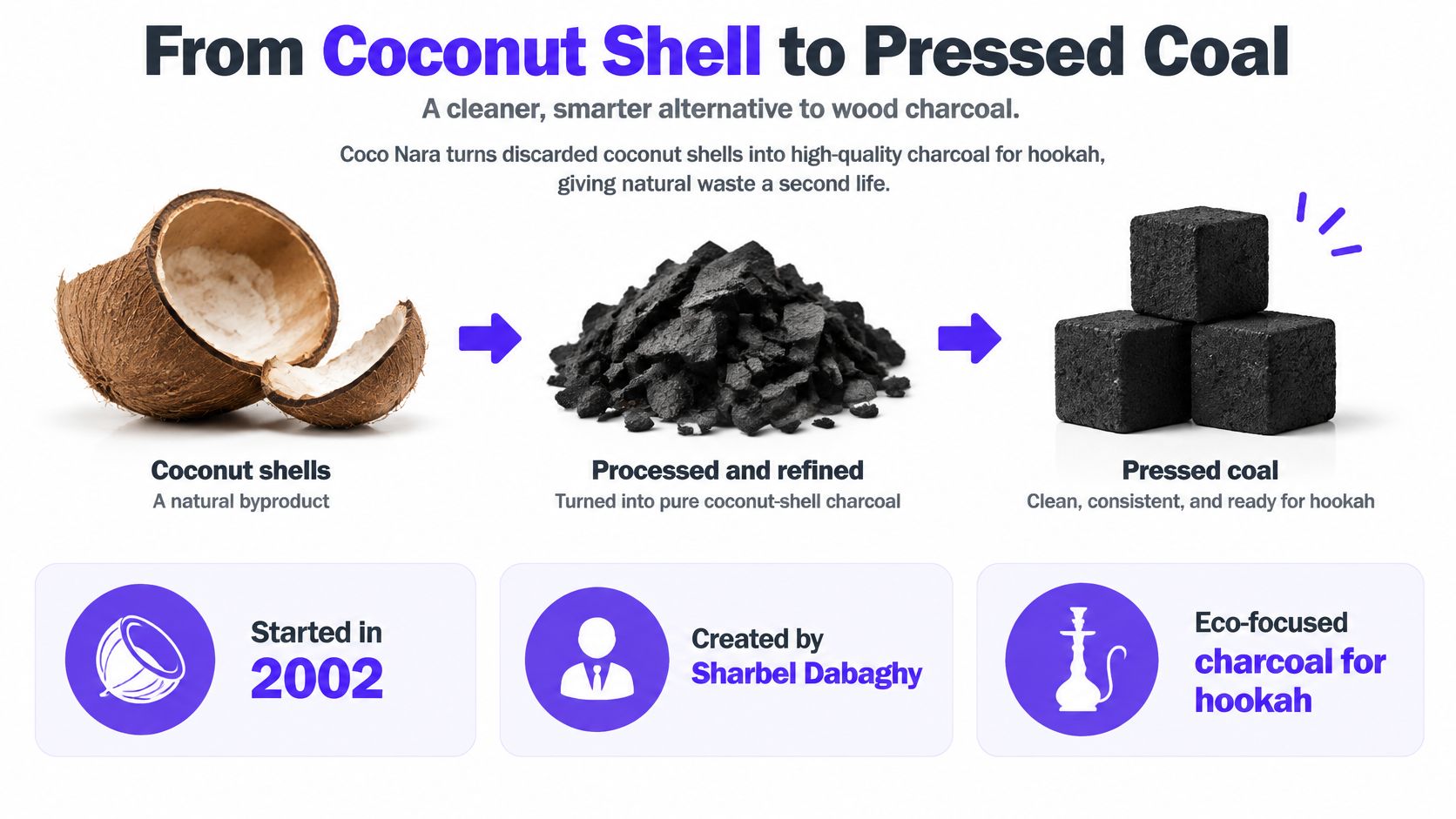
The Coco Nara history account places the concept in 2002, with Sharbel Dabaghy working on an eco-focused charcoal for hookah, completion reported in 2004, and a 2005 launch with Raed Haidar as partner and co-founder. The company says production investment in Indonesia began in 2006. A contemporaneous industry note on that same account says the charcoal was first introduced in Lebanon in 2005, then moved through the Middle East before the United States. Buyers still meet two shapes: compressed coconut-shell flats at 25 × 25 × 17 mm, and 33 mm quick-light pieces. The company does not publish a step-by-step pressing method, so there is nothing honest to invent about binders, kiln time, or mesh size.
What the company puts on the scale
Coco Nara's site reports 125,000,000 kilograms of coconut shells used, equated to 250,000,000 kilograms of wood displaced and 250,000 trees saved. That is a two-to-one mass claim plus a separate tree estimate. The same account calls the charcoal 100% coconut shell and odorless, smokeless, and tasteless. A retail claim tied to the brand puts average burn above 1.5 hours and ash below 5% of volume. Every one of those lines is a company statement, not a third-party audit.
What a shell does not fix
A renewable shell feedstock does not erase a heavy binder, a wet pallet, or a bad batch. The bowl still decides. If the flat smells like a damp carton before it ever sees the coil, the tree math on the website will not save the flavor.
Choosing Between Coco Nara and Other Coals
A natural coconut label does not prove a long, clean burn or indoor safety. Choose by the published size and heat information, how the coal lights, and whether the packaging states its additives. A familiar logo is not a substitute for those checks.
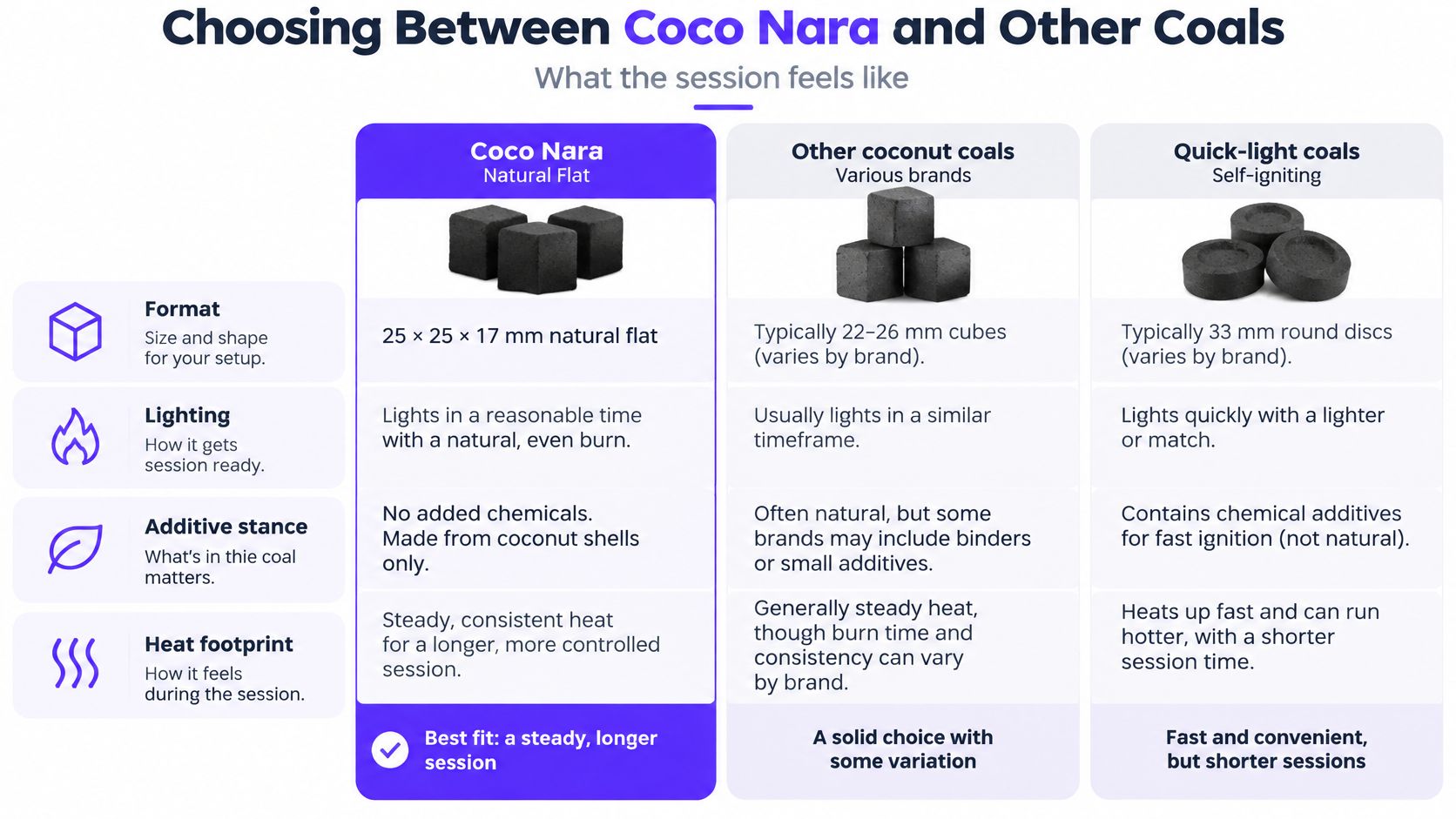
Coco Nara's 25 × 25 × 17 mm natural flat is made for a coil or stove, not a lighter. Its stated sulfur-free positioning and compact shape make it a practical match for a phunnel or HMD. The 33 mm quick-light is faster to start, but its round footprint can overwhelm a small bowl, and its quick-light formula is not the additive-free natural format. Match the coal to the bowl before weighing convenience against flavor.
Do not transfer a burn-time, sulfur, or ash claim from one brand to another. CocoBravo, CocoFumo, and Coco Fuego may appear alongside Coco Nara, but this comparison does not establish their formats, lighting requirements, or additives. Read each box for those details instead of treating a coconut label as proof of matching performance.
3 Kings belongs in a different category: a round quick-light tablet suited to a short session when a burner is unavailable. It starts from a lighter and can produce more odor at startup. Quick-light charcoal is the higher-carbon-monoxide category in the comparison, but that category-level distinction is not a lab result for a particular brand. Use it only with good ventilation, and do not mistake fast ignition for a better fit in a small bowl.
| Coal | Format | Lighting | Additives stance | Best fit |
|---|---|---|---|---|
| Coco Nara natural flat | 25 × 25 × 17 mm | Coil or stove, 5 to 8 min | No sulfur; not quick-light | Home bowls and HMDs with a burner |
| Coco Nara quick-light | 33 mm round | Lighter or torch, under 1 min | Quick-light formula | Travel or service with no burner |
| 3 Kings | Small round quick-light tablet | Lighter | Quick-light; check package for specific additives | Short, ventilated sessions |
Coal count by setup
- Home phunnel with foil: Start with two fully red 25 mm flats. Keep a third on the tray and add it only if the draw remains cool.
- HMD: Use one or two natural flats. Adding a third beneath a closed lid can scorch blonde leaf.
- Small Egyptian or funnel bowl: Use fewer coals, not a wider quick-light. One 33 mm round can cover too much of the bowl.
- Lounge coil service: Rotate natural pieces in response to the draw. Gray edges and thin smoke indicate when the heat is fading.
- No burner: Choose the 33 mm quick-light for mobile service when fast ignition matters more than the natural format's additive profile.
The right count depends on bowl size and heat response. Start conservatively, then add a piece only when the session needs more heat.
How to Light Natural and Quick-Light Pieces
Two products, two routines. Mixing them is how people put a half-lit round on tobacco and then blame the shisha.
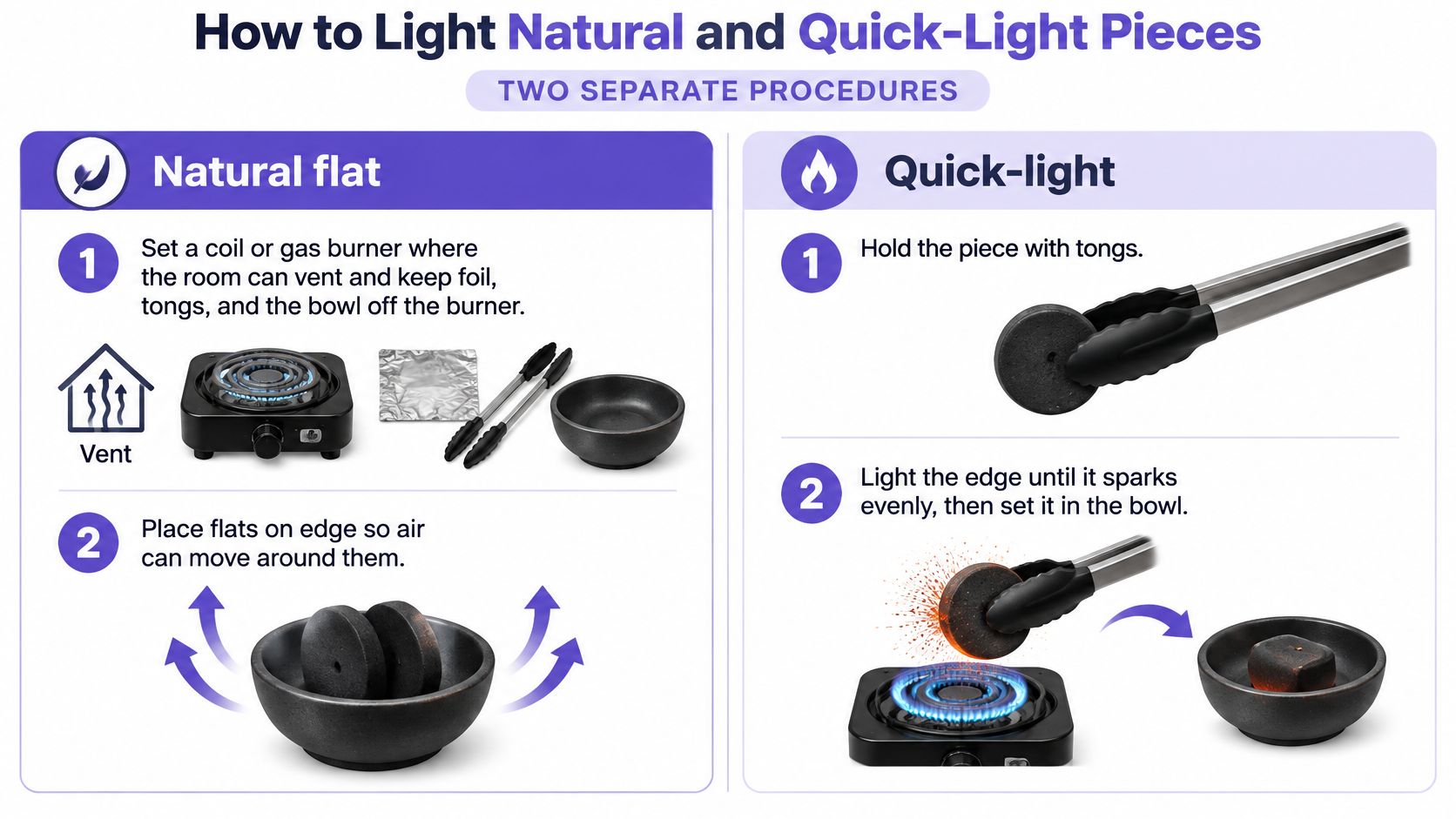
The Coco Nara quick-light specification says the 33 mm pieces light with a cigarette lighter or torch, reach full ignition in under one minute, and still claim a burn of up to 60 minutes. The natural flat needs several minutes and is the additive-free, sulfur-free format. Pick by workflow and bowl fit, not by matching burn claims. The wider round may need fewer pieces so a small bowl does not overheat.
Natural flat routine
Confirm the coal is red through, with no black center, before it touches the bowl. That check sits in front of every step below.
- Set a coil or gas burner where the room can vent. Keep foil, tongs, and the bowl off the burner so you are not lighting hardware.
- Place flats on edge so air reaches both faces. A flat slapped down on its broad side lights one skin and stays black underneath.
- Heat 5 to 8 minutes, turning once, until no black center remains and the coal is red through. Pulling it early to "save time" is the mistake.
- Blow off loose ash, then set the coals on foil or in the HMD. Ash left on the face insulates the tobacco.
- Start with two flats on a typical phunnel. Add a third only if the draw stays cool after a few minutes.
- Rotate or tap ash when the edges gray and the smoke thins. Pull coals off if the tobacco bites. More heat is not the fix for a harsh puff.
Quick-light routine
- Hold the piece with tongs over a nonflammable surface. Fingers and a tablecloth are how this format goes wrong.
- Light with a lighter or torch until the starter catches. Let the whole edge take, not one spark on a corner.
- Wait until the flame dies and the whole face is glowing. A dry piece should be there in under about a minute. A damp piece will not, and forcing it will not help.
- Let the starter odor clear before the coal touches the bowl. That smell is the formula leaving, not "coconut aroma."
- Use fewer pieces than you would with 25 mm flats. The footprint is larger.
- Never stack a half-lit quick-light on tobacco to save time. You will taste the starter, and you will not get the hour you were promised.
The failure that ruins flavor is parking a coal that is still black in the middle. It tastes sharp. It is not the same thing as a fully lit coconut coal.
Session Problems and What to Change
Fix the symptom you notice first. Adding another coal is usually the wrong move.
A black core or a chemical bite means the coal was not finished, or a quick-light went on the bowl too soon. Put it back on the burner until no black remains. Sparks, crumbling edges, or a wet-cardboard smell point to moisture, a crushed box, or a poor batch. That is not how a sound coconut coal behaves. Discard the piece and check the rest of the sleeve before you light a second one.
A WHO-hosted report on charcoal type and hookah CO found mean carbon monoxide of approximately 1,730 ppm for natural charcoal over 90 minutes, compared with 3,728 ppm for quick-light charcoal, with natural charcoal at a higher average temperature, and review evidence in that record identified 68 acute carbon monoxide poisoning cases linked to waterpipe use, including short sessions, outdoor use, and indoor secondhand exposure. Low ash does not predict low exposure. Headache, dizziness, or nausea is a stop signal, not a flavor note.
| Symptom | Likely cause | What to change |
|---|---|---|
| Black center or sharp taste | Coal not fully lit, or quick-light used too early | Finish on the burner until no black remains |
| Sparks, crumble, or musty odor | Moisture, damage, or a bad batch | Discard the piece and check the rest of the box |
| Dies well before an hour | Closed HMD vents, no rotation, or a tight pack | Open airflow and move coals when edges gray |
| Ash blanket or harsh blonde tobacco | Too much heat or a 33 mm coal on a small bowl | Tap ash, use fewer or smaller coals |
| Headache, dizziness, or nausea | Carbon monoxide in a poorly vented space | Stop, get fresh air, and do not treat low ash as safety |
Heat you can still manage
A session that dies well before the claimed hour is often an HMD with the vents shut, coals left in one spot, or a pack so tight air cannot move. Open the draw before you blame the brand. Thick ash on the tobacco is heat management. Tap the coal and raise it. Do not read an under-5% ash claim as a promise that this box stays clean. Scorched blonde leaf means too much footprint, especially a 33 mm piece on a small bowl. Use fewer coals or go back to flats.
Are Coco Nara Coals Safe Indoors
No. Sulfur-free and low-ash are performance claims. They do not establish that these coals are safe to burn indoors.
Natural charcoal and quick-light charcoal both produce carbon monoxide. A cleaner ingredient list does not turn the gas off. Natural coals can also run hotter, which is a session fact, not a safety upgrade. There is no categorical indoor-safety conclusion from "coconut," "no sulfur," or "little ash." Risk shows up in short sessions, outdoors, and from secondhand smoke in the same room. If someone feels wrong, the session is over.
The rules that matter
- Light every coal fully before use. A black center is unfinished fuel, not a gentle start.
- Never light or burn coals in a sealed or poorly ventilated room. A cracked window you immediately shut does not count.
- Keep children and nonusers out of the smoke. They are not "just sitting nearby" in a harmless way.
- Use a carbon monoxide alarm wherever coals are heated indoors. Guessing by how you feel is late.
- Treat HMDs and low ash as cleaning and flavor features, not health protection. A tidy tray can still sit in a bad room.
Where this bites hardest
The gap matters most in U.S. homes, lounges, cafés, and hospitality venues. Staff can sit in the same room for a full shift while guests rotate. One "quick bowl" in a back office with the door shut is a bad setup even when the coal is a natural flat. If you cannot vent the space, do not light the coal. Move the session, or cancel it.
An alarm and an open path to fresh air are part of the setup, the same way tongs are.
Verify the Box Before You Buy
A natural coconut label does not prove the box is this brand, and it does not prove the coals were stored dry. Checkout is the moment to be picky, not after the bowl tastes like a wet carton.
The Coco Nara supplier guidance warns that unauthorized sellers have allegedly distributed inferior products. It tells buyers to request trademark and company-registration documents, a certificate of natural product, laboratory certification, sample packaging, sealing and hologram stickers, and confirmation that the seller's bank-account name matches. Ask for that set before a large order. Supplier paperwork is not an independent third-party lab test. A letter from a wholesaler can be real and still say nothing about the batch in the carton.
Paperwork versus the box in your hand
- Seal and hologram: If the sticker is missing, lifted, or printed crooked, stop.
- Cube uniformity: Flats should match in size. A sleeve of chips and giants is a bad press or a repack.
- Odor, crumble, moisture: Musty smell, edges that dust off in your hand, or water stains mean the box got wet or sat too long.
- Batch consistency: One sleeve should look like the next. If box two is darker, softer, or broken, do not average them into "good enough."
Order a small test box before a master case. If the look and smell fail, switch brands. Do not light it "to be sure." For format, use 25 mm natural flats for burner sessions and HMDs, and the 33 mm quick-light only for no-burner service. We stock charcoal in coconut and quick-light types, organized by brand, so you can match the format to the session instead of grabbing whatever sleeve is closest. Confirm live size and stock on the product page, because both move. Adults only, and only in a ventilated space.
Shop Hookah Tobacco carries hookah charcoal in coconut and quick-light types alongside tobacco, hookahs, and the bowls, foil, HMDs, and tongs a session needs. If you are matching a 25 mm flat to a home burner or keeping a 33 mm quick-light only for no-burner service, start with the charcoal catalog and check the live listing before you order. Visit Shop Hookah Tobacco and pick the format that fits the bowl you already own.