






























Does tobacco expire, or does it just go stale? See shelf life by type, mold signs, and how to store shisha in 2026.
Tobacco rarely turns unsafe on one printed date, but its quality falls as moisture, heat, and air change, with cigarettes often listed at about 4 to 6 months while moist shisha is judged by seal, smell, and mold rather than a universal year count. That answer upsets the most popular advice online, which is to give every tub a tidy one or two year life and call it done.
A fixed number feels helpful in a shop. It's also misleading. A sealed pack kept in a dark cabinet and an opened jar left beside hot coals don't age at the same speed, even if both were made on the same day. If you're asking does tobacco expire, you're really asking three different questions. Has the flavor faded, has the tobacco dried out, or has something grown in it? Those outcomes need different decisions, and mixing them up is how people throw away usable stock or, worse, try to rescue a moldy tub.
Table of Contents
Does Tobacco Expire or Only Go Stale
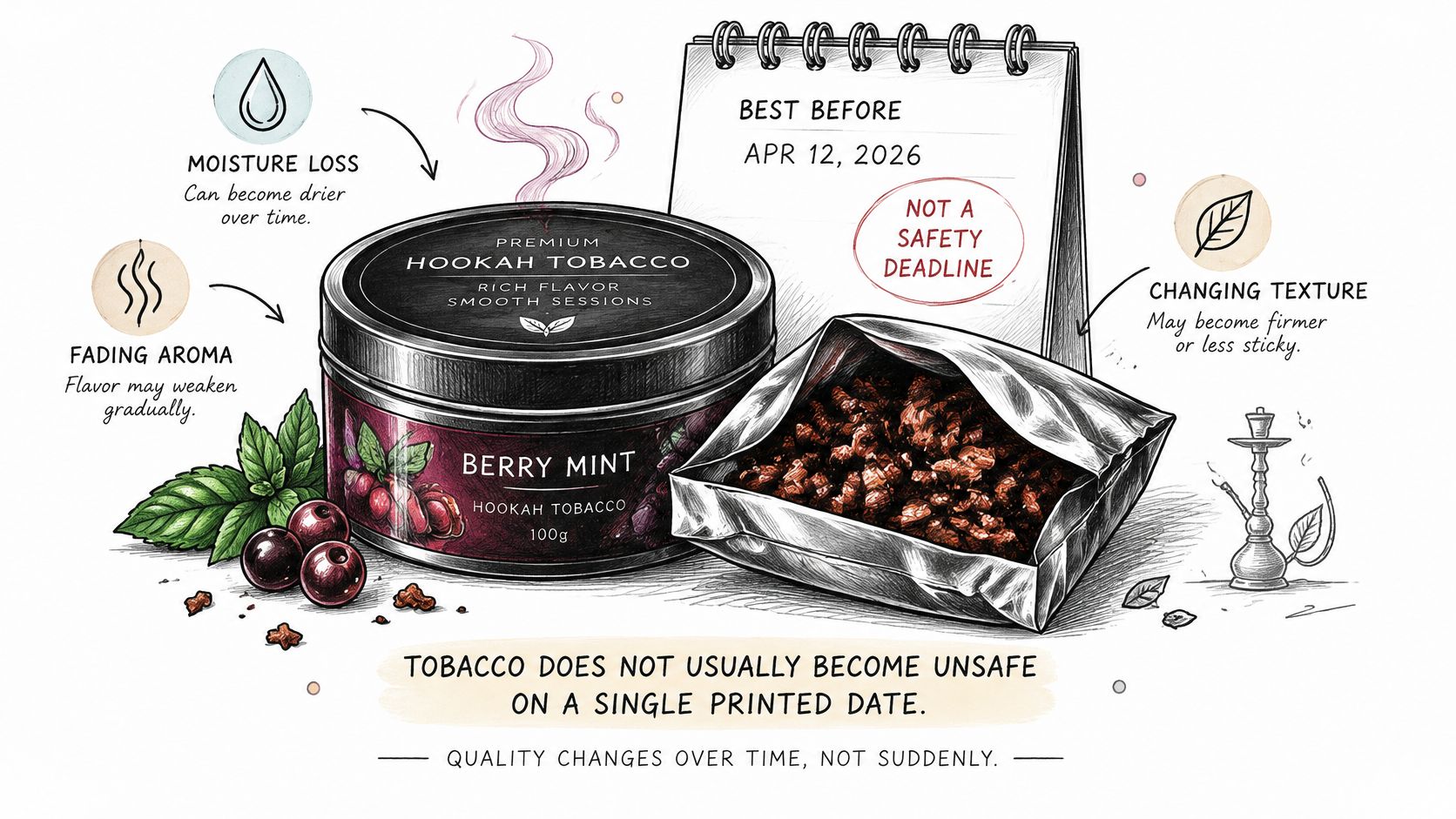
Tobacco doesn't usually flip from safe to unsafe at midnight on a printed date. What changes first is moisture, aroma, and texture, and only under the wrong conditions does microbial growth turn a quality problem into a discard decision.
Think of flavored shisha as a molasses jar, not a sealed can of beans. A can is built to sit untouched. An opened sweet preserve holds water and sugar, takes in air each time you lift the lid, and rewards clean, steady storage. Shisha behaves the same way because glycerin and molasses hold moisture against the leaf. Once air gets in, that moisture is available to you in the bowl and, unfortunately, to microbes in the jar.
Keep three outcomes separate and the rest gets simple.
The Three Outcomes That Matter
- Quality decline: The flavor tastes muted, or syrup has separated from the leaf, but the smell still matches the label and nothing looks off. It's a weaker session, not a safety event.
- Drying: The leaf feels stiff or crumbly and smokes harsh and uneven. If the smell is normal, you're dealing with lost moisture, not contamination.
- Contamination: You see mold or fuzz, or you get a sour, ammonia-like, or musty smell, leakage, or a swollen pack. That whole container is finished.
Older doesn't automatically mean dangerous, and no printed date doesn't mean indefinitely safe.
Aging isn't expiration, either. Leaf can be held on purpose before manufacture to develop character, which is a controlled process with a goal. A retail date, when a maker prints one, works more like a quality and stock rotation marker. It tells a buyer when to sell or use stock first. It doesn't prove the product becomes hazardous the next morning.
An opened tub is always the higher risk. Every opening lets in air, lets out aroma, and gives moisture a chance to move. A sealed pack kept cool and steady has one stable environment. An opened jar in a warm lounge has a new environment every shift. Judge them by that history, not just by age.
Shelf Life by Tobacco Type
Use these ranges to plan stock today, then inspect the actual package before you pack a bowl.
| Product | Planning range | What usually limits it |
|---|---|---|
| Unmanufactured tobacco in bales or hogsheads | About 1 to 3 years | Controlled storage; often aged 1.5 to 3 years before manufacture |
| Cigarettes | About 4 to 6 months | Staling from heat, air, and moisture loss |
| Snuff | About 3 to 5 months | Moisture and microbial risk in a moist product |
| Cigars | About 2 months | Drying and aroma loss when humidity is wrong |
| Sealed flavored shisha | No universal date; often many months if cool and sealed | Intact seal, printed date if any, smell and mold |
| Opened hookah tobacco | Often weeks to a few months | Repeated opening, heat, and drying or mold |
The first four rows come from controlled storage, not from a kitchen drawer. The Global Cold Chain Alliance storage reference lists unmanufactured tobacco stored in bales or hogsheads at approximately 1 to 3 years under controlled conditions, cigarettes at roughly 4 to 6 months, snuff at 3 to 5 months, and cigars at about 2 months. That spread is the point. A dry, finished cigarette and a bale of leaf aren't on the same clock, so don't borrow a number from one and apply it to another.
Why Shisha Gets a Judgment Range
There's no honest universal number for flavored shisha. Brands use different leaf cuts, syrup loads, glycerin levels, flavorings, and packaging, and each choice changes how the product holds moisture. Treat shisha as semi-perishable. If the maker prints a date, follow it for rotation and quality. If there's no date, the seal and your nose carry more weight than a guess.
In practice, a commercially sealed pack kept cool and dark often stays pleasant for many months. It can remain usable past a printed date if the seal never broke, the pack isn't swollen or leaking, and the smell is right when you open it. Expect the top notes to soften first. Citrus, mint, and light fruit flavors usually fade before heavier, sweeter blends do, so an older sealed tub may smoke fine but taste flatter than a fresh one.
An opened jar is a different purchase. Once you've broken the seal, plan on weeks to a few months of good quality, and plan on less if the lid comes off daily in a warm room. A home smoker who opens a tub twice a month and closes it tightly will usually get more good sessions from it than a lounge jar that sits open during prep. The tobacco is the same. The air exposure isn't.
Temperature Changes the Planning Range
The same storage reference draws a clear contrast. Refrigerated storage at approximately 35 to 40°F (1.7 to 4.4°C) is described as reducing deterioration, slowing biological activity, and inhibiting insect infestation, while warmer temperatures of 65 to 75°F (18 to 24°C) stimulate chemical and biological activity. That's warehouse language, not an instruction to put tonight's jar in your kitchen fridge. It tells a buyer why a cool back room and a hot delivery van produce different results from identical cases.
Moisture cuts both ways. Too much invites mold. Too little makes leaf brittle, and brittle leaf shatters, packs unevenly, and takes heat badly. When you read a row in the table, read it as "this long if storage stays decent." If storage hasn't stayed decent, the package in your hand outranks the table.
Why Moisture Sets the Mold Clock
Older tobacco is not automatically dangerous, and a missing date does not make it safe. Its moisture history matters more: the product may lose flavor, dry out, or become contaminated, depending on how much free water and warmth it encountered.
A kitchen sponge makes the distinction easier to understand. It can feel wet while holding much of its water in a way that microbes cannot use. Mold grows from available moisture, not from how damp tobacco feels to the touch.
That available moisture is described by water activity. It differs from total water content and from dampness on the surface. Two packs can feel similarly moist yet present different mold risks if the water in one is more available to microbes.
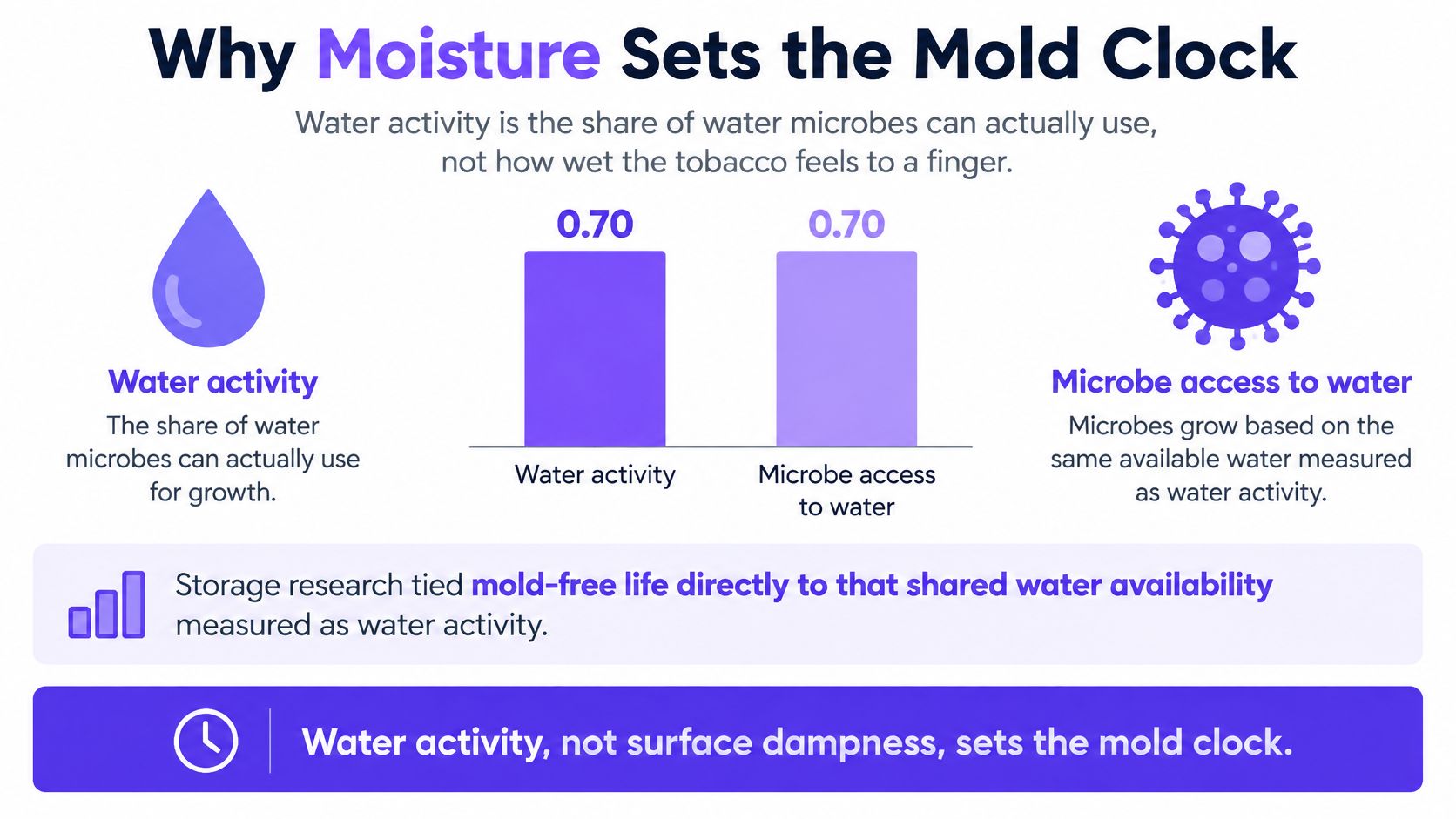
There is no dependable calendar that converts a particular moisture level into a fixed number of mold-free days for every tobacco product. In general, mold risk rises when free moisture and warmth increase, especially if a pack is poorly sealed. Cooler, drier, stable conditions reduce those pressures, but they cannot guarantee safety if a product has already been contaminated or its packaging has failed.
What Those Conditions Mean at Home
You do not need to measure water activity in a home or lounge prep area. Use it as a way to understand why age alone is a poor guide. A warm, humid tub with a weak seal is a different case from a sealed pack kept in stable conditions, even if both were purchased at the same time.
Flavored shisha also differs from raw tobacco leaves. Syrups, humectants, and commercial packaging affect how moisture is held and how exposed the blend is. The seal limits contact with the surrounding air while intact. Once opened, repeated exposure to air and changes in room conditions can alter the product.
Practical rule: Follow a printed label when the brand supplies one, but treat mold, an unusual odor, or package damage as stronger warnings than a date.
Flavor and nicotine do not necessarily change at the same pace. A peer-reviewed storage study of certified cigarette tobacco reported that room-temperature storage reduced oven-measured volatile compounds by approximately 24% after one year. Samples stored at 4°C or −20°C remained comparatively stable. Nicotine and selected tobacco-specific nitrosamines generally stayed within a 15% range over three years under the tested conditions.
Those findings concern the tested cigarette tobacco, not a guarantee for every shisha blend. They illustrate why aroma can fade while nicotine changes relatively little. A flat session alone does not show that tobacco is unsafe, and a strong session does not prove that it is fresh. Quality loss and contamination are separate questions. Visible mold, an unusual odor, or damaged packaging raises a different concern from a blend that tastes dull.
A home fridge is not automatically the answer. Temperature changes and condensation can introduce moisture, and opening a cold container in a warmer room can expose it to damp air. For shisha, keeping a pack sealed and in stable conditions is a better starting point than moving it in and out of the refrigerator.
Signs and Pack Stories to Keep or Throw Out
An old tub is not automatically dangerous, and a missing date does not make it safe. The container's history matters: moisture loss can leave tobacco dry and flat, while excess moisture and poor storage can allow contamination. Make the decision by checking the whole pack, not just the spoonful on top. If you find mold in one corner, treat the entire container as contaminated. You cannot reliably confirm that the rest is clean.
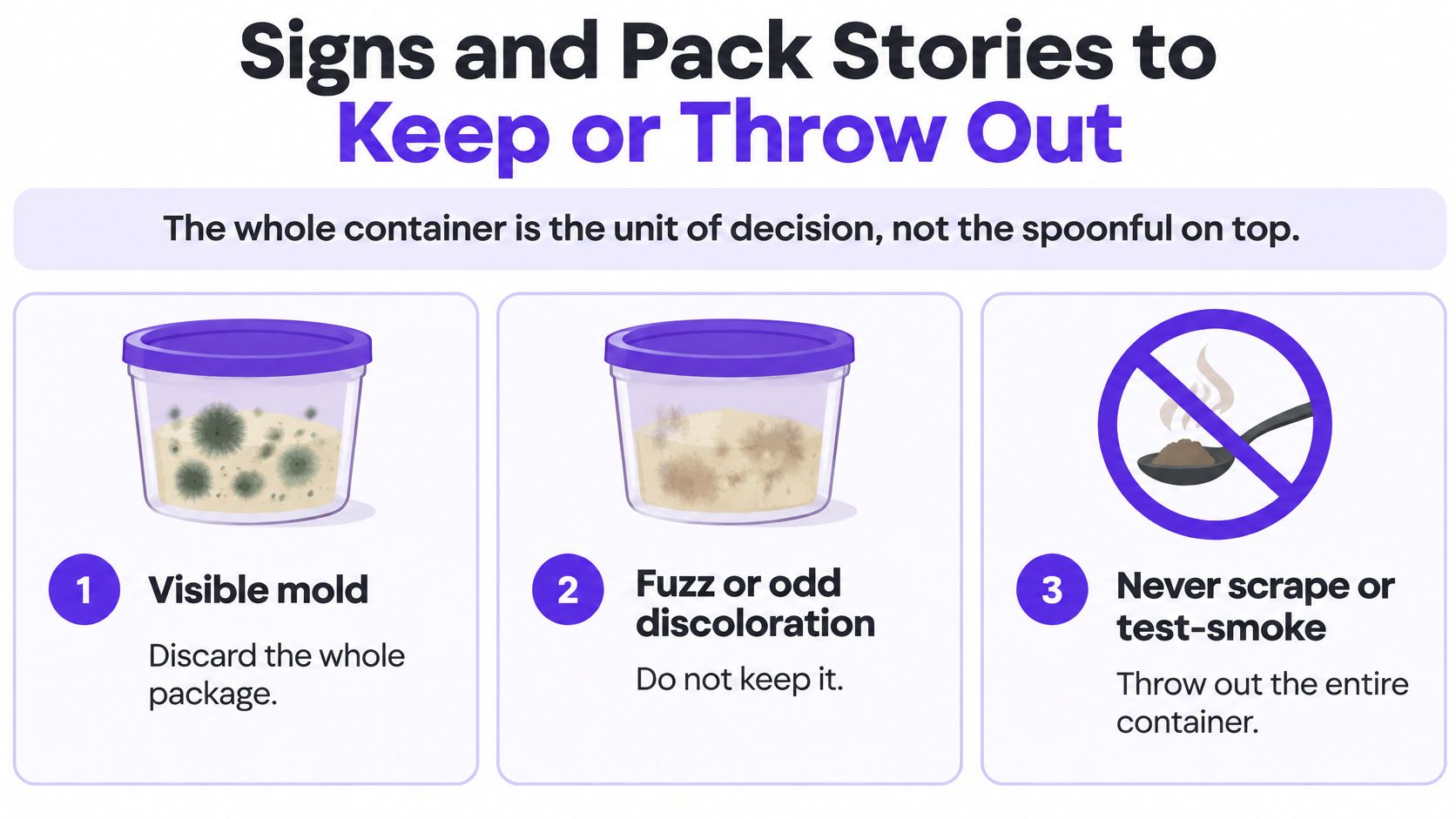
A 2025 tobacco storage study found that warmer, more humid storage was associated with faster declines in tobacco's pH and sugars, while controlled storage better preserved quality. The practical lesson is simple: heat and moisture can change a pack faster, but a change in flavor alone does not establish that it is unsafe. Visible mold or a persistent off-odor is different. Contamination may be unevenly distributed, so removing the affected surface cannot make the remaining tobacco reliably safe.
Check Every Pack in the Same Order
Use the same five checks each time. A consistent order helps separate signs of spoilage from ordinary drying or flavor fade.
- Seal: Is it intact, or has it lifted, torn, or been poorly resealed?
- Swell or leak: Is the pack puffed, sticky on the outside, or leaking syrup?
- Color: Do you see fuzz, pale spots, dark patches, or discoloration that does not match the blend?
- Smell: Does it smell like the labeled flavor, or is there a musty, sour, ammonia-like, or solvent-like odor?
- Texture: Is the leaf pliable and coated, dry and crumbly, or sitting in pooled, separated syrup?
| What you notice | Likely meaning | Action |
|---|---|---|
| Visible mold, fuzz, or unusual discoloration | Possible fungal contamination beyond the visible area | Discard the entire package. Do not scrape or test-smoke it. |
| Musty, sour, ammonia-like, or solvent-like smell | Possible spoilage, even without visible mold | Discard it. |
| Swollen pack, leak, or broken seal | Lost protection or a change in the pack | Set it aside. Discard it if the smell or appearance is unusual. |
| Insects or webbing | Stored-product pests | Discard it and check nearby stock. |
| Very dry, crumbly leaf or separated syrup, with a normal smell | Moisture loss or settling | It may be usable, but smoke can be harsher or uneven. This alone does not indicate mold. |
| Muted flavor, with normal smell and texture | Aroma fade | It may still be usable, but expect a flatter session. |
Mold is a safety concern, not a flavor problem to work around. A review in Tobacco Induced Diseases explains that visible growth may signal contamination beyond what you can see, and some molds can produce harmful mycotoxins. Coals are not a reliable way to remove that risk. Do not scrape mold away, transfer the apparently clean tobacco to another jar, or test a suspect pack in a bowl.
Storage conditions help explain why packs of the same age can turn out differently. Warmer and wetter storage changes tobacco faster than cool, moderate conditions. Use that as a guide to the history of the pack, not as a substitute for checking its smell, appearance, and texture.
Four Pack Stories
Story one, the sealed tub past its date. You find a sealed tub in a dark cabinet, a few months past the printed date. The seal is intact, the tub is not swollen, and the tobacco smells like its labeled flavor when opened. There is no fuzz or unusual color. That points to a quality question, not an obvious sign of contamination. You may choose to use it, but the session could taste flatter. For a shop, a forgotten tub is a stock-rotation problem, and its condition still needs checking.
Story two, the lounge jar open for two months. The leaf feels stiff, syrup has settled at the bottom, and the clouds are thinner, but the smell is normal. That pattern fits drying and settling more than visible spoilage. Stirring may redistribute the syrup for a more even pack, but it cannot restore lost aroma. You can use it if you accept a harsher session, or retire it to keep the lounge's standard consistent. Adding water is not a reliable fix.
A dry jar is a quality decision. A moldy jar is not a decision at all.
Story three, the hot-car tub. A pack spends an afternoon in a hot vehicle. A week later, you see white or green fuzz, or the tub smells sour when opened. Discard everything in that container. Do not pick around the growth, move the rest to a clean jar, or pack a small bowl to test it. Check anything stored nearby as well, since the same conditions may have affected other stock.
Story four, dry leaf versus wet blend. Unprocessed Virginia leaf can become brittle when stored too dry. It may break easily, pack poorly, and smoke hot. A wetter molasses blend with a loose lid can face the opposite problem: in a warm room, excess available moisture can favor mold. The two products can behave differently on the same shelf over the same period. Their storage history matters more than age alone, which is why one expiration rule cannot fit every tobacco format.
Write the opening date on each tub. That simple record helps distinguish normal aroma fade from a jar that has been open longer than anyone remembers. Keep quality loss separate from safety concerns: flat flavor or dryness may affect the session, while visible mold, pests, or a persistent unusual smell are reasons to discard the pack.
How to Store Hookah Tobacco
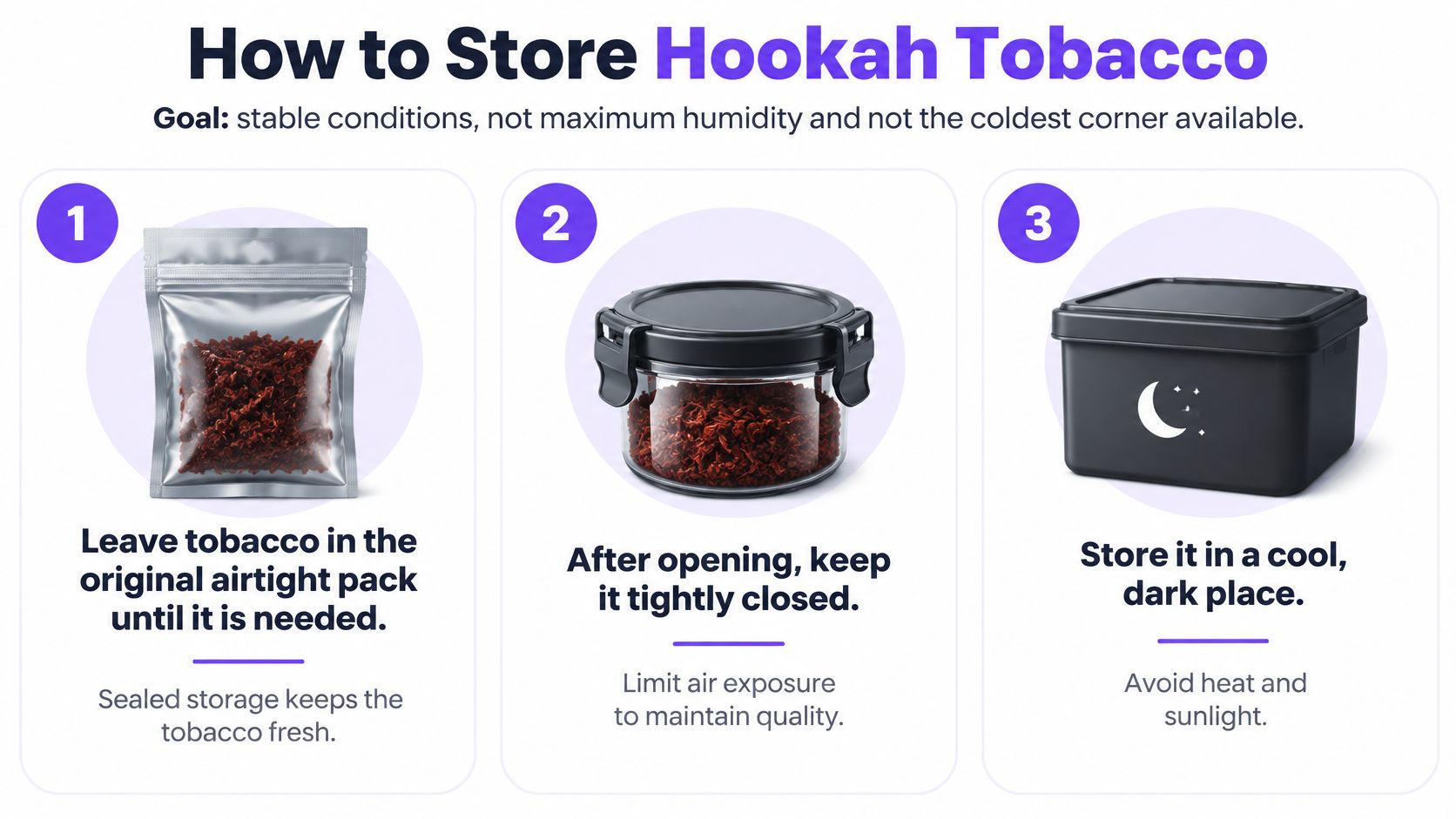
Aim for stable conditions, not maximum humidity and not the coldest corner you can find. Tobacco doesn't need pampering. It needs the same conditions tomorrow that it had today.
The Eight-Step Routine
- Leave it sealed: Keep tobacco in the original airtight pack until you need it. The manufacturer's seal is better than any jar you'll transfer it to early.
- Close it immediately: After opening, press out extra air where the format allows and shut the lid right away. Small headspace means less air working on the leaf between sessions.
- Pick a boring spot: Use a cool, dark, dry cabinet away from windows, heaters, dishwashers, coal stations, and parked cars.
- Don't chase humidity: Skip wet towels, open water bowls, and damp sponges near stock. You'll raise available moisture without controlling it.
- Skip the household fridge: Don't refrigerate or freeze typical shisha jars unless the manufacturer tells you to. The reasoning is covered below.
- Date every tub: Write the date opened on the lid or side where staff will see it during prep.
- Rotate first in, first out: Move sealed cases by received date and opened jars by opened date. New stock goes behind old stock, every time.
- Quarantine problems: Pull leaking, swollen, infested, off-smelling, or moldy packages away from good stock the same day you spot them.
Humidity deserves a plain explanation because well-meaning people get it backwards. A review of tobacco storage monitoring in Sensors and Materials notes that high humidity promotes tobacco moisture absorption and creates conditions favorable to mold growth, while warm, humid storage also increases the risk of stored-tobacco pest infestation and quality downgrading. Bone-dry air causes the opposite loss, stripping aroma and usable moisture. You aren't trying to make tobacco wetter or drier. You're trying to stop it from changing.
Settling the Fridge Debate
You'll hear two confident answers about refrigeration, and both come from somewhere real. One view treats tobacco as semi-perishable and argues for refrigerated storage, and controlled warehouse guidance does use cold to slow insects and biological activity. The other warns against home refrigeration because a cold jar pulled into a warm room collects condensation on the leaf and lid, and repeated cycling changes texture.
Both can be true in their own setting. A validated cold chain with sealed commercial packaging and controlled warm-up is not the same as a home jar going in and out of a kitchen fridge next to leftovers. For most homes and U.S. lounges, a steady cool room beats improvised cold. If a manufacturer specifies cold storage for a particular product, follow that instruction for that product and let the sealed pack come back to room temperature before opening it, so condensation forms on the outside rather than in the tobacco.
Location beats gadgets in daily operations. A jar stored beside lit coals or in a sunny front window ages faster than the same brand in a back cabinet, even if both lids are perfect. A buyer can undo months of careful packing in one afternoon by leaving a delivery in a hot vehicle. When a flavor suddenly tastes tired across several tubs, check where the case sat before you blame the blend. Clean hands and clean tools matter too. A sticky spoon that moves between flavors carries moisture, crumbs, and whatever was on the counter into the next jar.
Decide Whether to Smoke, Replace, or Discard
Make the call in three buckets and don't negotiate with the third one.
- Smoke it: The seal was sound or the jar was well kept, the smell matches the flavor, and there's no mold, leak, swelling, or insect sign. Accept a milder session if the aroma has softened.
- Smoke it once or replace it: The tobacco is only dry or flat, with normal smell and color. Use it knowing it'll run harsher, or replace it if the session matters. Don't rehydrate it with water, which adds uncontrolled moisture without restoring flavor.
- Discard it: Mold, a sour or ammonia-like smell, insects, swelling, or leakage means the whole package goes. Then check every tub stored beside it before you pack anything else.
For a lounge or shop, pull suspect units off the service shelf the same day. Keep rotating by opened date so a forgotten jar never becomes the one packed for a guest, and keep quarantined stock physically separate so a busy shift can't grab it by mistake. Replacing a tub is simpler and cheaper than rescuing one, and it's the only option that protects your standard.
When you do replace stock, match the format already in use so staff and home smokers aren't relearning pack sizes mid-session. We sell hookah tobacco that can be shopped by brand or by weight, including Isfahani, Al Fakher, and Starbuzz. Buyers must be 21 years or older to purchase tobacco products from the website, and perishable products including tobacco may not qualify for return depending on condition and packaging, so buy the quantity you'll rotate through while it's fresh. A fresh sealed pack, stored cool and dark and dated when opened, is the practical reset after a bad tub.
Replace a questionable tub instead of rescuing it, and restock in the brand and weight your home setup or lounge already uses so rotation stays simple. Shop fresh sealed shisha, hookahs, charcoal, and accessories at Shop Hookah Tobacco, then date each pack when you open it and store it cool and dark from day one.