
























Golden Desert charcoal explained: coconut cube sizes, pack options, heat behavior, how to load it in a hookah, and fixes for common problems.
A larger charcoal cube isn't automatically a better choice for your hookah. Golden Desert sells several shapes and pack sizes, but its catalog doesn't establish a universal coal count, guaranteed session length, or independently measured ash percentage. Choose the format for your bowl, then choose the pack size for your purchasing routine, not the other way around.
Table of Contents
Golden Desert Charcoal Formats and Pack Sizes at a Glance
Golden Desert charcoal is a coconut-shell hookah charcoal, offered in formats for home use and lounge service. The Golden Desert catalog describes it as 100% coconut shell, natural, sulfur-free, spark-free, odor-free, and designed not to add an aftertaste, while listing cube, flat, and XL products alongside boxes and lounge cases.
Those descriptions need separating. Material, dimensions, weight, and piece count are product specifications. Statements about odor, sparks, and flavor neutrality are manufacturer claims, not independent performance certifications.
Golden Desert pack sizes, piece counts and reference prices
Format Pack weight Piece count Reference price Best fit Golden Cube trial box 0.5 kg 36 pieces $6.99, listed on the official Golden Cube page Trying the brand or light home use Standard home box 1 kg Confirm on the selected listing Check the current listing Regular home use Coconut charcoal box 2 kg Confirm on the selected listing $21.99, listed on the official coconut charcoal page Steady home sessions Standard cube box 3 kg Check the cube specification before ordering Check the current listing Small bar or frequent home use Lounge case 10 kg Confirm case contents before ordering Check the current listing High-volume lounge use XL cube lounge case 20 kg Confirm on the selected listing $159.99 for 26 mm cubes in the 5Star Hookah XL listing Lounge workflows already tested with XL cubes
Treat these as reference prices, not checkout quotes. Delivery charges, availability, and the exact format can change the practical value of an order.
Read across a row rather than choosing by the largest weight printed on the box. The trial pack limits your commitment. The regular home boxes make sense once you know the coal works with your burner and bowl. Lounge cases become useful when staff can consume and store them reliably.
Compare usable pieces, not cardboard size
A heavier box doesn't tell you how many sessions you'll get. Flats, standard cubes, and XL cubes occupy different footprints, and staff may use different quantities on the same bowl.
Before ordering, check:
- Exact format. Don't assume a familiar package contains the same coal shape as your previous purchase.
- Declared piece count. Use the actual listing rather than estimating from package weight.
- Delivered cost. Compare equivalent formats after shipping, not just the shelf price.
- Storage space. Keep charcoal dry and protected from spills before committing to a case.
For a first purchase, choose a trial or home-sized box. Bulk buying should follow a successful setup test, not replace it.
What Coconut Shell Charcoal Means for Your Session
Coconut-shell charcoal is a dense carbon fuel, not a shortcut to instant ignition. Unlike quick-light charcoal, it doesn't rely on added ignition agents to start readily, so you need a suitable burner and enough time to light the whole piece.
The Golden Desert charcoal collection specifies 216 pieces per 3 kg box for the commonly marketed 25 mm cube, equivalent to an average nominal mass of approximately 13.9 g per cube. That's a useful purchasing benchmark, but it's an average calculated from declared package contents, not a measurement of every cube.
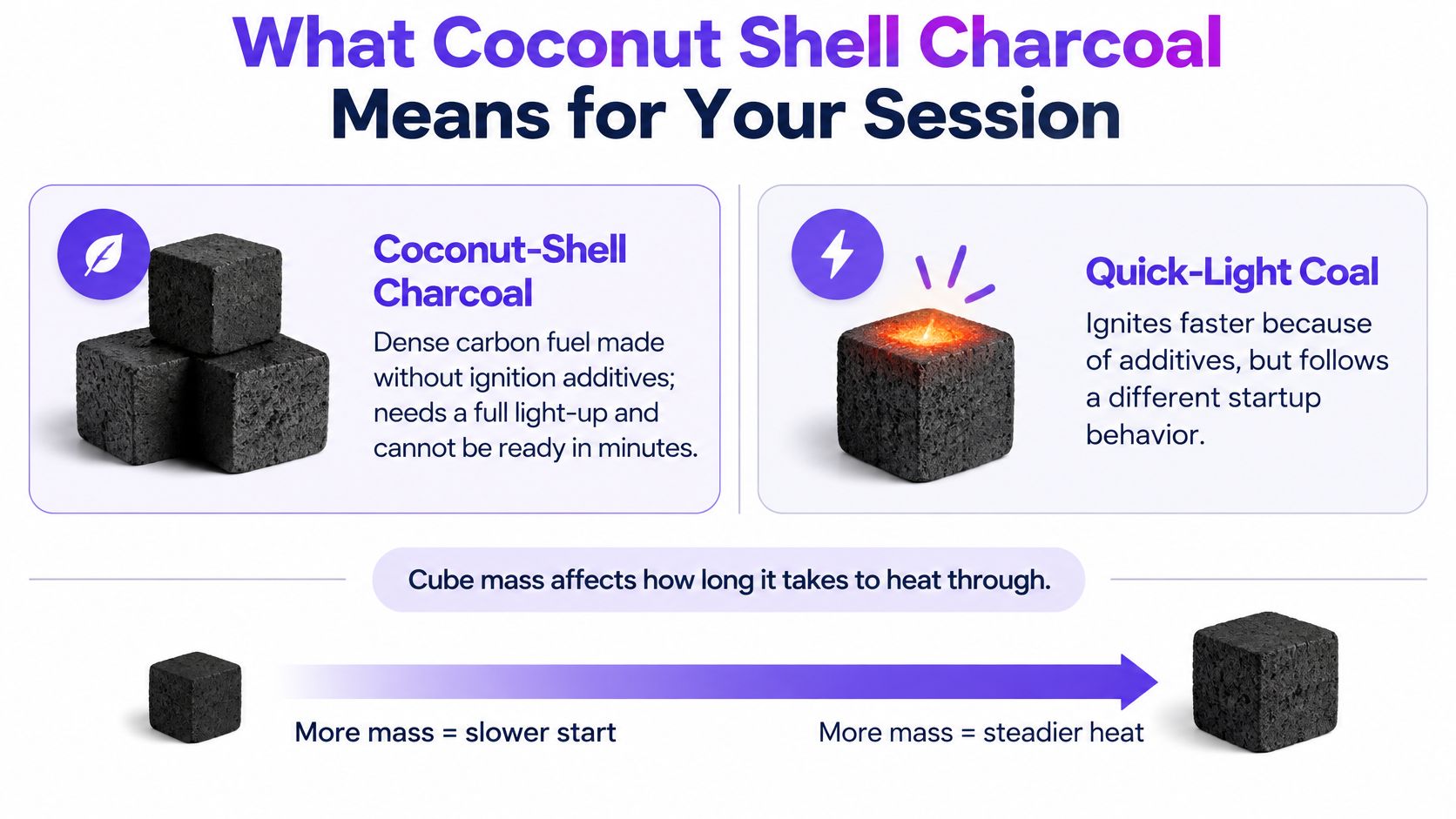
Natural coconut charcoal compared with quick-light charcoal
Golden Desert natural coconut Quick-light charcoal Feedstock Coconut shells, according to the manufacturer Charcoal with added ignition agents Ignition additives None listed; marketed as sulfur-free Added to assist lighting Light-up behavior Needs thorough ignition on a suitable burner Starts more readily because of ignition agents Measured temperature No Golden Desert-specific laboratory result established No directly matched brand comparison established Ash and odor claims Low ash and no chemical odor are commercial claims, not independently verified results Check the particular product; don't assume uniform performance
More charcoal mass generally means more material to heat before use. Once fully lit, a substantial cube can provide a larger thermal reservoir than a smaller flat, helping resist abrupt changes in heat delivery. That doesn't make a cube better: a smaller bowl may benefit more from a modest, adjustable heat input.
Foil and heat-management devices also change how that stored heat reaches the tobacco. A coal can be burning well while the bowl performs poorly because its placement restricts airflow or concentrates heat in the wrong area.
Test the claim that matters to you
Golden Desert's low-ash, spark-free, and odor-related descriptions aren't substitutes for batch testing. The available product information doesn't establish independent laboratory burn-time or ash-percentage results, so there's no defensible universal session-duration promise.
Practical rule: Judge charcoal on a familiar setup before judging it on a new bowl, new pack, and new heat-management device together.
Use the same tobacco preparation and burner routine you already understand. Watch for easy handling after ignition, intact pieces, manageable ash, and a heat response you can control. If you're changing several components simultaneously, you won't know whether the charcoal improved the session or merely compensated for another change.
“Natural” also doesn't mean harmless. Burning charcoal produces carbon monoxide, and smoking carries health risks; never light or use charcoal in an enclosed, poorly ventilated space.
Cube Size, Piece Count and How Heat Builds
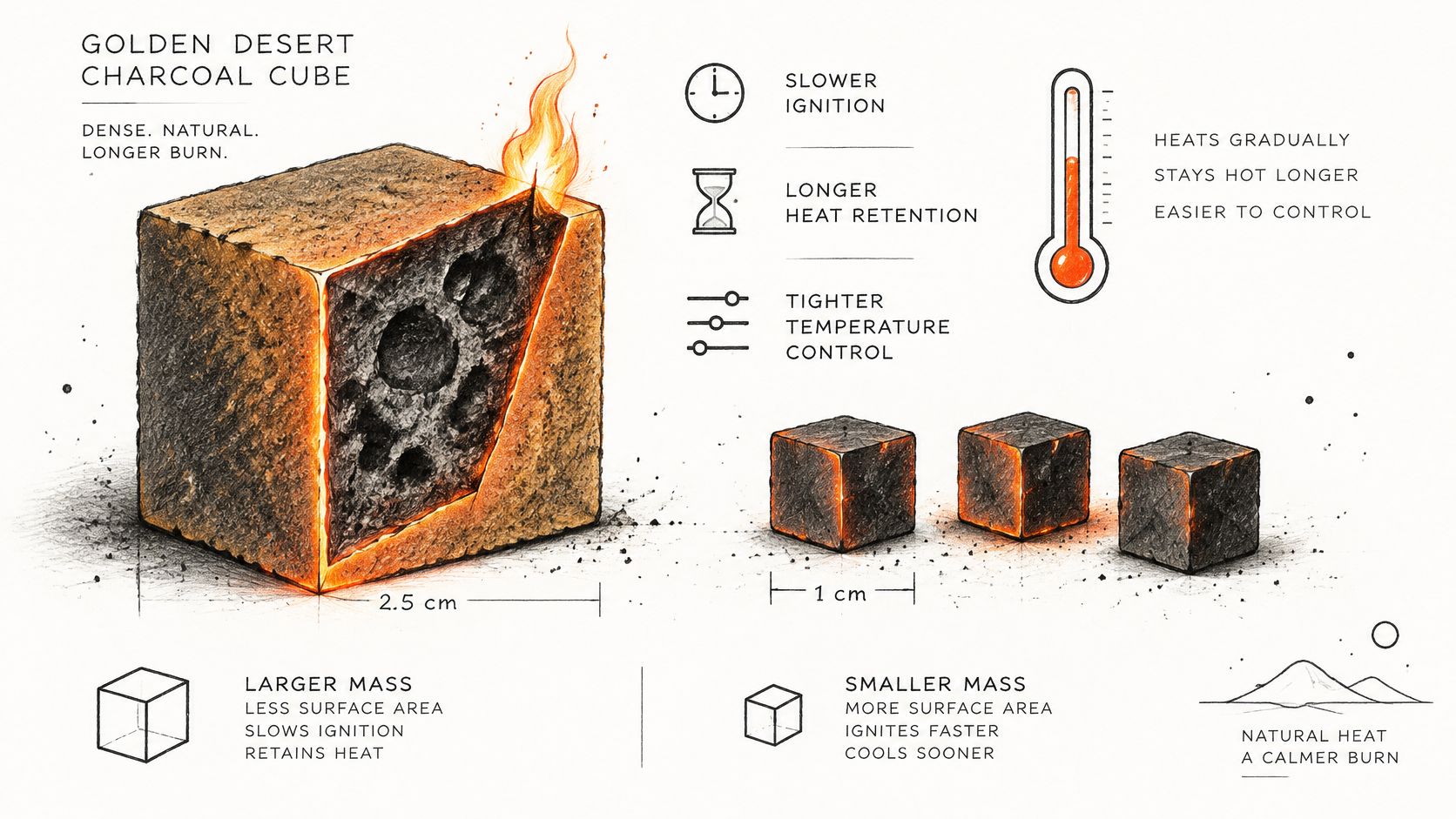
A small increase in cube dimensions changes more than the fit inside your heat-management device. It changes the amount of fuel in each piece, the exposed surface relative to that fuel, and how quickly the center heats through.
The Hookah Junkie cube listing identifies the standard format as 25 mm cubes; compared geometrically with the 26 mm XL format, a true XL cube has approximately 12% more volume, calculated by cubing the ratio of their side lengths. That's a geometric comparison, not a measured increase in heat output or session duration.
Why a larger cube behaves differently
As cube size increases, volume grows faster than surface area. Under comparable composition and airflow, the larger piece has more fuel behind each exposed surface, which can help preserve usable heat as it burns.
But the trade-off is real. A larger piece needs thorough ignition, takes up more room, and may leave less clearance around an HMD lid or vent. If it presses against neighboring coals, the arrangement can behave differently from the same nominal coal count in a smaller format.
Dimensions alone don't establish density, strength, or oxidation rate. Product counts and package weights are commercial specifications, not independent engineering measurements. Rounded corners, manufacturing tolerances, and batch characteristics can all affect how a piece fits and burns.
Retest the arrangement instead of copying it
Say a lounge changes from standard cubes to XL because the purchasing manager wants fewer replenishment interruptions. Staff shouldn't load the new coal into every bowl using the old arrangement.
A sensible test changes the coal format while keeping the bowl, tobacco preparation, and heat-management device familiar:
- Check physical clearance. Coals shouldn't jam together or prevent the device from operating as intended.
- Reduce the initial heat input. Begin conservatively rather than assuming the previous count transfers unchanged.
- Observe the warm-up. Record when the bowl reaches acceptable output and whether it continues getting hotter afterward.
- Track staff intervention. A format that needs constant removal and replacement may be less useful than its longer-lasting appearance suggests.
The useful format is the one staff can control repeatedly, not the one that looks largest on the burner.
For procurement, the important result is a repeatable bowl routine. A size change that saves handling but increases scorched bowls isn't an operational improvement.
How to Load Golden Desert Charcoal Step by Step
- Choose the bowl and heat interface. Start with an intact bowl and either properly secured hookah foil or a compatible heat-management device. Confirm that the device sits securely and doesn't obstruct the bowl's intended airflow.
- Prepare the tobacco before applying heat. Pack for the tobacco and bowl you're using, leaving the clearance that setup requires. Don't try to add tobacco beneath an already heated device.
- Choose a conservative coal arrangement. Use the device's fit and operating instructions as constraints, not a reason to fill every available space. Keep room to separate or remove pieces.
- Light the charcoal completely. Use a suitable charcoal burner, turn pieces with tongs, and inspect all faces for dark, unlit areas. A glowing edge alone doesn't establish that the entire cube is ready.
- Transfer with gaps for airflow. Position coals on the foil or inside the device as intended, without placing them directly against exposed clay. Allow the bowl to warm gradually rather than chasing immediate dense output.
- Adjust after observing the response. If the smoke becomes harsh, reduce heat. If output remains weak, check ignition and airflow before adding more fuel.
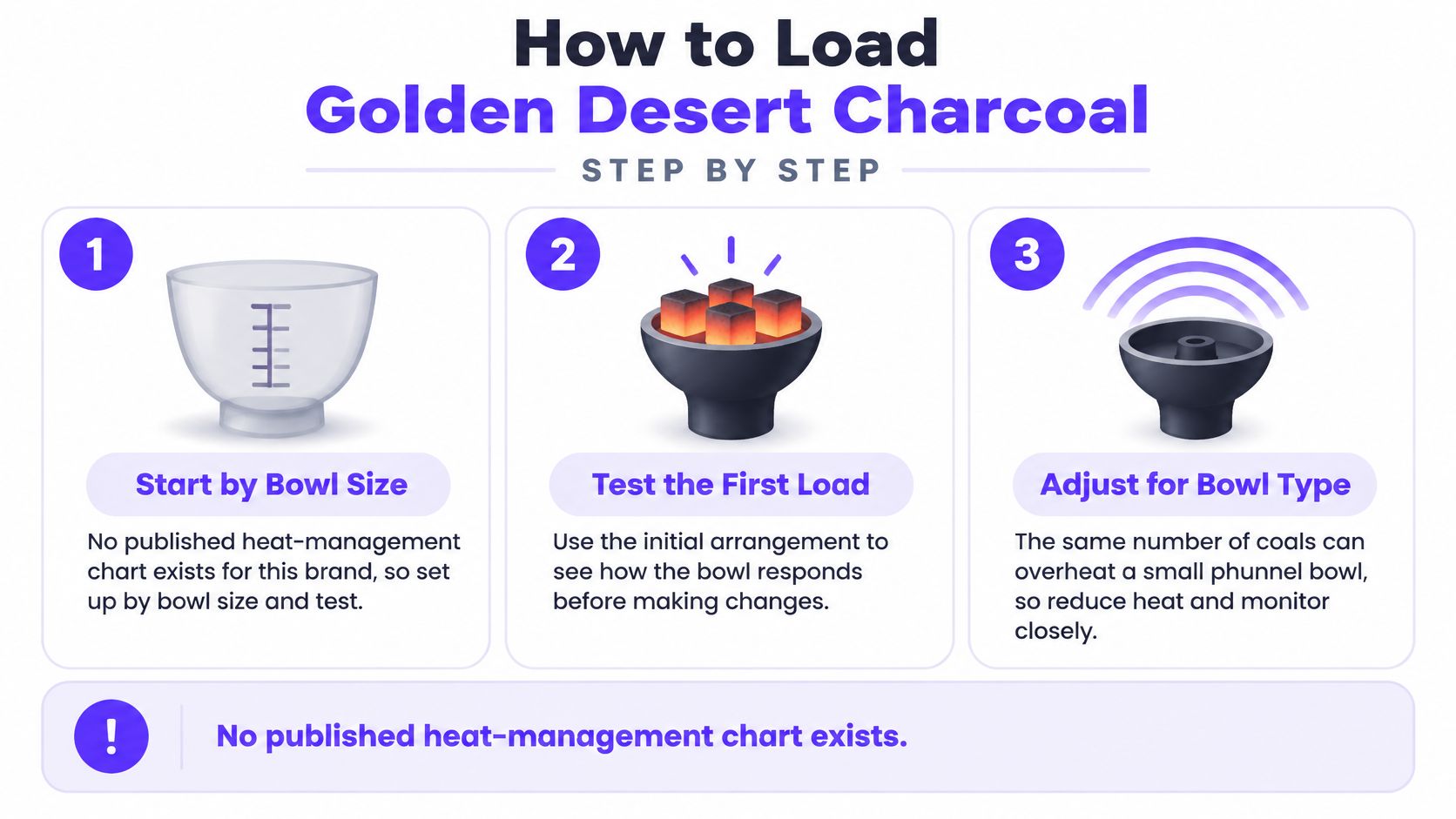
No reproducible Golden Desert-specific heat-management chart is established by the available product coverage. These steps are a starting routine to test, not a manufacturer-certified coal prescription.
Match heat to the bowl, not the burner
The Hookah Junkie Golden Desert coverage describes an XL burner capacity of up to 20 pieces and references a comparison reporting mean temperatures of 292 ± 87°C for natural charcoal versus 247 ± 92°C for quick-light charcoal. That comparison isn't a Golden Desert-specific temperature guarantee, and the spreads overlap.
The practical implication is caution, not a fixed temperature setting. A small phunnel bowl and a larger traditional bowl don't necessarily respond alike to the same arrangement. Tobacco depth, moisture, exposed area, and airflow all influence how much heat reaches the packed material.
An HMD adds its own metal mass, vents, and enclosure. Foil presents a different heat-transfer path, with performance affected by tension, holes, and coal position. Don't copy an arrangement between them without checking the result.
Burner capacity is a staging limit, not a serving recommendation. A lounge may need a large burner to prepare coals for several bowls, while each bowl needs only the heat appropriate to its own setup.
Write a routine staff can reproduce
Use a heat-resistant tray and tongs for transfers. Keep the burner away from combustible materials, don't leave it unattended, and place removed coals in a suitable heatproof receptacle.
For each trial, record the bowl model, tobacco preparation, foil or HMD, initial coal arrangement, time to acceptable output, and the point when replacement becomes necessary. Include every adjustment rather than recording only the final successful arrangement.
That distinction matters in service. A bowl that performs well only after repeated rescue adjustments isn't yet a reliable staff procedure.
Fixing Harsh Smoke, Weak Vapor and Short Sessions
Harsh, bitter smoke calls for a heat check before another coal. Too much heat for the bowl load is a plausible cause, but poor packing or tobacco touching a hot surface can produce a similar complaint. Remove heat first and observe whether the harshness eases.
Don't diagnose every problem as bad charcoal. A leak, obstructed airway, or poorly seated device can make a fully lit coal appear ineffective.
Golden Desert setup symptoms, likely causes and first changes
Symptom Likely cause First change Harsh, bitter smoke Excess heat for the bowl load or tobacco contacting a hot surface Remove a coal or increase spacing Weak or thin vapor Insufficient heat, incomplete ignition, or blocked airflow Check ignition and airflow before adding a coal Session ends early Coals burned down, accumulated ash, or tobacco already overheated Clear loose ash and assess whether replacement heat will help Excess ash on foil Fragile pieces, handling damage, or a storage-related problem Store charcoal dry and compare intact pieces from another pack Cracked or scorched bowl Direct coal contact, excessive heat, or thermal shock Stop using a cracked bowl and correct the heat interface before restarting
Ash deserves a careful diagnosis. A visible ash layer doesn't, by itself, prove that the coal is damp or low-grade. Look at whether pieces crumble during handling, whether the same behavior repeats, and whether staff are dropping ash onto the foil while moving coals.
Change a variable you can identify
Some fixes are immediate. Moving coals apart, clearing loose ash safely, or checking the hose and bowl seals can tell you whether the current arrangement is responsible.
Other questions require a controlled comparison. If you suspect batch quality, keep the bowl routine unchanged and compare packs stored under the same dry conditions. Don't compare a fresh sealed box with an open box that has sat beside a sink.
Troubleshooting priority: Correct ignition and airflow before using extra charcoal to compensate.
For a short session, distinguish spent fuel from spent tobacco. Fresh coals may help when the existing pieces have burned down, but they won't reverse tobacco that has already scorched. Continuing to add heat can make that failure more obvious rather than fix it.
Use a simple isolation sequence:
- Inspect cold. Check the bowl, seals, airway, foil, and device seating before lighting.
- Confirm ignition. Eliminate partially lit pieces as a cause.
- Observe the response. Make a small heat adjustment and allow the bowl to respond.
- Record the outcome. Keep the successful change and leave unrelated settings alone.
If a bowl cracks, retire it rather than testing another coal arrangement on damaged clay.
Choosing a Format and Running Your First Test
Buy for the workflow you can maintain. A home smoker can accept a more hands-on warm-up; a lounge needs a method different staff members can execute without improvising at every table.
Start with the kind of decision you're making:
- Trying coconut charcoal. Choose a small purchase that lets you assess lighting, handling, and compatibility without committing storage space.
- Maintaining a familiar home setup. Favor the format that fits your existing foil or HMD routine comfortably.
- Standardizing a bar or café. Prioritize a clear bowl recipe and replenishment procedure over the largest available package.
- Buying for a busy lounge. Confirm the exact format, case contents, storage conditions, and staff handling method before ordering bulk quantities.
Flats can be useful when you want a different footprint or more placement flexibility. Hexagons need their own fit check rather than being treated as cubes with a different appearance. Neither shape is automatically superior; the important question is whether you can arrange it securely and control the resulting heat.
A trial that produces a buying decision
Choose the setting first. Use a bowl and tobacco preparation you intend to keep using. A test on equipment that won't be part of normal service doesn't settle the purchasing question.
Buy the smallest suitable trial quantity. The available listings don't establish batch-to-batch consistency, so a lounge shouldn't treat a large order as proof that every case will perform identically.
Run the routine without improvising unnecessarily. Fully ignite the charcoal, use a deliberate arrangement, and let the bowl respond. Keep a safe place ready for removed coals so reducing heat is easy rather than inconvenient.
Write down the useful observations. Record coal count, bowl, heat interface, time to acceptable output, replacement behavior, and session end. Add whether the coal stayed intact and how much attention the bowl required.
Repeat before scaling. Look for a result you can reproduce across separate sessions. If the outcome varies, identify whether packing, lighting, or placement changed before blaming the purchase.
Evaluate handling as well as heat
For home use, decide whether the startup effort fits your routine. Charcoal that performs well after full ignition can still be the wrong choice if you routinely rush that stage.
For lounge service, ask whether the format supports safe transfers, orderly staging, and predictable replacement. Staff shouldn't need to crowd a device or leave hot coals in unsuitable places while waiting for a bowl.
Keep purchasing notes separate from performance notes. The former should identify the exact listing and delivered cost; the latter should explain what staff did. That separation prevents an inexpensive case from being mistaken for a successful operational test.
At Shop Hookah Tobacco, we organize charcoal by brand and offer coconut and quick-light types, so you can compare the options without treating their ignition behavior as interchangeable. Confirm that the specific Golden Desert pack you want is listed before planning an order; don't substitute a similarly named brand.
Run a trial session this week, record the result, and let that record determine your next pack size. A clear, repeatable setup is a better reason to buy bulk than a promising description on a box.
Shop Hookah Tobacco offers coconut and quick-light charcoal organized by brand, alongside bowls, burners, foil, and heat-management accessories. Visit Shop Hookah Tobacco to check current charcoal listings and choose supplies for a controlled trial before committing to a larger order.