
























Master heat management for smoother hookah sessions. Learn charcoal types, foil vs HMD use, coal timing, and fixes for harsh smoke that actually work.
You've packed the bowl, the coals are glowing, and the first few pulls are excellent. Then the smoke turns sharp, the flavor goes bitter, or the bowl seems to die long before you're finished. Most smokers blame the tobacco or the bowl first, but the more common culprit is heat management.
Heat determines how quickly the tobacco cooks, how evenly the bowl develops, how much smoke it produces, and whether the session stays pleasant. The goal isn't maximum heat. It's a controlled heat zone that develops gradually, responds to airflow, and stays below the point where the tobacco scorches.
Table of Contents
Why Heat Management Makes or Breaks a Session
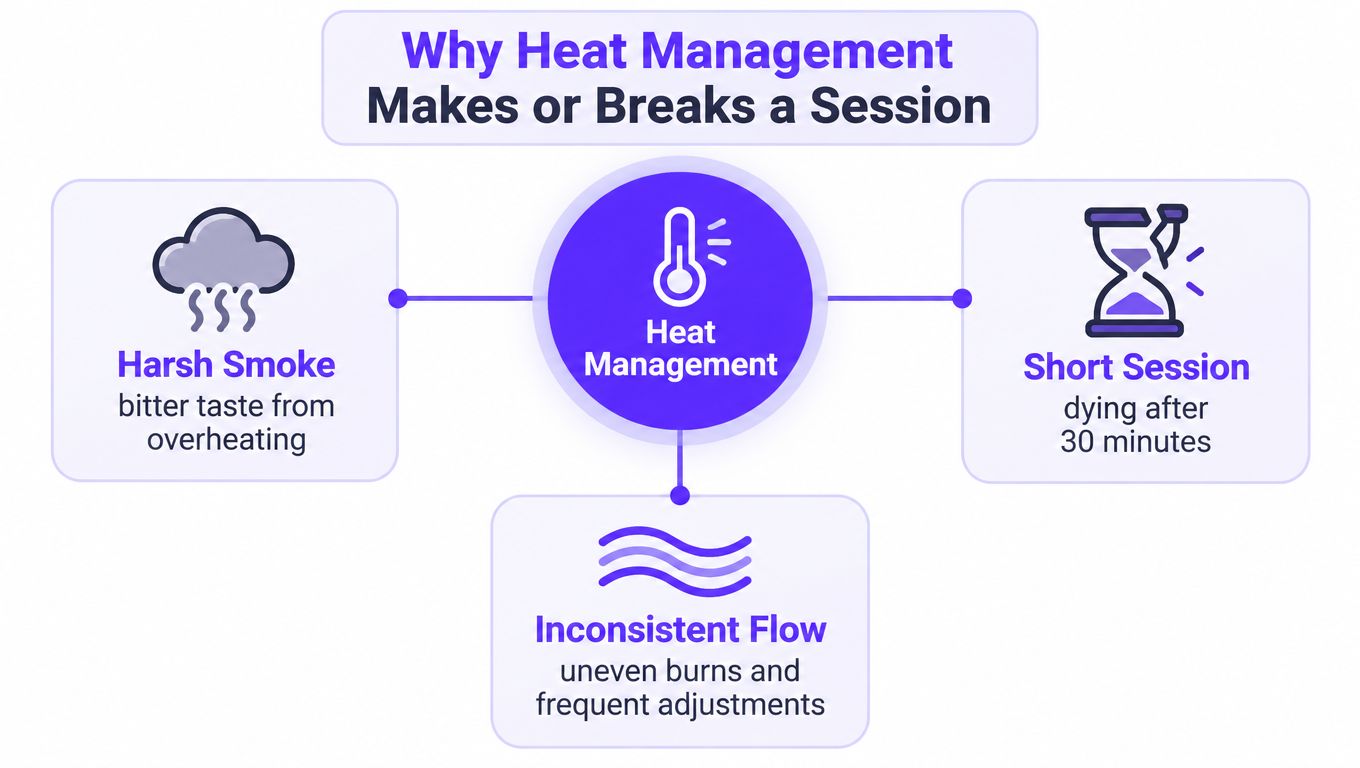
Good heat has a recognizable feel. The draw should become warmer and fuller without scratching your throat. Flavor should open gradually instead of arriving as a burnt edge. Smoke density should build with steady pulls, not require aggressive inhalation to keep the bowl alive.
Overheating usually announces itself quickly. The smoke becomes harsh, the flavor loses its sweeter or brighter notes, and the bowl may taste bitter even after you move the coals. Under-heating produces the opposite problem. The draw stays thin, the flavor remains muted, and the session feels stalled. Repeatedly adding more coal can then turn a slow start into a scorched bowl.
Read the bowl before changing it
Use the draw as your first instrument. A suddenly hotter pull means the bowl is receiving more energy than it was a few minutes earlier, even if the coals look unchanged. Ash buildup, a coal shifting toward the center, restricted airflow, or a change in draw frequency can all alter the temperature at the tobacco surface.
A practical sequence is simple:
- Start conservatively. Place the initial coals toward the outer edge rather than directly over the center.
- Give the bowl time to respond. A slow warm-up produces a more forgiving session than an aggressive start.
- Change one variable at a time. Move a coal, remove a coal, open an HMD vent, or adjust airflow. Don't do several at once.
- Wait for the flavor to confirm the adjustment. A fix is working when harshness recedes and the draw becomes smooth without losing body.
Practical rule: If the bowl turns harsh, remove heat before you add airflow. More airflow can make a hot coal burn harder and worsen the problem.
Heat management also protects consistency. A bowl that starts too hot often delivers impressive smoke briefly, then loses flavor because the upper layer has cooked too aggressively. A measured start gives the tobacco time to develop and makes later adjustments smaller. That's why charcoal choice, foil tension, HMD settings, coal timing, and troubleshooting all matter more than memorizing a single coal count.
Choosing the Right Charcoal for Your Setup
Charcoal changes the entire response of a bowl. Natural coconut charcoal usually gives a steady heat profile and relatively clean flavor when it's fully lit, which is why many experienced smokers use it for longer flavor-focused sessions. It does require a proper burner and patience during ignition. Partially lit natural coal can produce weak heat, unpleasant odors, and misleadingly poor smoke.
Quick-light charcoal is convenient when equipment or time is limited. Its ignition aid makes startup easy, but that convenience can affect the early taste and may create more noticeable smoke or odor while the coal finishes burning. It's useful for travel or an occasional setup, but it's a shortcut rather than a direct replacement for fully lit natural charcoal in a controlled session.
Wood charcoal can produce a different heat character and ash pattern depending on its source and shape. It may suit smokers who prefer its traditional profile, but it requires closer attention to consistency. A 2025 Scientific Reports study on charcoal and HMD emissions found that coconut-derived charcoal produced lower carbon-monoxide yields than wood charcoal, while HMD use reduced emissions further. Toxicants remained present in substantial amounts, so lower emissions don't mean harmless use.
Match the coal to the bowl
| Charcoal Type | Heat Profile | Ignition Time | Best For |
|---|---|---|---|
| Natural coconut | Steady once fully lit, suitable for controlled heat | Requires a dedicated burner and complete lighting | Flavor-focused home sessions and repeatable setups |
| Quick-light | Fast initial response, less predictable during ignition | Lights quickly with an ignition aid | Travel, limited equipment, or occasional use |
| Wood | Traditional character with variable heat and ash behavior | Depends on the piece and lighting method | Smokers who prefer a wood-charcoal profile and can monitor closely |
Shape matters too. Cubes tend to sit securely and provide a concentrated heat zone, while flatter pieces spread heat across more surface area and can respond faster. The right choice depends on the bowl diameter, the gap between coal and tobacco, and whether you're using foil or an HMD.
Avoid judging coal quality by how aggressively it glows. A bright coal can still be poorly positioned, partly lit, or too close to the tobacco. For consistency, fully light natural coconut pieces, brush off loose ash before placement, and use tongs that let you move each coal without crushing it.
Foil Setup and Coal Placement Step by Step
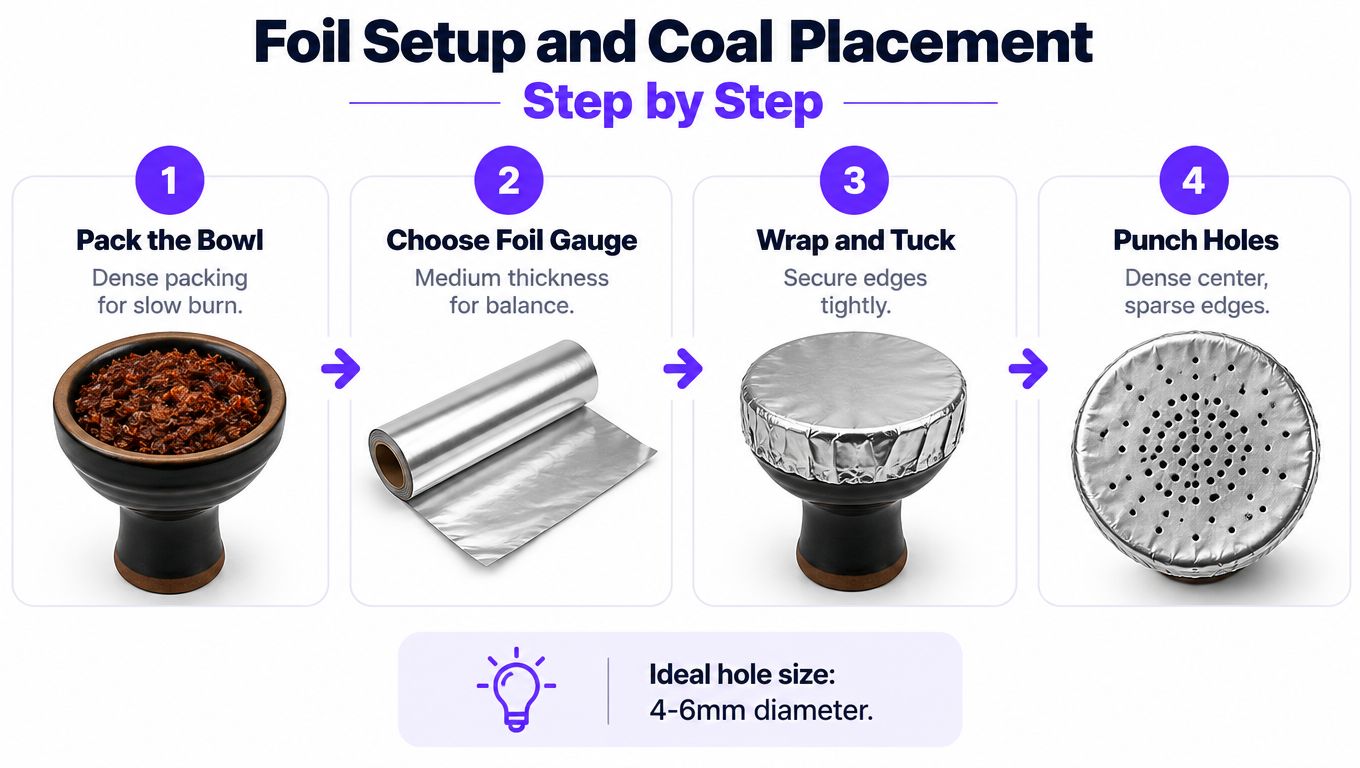
Foil gives you direct control, but it also exposes every packing mistake. Start with a clean bowl and distribute the tobacco evenly. A dense pack slows the heat response and can support a longer session, while a looser pack responds faster and needs more careful coal management. Keep the tobacco below the foil so it doesn't touch the hot surface.
Use foil that's thick enough to stay tight over the bowl. Pull it across the rim, press it down firmly, and tuck the edges so the surface doesn't sag when you move the coals. A loose sheet creates inconsistent contact and allows the coal to sit closer to one area than another.
Build an intentional hole pattern
Punch the holes after the foil is tight. A denser pattern through the center gives you more direct airflow and a slower, more controlled heat response when the outer areas receive the first coal placement. More evenly distributed holes can support a hotter setup, but they also make the bowl react faster to heavy coal placement.
Use a poker or similar tool that creates clean openings rather than tearing the foil. Large irregular holes can create hot spots and weaken the sheet. Keep the pattern symmetrical enough that the coal positions make sense, then leave enough solid foil between openings to preserve tension.
Place the first coals around the rim. Edge placement warms the bowl gradually and allows you to shift the heat zone without immediately cooking the center. Starting in the middle is one of the fastest ways to create harsh smoke, especially with a shallow bowl or a tight pack.
After the bowl stabilizes, rotate the coals with tongs. Turn each piece so a fresh face contacts the foil, then move it slightly around the edge. Don't lift the foil to inspect the tobacco. If the smoke becomes too hot, move the coal farther outward or remove one briefly. If the bowl is weak but the coals are fully lit, bring one coal slightly inward instead of adding several at once.
The supplied foil setup video can help you compare the visual steps with your own packing and placement routine. Use it as a setup reference, then tune the result to your bowl rather than copying a coal position blindly.
HMD Versus Foil for Heat Consistency
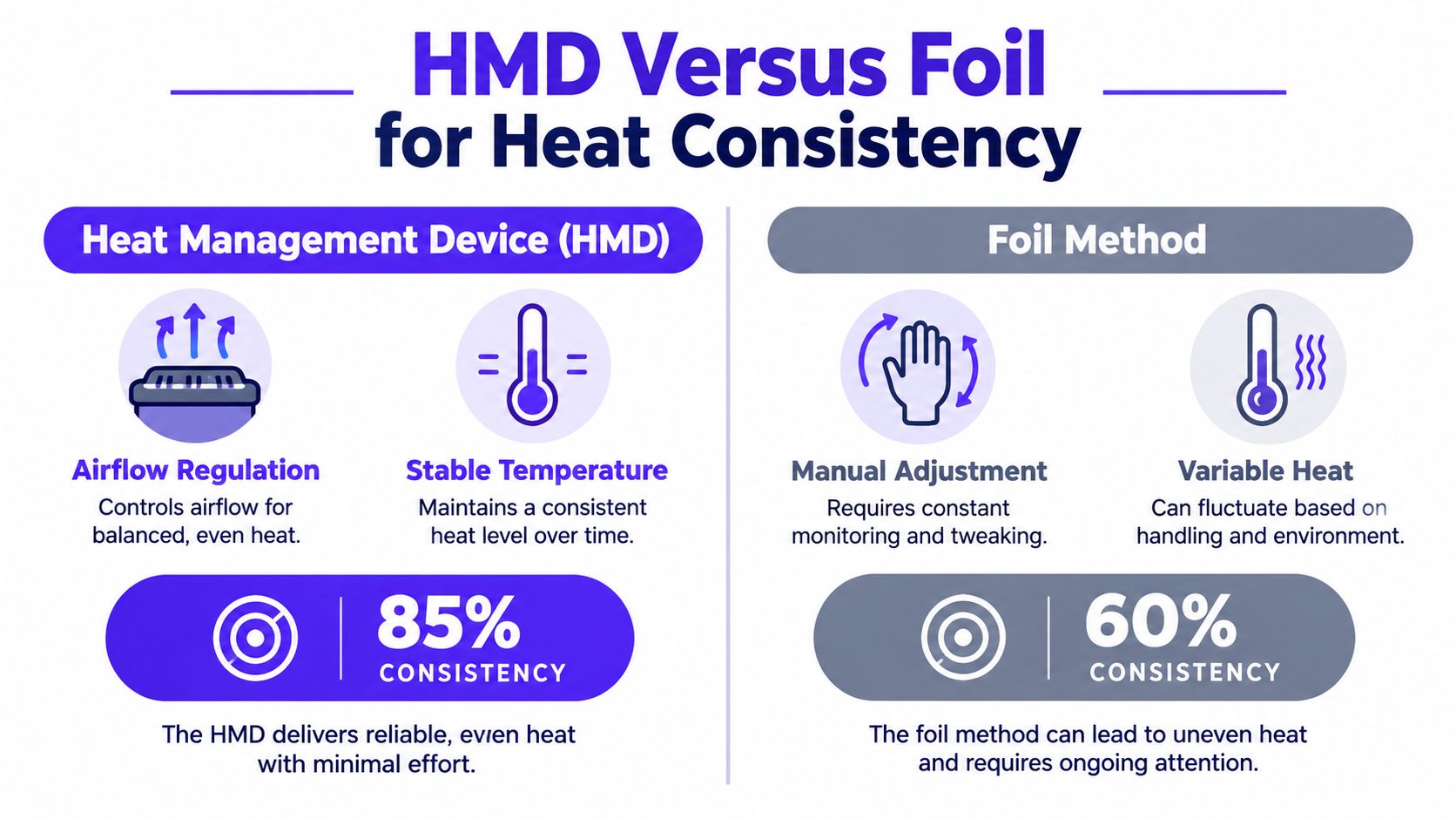
A heat management device sits between the charcoal and the bowl. Its body holds the coals, creates a more stable heat chamber, and controls how air reaches the burning surfaces. Some designs include a lid or adjustable vents, allowing you to reduce or increase airflow without handling the coals as often.
Foil is more open and immediate. You can slide coals to the edge, lift one away, or change the hole pattern for a different airflow response. That flexibility makes foil excellent for learning how your bowl behaves. It also means the smoker must monitor the session more actively because a small coal shift can create a noticeable hot spot.
Compare the practical trade-offs
| Factor | HMD | Foil |
|---|---|---|
| Heat consistency | More stable once the device and bowl are matched | Depends heavily on placement and foil tension |
| Adjustment style | Vent settings and coal position | Direct coal movement and hole pattern |
| Learning curve | Easier to repeat after finding the right setup | More hands-on, but teaches the bowl's response |
| Cleanup | Ash stays more contained | Ash can fall onto the foil or surrounding surface |
| Flexibility | Device shape can limit bowl compatibility | Works across a wider range of bowl shapes |
An HMD doesn't automatically rescue a poor pack. If the tobacco is touching the device, the bowl is overfilled, or the device fits badly, the session can still burn. A well-fitted HMD is most useful when you want repeatability across multiple sessions and prefer making small vent adjustments rather than constantly moving foil-side coals.
Foil remains a strong choice for smokers who enjoy active control, use different bowl styles, or don't want to buy a device for every setup. An HMD makes more sense for regular sessions, lounge service, or anyone who wants a steadier heat zone with less ash movement.
Vent settings change the result. Opening vents can increase airflow around the coals and raise heat output, while closing them can slow the burn and soften the response. Make small changes, then judge the draw and flavor. Smoother smoke doesn't mean the session is free of charcoal exposure. The device manages heat and smoke transfer into the bowl, but the charcoal is still burning nearby.
Managing Coal Timing Through a Long Session
A consistent session depends less on watching a clock than on reading the coal. Ash insulates the burning surface and changes how much heat reaches the foil or HMD. A coal covered in loose ash may look active but deliver less useful heat, while a freshly turned face can create a sudden increase.
Rotate coals when one side has accumulated ash or when the draw becomes uneven. Brush ash away with tongs or a coal screen, but do it carefully. Crushing the coal creates fragments that burn quickly and can fall through foil holes.
Use a controlled startup
For a two-coal start, place both pieces at opposite outer positions. This spreads the initial heat and leaves room to bring one inward later if the bowl needs more energy. A three-coal start can work for a larger bowl or a setup designed for faster heating, but it gives you less margin for error. If the smoke is already dense and warm, don't add a third coal just because the setup normally uses one.
After the initial warm-up, rotate each coal rather than replacing both at the same time. Replace a coal when it has become small, cracked, or unable to hold a useful glowing face after ash removal. Adding a fresh coal beside two exhausted pieces can produce a heat spike, so remove or move the older pieces first if the bowl is already running hot.
A steady session is built through small corrections, not dramatic resets.
If the bowl begins fading, add heat gradually. Move one coal slightly inward, open an HMD vent a little, or introduce a fresh coal while shifting an old one away. If the flavor becomes sharp before the smoke drops, the temperature has likely drifted high. Remove a coal or move both pieces outward before the tobacco becomes bitter.
Don't use a fixed schedule as a substitute for observation. Ambient airflow, draw frequency, bowl material, tobacco moisture, and coal shape all change the timing. The reliable cue is the relationship between heat, draw resistance, smoke texture, and flavor.
Troubleshooting Harsh Smoke and Uneven Heat
Harsh smoke is often treated as a tobacco problem, but the first diagnostic question should be, “Where is the heat?” A bowl can taste harsh because the coals are too close to the center, because the pack is pressing against the foil, or because the startup was too aggressive.
Match the symptom to the adjustment
Harsh on the first draw usually points to excessive startup heat or tobacco touching the foil. Remove one coal, move the remaining coal toward the rim, and check the pack on the next setup. The correction is working when the throat sensation softens without forcing you to take shorter, weaker pulls.
Bitter flavor halfway through often means the heat zone has stayed concentrated in one place. Rotate the coals and move them to fresh foil positions. If the bowl remains bitter after the heat falls, the tobacco may already be scorched, and continued coal adjustments won't restore the lost flavor.
A session that burns out quickly generally received too much heat for too long. Too many coals, central placement, or failure to rotate can cook the upper layer before the lower tobacco contributes properly. Remove a coal, spread the remaining heat across the edge, and avoid trying to recover lost smoke by adding more fuel.
Weak smoke with fully lit coals can come from under-heating, restricted airflow, a poor seal, or stale charcoal. Check the hose and stem for blockage, confirm that the foil is tight, then add heat in a small step. If the coal is crumbling or producing an unpleasant smell, replace it rather than compensating with more pieces.
Don't solve a harsh bowl with a harder draw. A stronger pull can increase airflow over the coals and raise their output, which may intensify the very problem you're trying to fix.
Uneven heat can also come from the bowl itself. A warped foil surface, uneven tobacco level, or a device that doesn't sit flat creates different distances between coal and tobacco. Before changing charcoal brands, inspect the physical setup. Heat management starts with a level bowl, a secure seal, clear airflow, and coal positions you can reproduce.
There's another issue that deserves direct attention. An HMD can reduce charcoal-smoke transfer and make a session feel smoother, but it isn't a safety switch. Controlled evidence found that charcoal-heated hookah produced substantially more exhaled carbon monoxide than electrically heated hookah or cigarette smoking, and indoor charcoal use creates an ambient exposure issue even when the bowl tastes clean. Use a carbon-monoxide detector, keep charcoal and hookah operation outdoors or in well-ventilated spaces, and don't assume a smoother draw means low-risk use.
Heat Management Playbook for Your Next Session
Treat the setup as a sequence of decisions rather than a fixed recipe.
- Choose the fuel deliberately. Use fully lit natural coconut charcoal when you want controlled, sustained heat. Use quick-light only when its convenience justifies the trade-off.
- Prepare the bowl for response. A dense pack slows the heat curve. A looser pack reacts faster and needs closer monitoring.
- Secure the foil or fit the HMD. A loose surface creates hot spots. An incompatible device creates uneven contact and airflow.
- Start at the edge. Let the bowl warm before moving heat inward.
- Change one variable. Move a coal, remove a coal, adjust a vent, or correct airflow. Then reassess.
- Read the draw and flavor. Smoke volume alone doesn't prove that the bowl is running correctly.
- Rotate before the coal fails. Ash buildup and one-sided burning are early warnings, not reasons to wait.
- Protect the air around the session. Heat control improves consistency, but charcoal still produces emissions. Use a CO detector and adequate ventilation.
The best setup is the one you can repeat. Keep notes on bowl type, tobacco packing, foil or HMD choice, coal shape, and the adjustments that worked. After a few sessions, you'll stop chasing smoke and start controlling the temperature that produces it.
Shop Hookah Tobacco offers bowls, foil, heat management devices, charcoal, tongs, hookahs, and tobacco in one catalog, so you can match your heat-control method to the rest of your setup. Visit Shop Hookah Tobacco to choose the supplies for a more repeatable next session.