






























Discover how to choose the best hookah shop, explore online versus brick-and-mortar options, and learn product categories, compliance, and buying tips.
The most popular advice about buying hookah supplies is usually too simple: “Shop online for selection, or visit a store for the experience.” That misses the operational question. A home smoker, a lounge manager, and a smoke-shop buyer aren't solving the same purchasing problem, so they shouldn't use the same channel.
A serious hookah shop is part retailer, part sourcing partner, and sometimes part compliance operation. The right choice depends on what you're buying, how often you need it, whether you must inspect it first, and how confidently the seller handles age verification, labeling, shipping, and replenishment.
Table of Content
What a Hookah Shop Actually Is Today
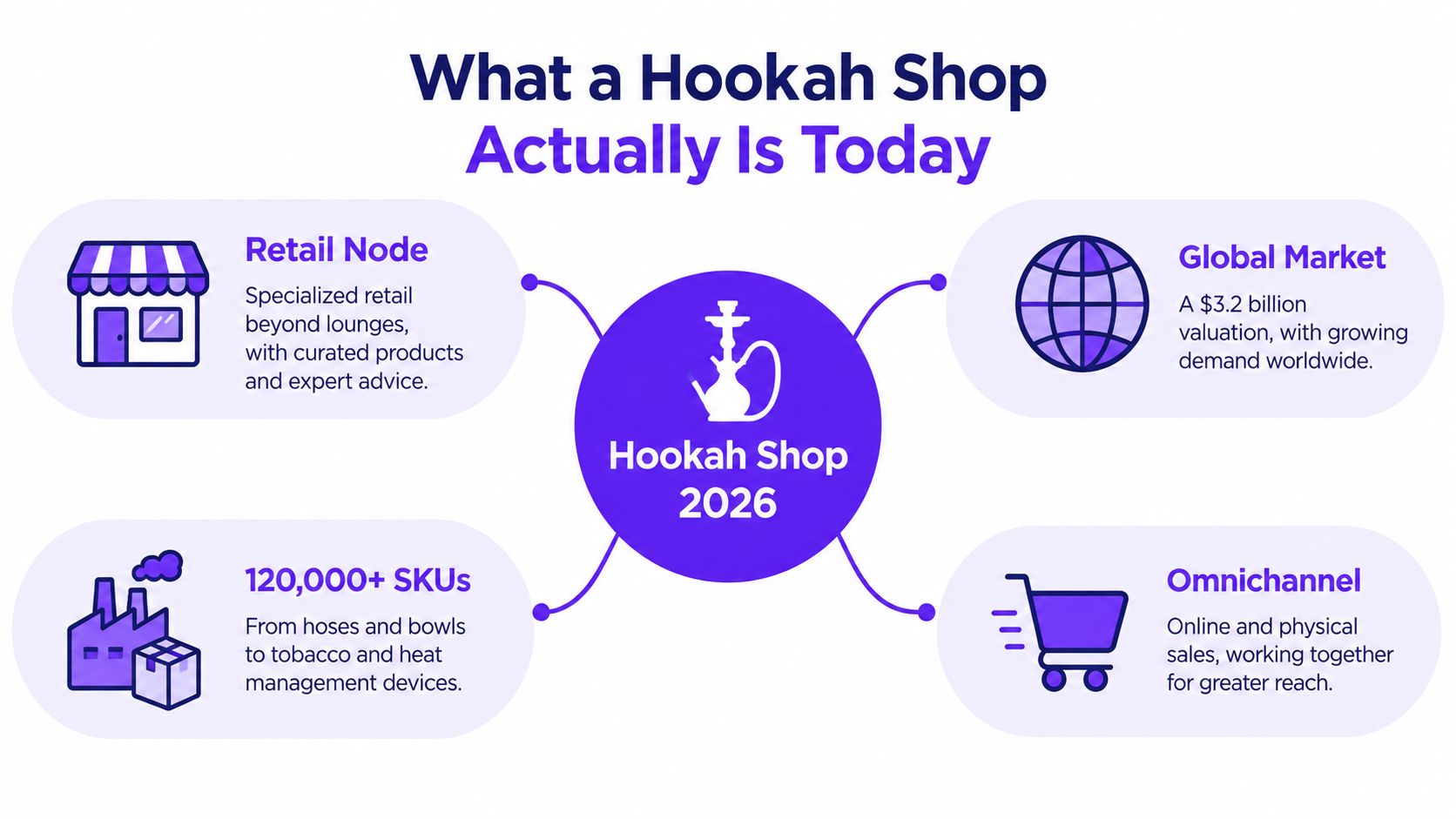
A hookah shop isn't merely a dark room with couches, music, and a menu of flavors. Walk into a well-run location and you'll find a retail operation managing consumables, hardware, replacement parts, charcoal, customer education, and often wholesale relationships at the same time.
That matters because the category has become large enough to support specialized retail. One market report estimates the global hookah market at $3.2 billion in 2025, with a projection of $5.6 billion by 2034 at a 6.4% CAGR. The same global hookah market report estimates that active hookah-themed commercial establishments worldwide exceeded 120,000 in 2025, with year-over-year growth of 8.3%.
A retail node, not just a lounge
Consider a lounge owner preparing for a busy weekend. They need tobacco in dependable case quantities, charcoal that performs consistently, replacement hoses, bowls, grommets, and heat-management equipment. They aren't browsing for a novelty purchase. They're trying to prevent a service interruption.
A home buyer has a different basket. They may need one hookah, a compatible bowl, a hose, tongs, and a manageable charcoal option. A professional shop can serve both customers, but the buying process, margin structure, and service expectations differ.
Traditional hookahs still anchor demand. The same market report estimates that traditional hookahs generated about $1.40 billion, or 43.7% of total market revenue, while hardware, charcoal, and accessories continue to expand the assortment available to retail and wholesale buyers.
Where online and physical operations overlap
Modern operators often serve B2C and B2B buyers simultaneously. The online storefront may show consumer pricing and individual products, while a business account provides case quantities, wholesale terms, or a separate procurement workflow. A physical store may offer immediate pickup to an individual while preparing recurring orders for a nearby lounge.
That dual role is useful when sourcing is fragmented. Instead of contacting one supplier for tobacco, another for charcoal, and another for parts, buyers can compare a broader catalog in one place. The shop earns trust by keeping product information current, separating retail and wholesale processes, and making replenishment predictable.
Practical rule: Judge a hookah shop by how reliably it supports the next purchase, not just how attractive the first purchase looks.
Core Product Categories and Services
A reputable hookah shop should make its catalog easy to understand. The exact brands vary, but the product architecture is fairly consistent.
Consumables and heat
The main consumable is shisha tobacco, organized by brand, flavor, and package size. Buyers may encounter established names such as Al Fakher, Starbuzz, and Mazaya, along with other regional or specialty lines. A useful store lets customers filter by brand and weight instead of forcing them to search through unrelated products.
Charcoal deserves its own buying decision. Quick-light products prioritize ignition convenience, while natural coconut-shell charcoal is generally selected for a cleaner operational profile and longer, more controlled heat management. A shop that treats all charcoal as interchangeable is making the buyer do too much technical work.
Hardware and replacement parts
Hardware includes complete hookahs, glass bases, stems, bowls, trays, hoses, mouthpieces, grommets, burners, tongs, and heat-management devices. Compatibility is the issue that causes the most avoidable frustration. A bowl may fit one adapter but not another, and a replacement hose may require the correct connector or seal.
Look for product pages that identify dimensions, materials, included components, and what isn't included. A premium hookah sold without a base or bowl can be perfectly legitimate, but the listing should make that clear before checkout.
Adjacent adult-use categories
Some retailers extend beyond hookah products into disposable vapes, rolling papers, and nicotine pouches. That can be useful for smoke-shop and convenience-store buyers who want one supplier for several adult-use categories, but it also increases the need for disciplined catalog management and labeling review.
The service layer separates a shelf from a supplier. Business buyers should look for wholesale account pathways, master-case information, order history, stock indicators, and a clear contact process for replenishment. These tools matter more than a visually impressive product grid when a lounge needs to replace fast-moving inventory.
For an individual customer, the most valuable service may be compatibility advice. For a lounge, it may be dependable case pricing and stock visibility. For a reseller, it may be brand breadth without opening accounts across several vendors.
Online Versus Brick-and-Mortar Hookah Shops
Online and physical stores solve different parts of the buying problem. Online purchasing usually wins on catalog organization and convenience. Brick-and-mortar purchasing wins when inspection, immediate possession, or direct advice matters more than selection.
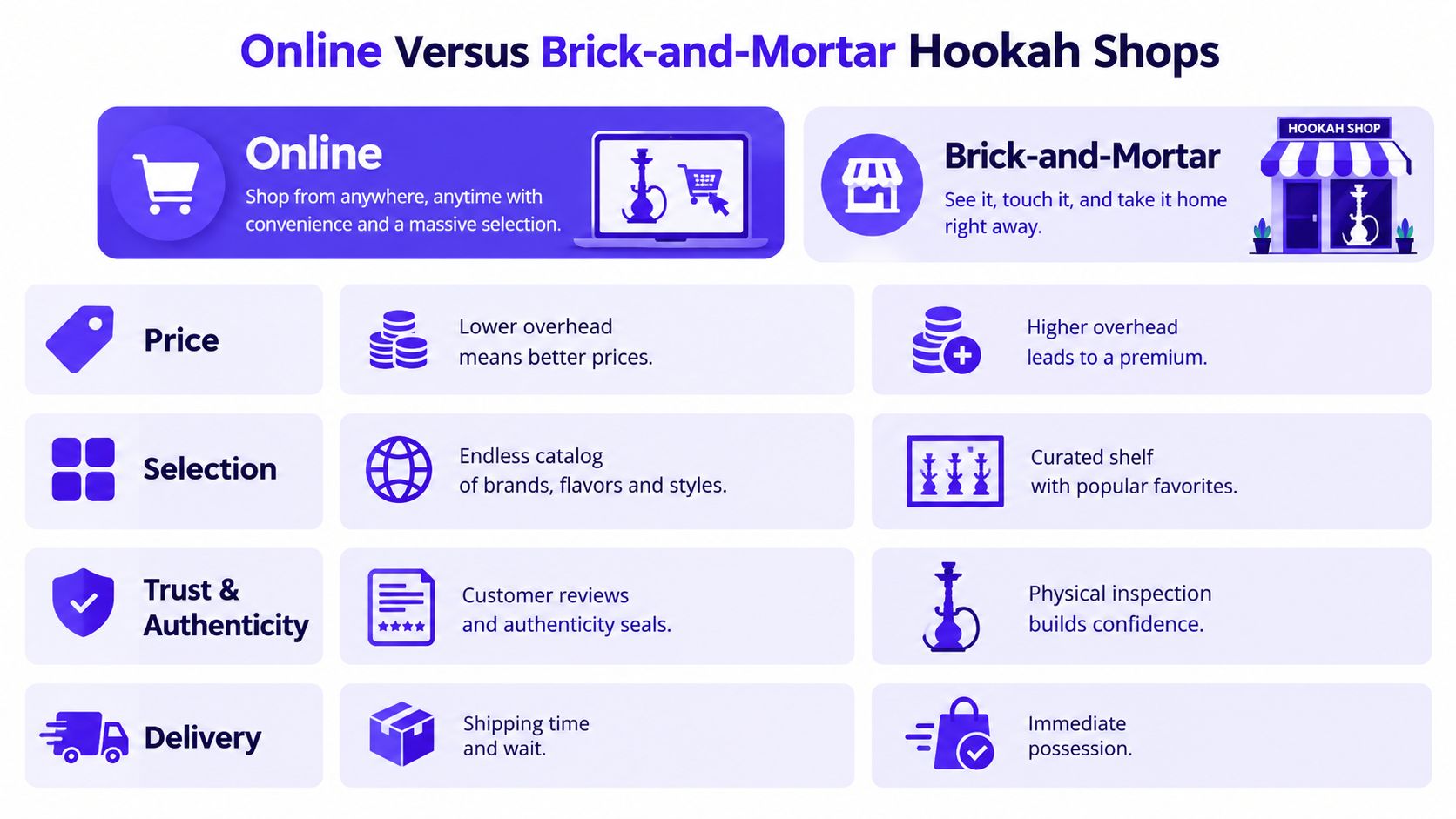
| Factor | Online Shop | Brick-and-Mortar Shop |
|---|---|---|
| Inventory | Broad catalog, brand filters, wishlists, and possible business portals | Curated shelf, local availability, and staff-selected assortment |
| Product experience | Relies on specifications, photos, and reviews | Allows physical inspection of glass, finishes, seals, and packaging |
| Compliance | Age verification must work through checkout and delivery processes | Staff can check identification before completing the sale |
| Pricing | Easier side-by-side comparison and bulk review | Overhead can be reflected in pricing, but advice and instant pickup add value |
| Delivery | Shipping wait and possible carrier restrictions | Immediate possession when the item is in stock |
An online shop is usually the better starting point for a buyer comparing several brands or building a replenishment list. Search, filters, order history, and wishlist tools reduce repetitive work. Business buyers can also review case counts before contacting a sales team, provided the retailer explains whether displayed pricing is final or subject to confirmation.
A physical store earns its place by reducing uncertainty. You can inspect a glass base for finish quality, compare the feel of hoses, ask whether a bowl matches your heat-management device, and leave with the item immediately. That experience costs the operator more to provide, so the shelf price may not match the lowest online offer.
Watch for two common failures. An online catalog with stale stock or unclear shipping rules creates checkout friction. A physical shop with limited technical knowledge may offer immediacy without helping you avoid a compatibility mistake.
For home users, online is often efficient for repeat purchases and physical retail is useful for the first setup. Lounge owners typically need both, using online tools for planned replenishment and local stores for urgent replacement needs. Retail resellers should prioritize supplier documentation, case structure, and compliance processes over either channel's atmosphere.
How to Choose a Reputable Hookah Shop
A polished website doesn't prove that a retailer is dependable. Use a repeatable screening process before placing a large order or trusting a new supplier with lounge inventory.
Start with compliance visibility
Look for an age-verification policy, shipping restrictions, terms and conditions, and a clear explanation of which products can be sold in your location. A retailer that hides these details creates unnecessary risk for both sides of the transaction.
Don't treat a visible age gate as the entire compliance program. Review how the checkout handles age confirmation, whether delivery requires an adult signature or identification, and whether the store distinguishes tobacco products from accessories and other categories.
Audit the product information
Authentic inventory usually has more than a lifestyle photograph. Check for:
- Specific product details: Look for brand, size, material, included components, and compatibility information.
- Pack structure: Master-case counts and unit quantities help commercial buyers calculate replenishment.
- Stock clarity: In-stock, out-of-stock, and back-order indicators are more useful than vague availability language.
- Label visibility: Packaging should show the information required for the applicable market, rather than relying on improvised stickers or incomplete descriptions.
A low price isn't evidence of a counterfeit product, but an unusually vague listing should slow you down. Ask for packaging photographs, lot information, or supplier documentation when the purchase is commercially important.
Test the service before you depend on it
Send a focused question about a product combination, case quantity, or shipping restriction. A useful response should answer the question directly, identify any uncertainty, and explain the next step. For wholesale accounts, ask how pricing is confirmed, how stock is allocated, and what happens when a listed item becomes unavailable.
A responsive supplier doesn't need to promise everything. It needs to explain what it can deliver and what it can't.
Read the returns policy before ordering fragile hardware. Confirm who handles damage claims, whether opened consumables are returnable, and whether the business has a real contact path beyond an automated form.
Legal and Age-Compliance Considerations
In the United States, selling hookah tobacco is not an informal transaction just because the product is associated with a lounge or specialty store. Federal guidance requires retailers to sell covered tobacco products only to customers 21 and older, check photo identification for anyone who appears under 30, avoid free samples, and display required health-warning statements on packaging and advertising. These requirements are summarized in the FDA retail tobacco guidance.
The FDA's guidance was updated in 2026, and it describes hookah tobacco as regulated across manufacture, import, packaging, labeling, advertising, promotion, sale, and distribution. That scope affects more than the person behind the register. It reaches product sourcing, marketing copy, promotional offers, warehouse procedures, and the information shown during online checkout.
Physical sales and online sales
A store employee can request identification at the counter and refuse a sale when the customer doesn't meet the requirement. Online sellers need a process that addresses age verification during checkout and, where applicable, at delivery. A simple checkbox without meaningful controls may not be sufficient for a retailer's operating needs.
State and local rules can add requirements beyond the federal baseline. Licensing, tax treatment, shipping restrictions, packaging rules, advertising limitations, and local tobacco-retail rules may differ by jurisdiction. Buyers should confirm the rules that apply to their own location rather than assuming that a supplier's general policy covers every transaction.
What buyers should ask
Commercial customers should request clarity on licensing, invoices, product labeling, shipping limitations, and account eligibility. Retailers should train staff, document refusals, keep warning statements accurate, and review promotional practices before publishing them.
Compliance also functions as a trust signal. A hookah shop that explains its policies plainly is showing that it understands the operational responsibility attached to the category.
Practical Buying Tips for Every Hookah Shop Customer
The right purchase starts with the buyer's role, not the product photo.
Home enthusiasts
Start with a compatible setup rather than collecting isolated parts. Confirm that the bowl, grommets, hose connector, and heat-management device work together. If you're testing flavors, buy a manageable assortment and record which bowl and heat configuration produced the result you liked.
Charcoal selection deserves special attention. In a controlled study, quick-light charcoal produced mean carbon monoxide output of 3,728 ± 2,028 ppm over 90 minutes, compared with 1,730 ± 501 ppm for natural charcoal, with p = 0.016. The controlled charcoal study found the quick-light result was more than double the natural-charcoal output under the study conditions.
| Charcoal Type | Mean CO Output | Standard Deviation |
|---|---|---|
| Quick-light charcoal | 3,728 ppm | 2,028 ppm |
| Natural charcoal | 1,730 ppm | 501 ppm |
The figures don't turn charcoal into a guarantee of safe use. They do show why ignition convenience carries a meaningful trade-off for indoor air quality and ventilation load.
Lounge owners
Ask for business-account terms before building a menu around a supplier. Confirm case quantities, stock visibility, lead times, damaged-goods procedures, and how price changes are communicated. A lower unit price doesn't help if the supplier can't replenish a fast-moving flavor or charcoal line.
Keep a simple purchasing record by product, case size, and service demand. That gives managers a basis for deciding whether to broaden brands or consolidate around dependable sellers.
Retail buyers
A smoke-shop or convenience-store buyer should review label compliance, age-restricted checkout procedures, and supplier documentation before adding adjacent categories. Brand variety can attract different customers, but too many slow-moving products tie up shelf space and make inventory control harder.
Buy the replenishment process, not just the opening order.
Before payment, verify the seller, product specifications, package quantity, compatibility, stock status, shipping terms, and returns process. Those checks prevent most avoidable purchasing problems.
Common Misconceptions About Hookah Shop Culture
The first misconception is that hookah is automatically safer than cigarettes because users share a waterpipe or because the session feels social. Public-health sources don't support that assumption. A clinical exposure study found that charcoal-heated hookah caused exhaled carbon monoxide to rise about 9 to 10 times more than either electrically heated hookah or cigarette smoking in young adults, while nicotine levels rose similarly across the smoking modes.
That distinction matters for buying decisions. Changing flavor or tobacco branding doesn't address the heat source that creates combustion-related carbon monoxide. Hardware, charcoal, airflow, and session conditions deserve more attention than marketing language about smoothness.
A second misconception is that hookah belongs only to one region or only to nightlife. WHO-linked surveillance materials describe waterpipe smoking as prevalent worldwide and identify it as one of the most popular forms of tobacco use among youth. One WHO FCTC database entry records lifetime prevalence rising from 29% at college entry to 45% at one-year follow-up, while another summary reports 45% occasional use, 10% weekly use, 17.9% monthly use, and 17.1% yearly use.
Those figures describe surveillance findings, not a reason to generalize about every customer. They do show why retailers need disciplined age controls and why a hookah shop should be evaluated as a regulated retail channel, not merely a social venue.
Finally, not every shop operates the same way. One may specialize in wholesale replenishment, another in premium hardware, and another in an experiential lounge. Buyers should assess the operation in front of them rather than relying on the category label.
Your Next Steps as a Hookah Shop Buyer
Choose the channel according to the job.
- Home smoker: Use online selection for repeat consumables and visit a physical store when you need help matching parts or inspecting hardware.
- Lounge owner: Request business-account details, case quantities, replenishment terms, and a clear stock process before committing to a menu.
- Retail buyer: Audit supplier documentation, age controls, labeling, shipping restrictions, and returns before adding a new category.
- First-time buyer: Purchase a compatible setup, not a random collection of attractive accessories.
Use the same basic filter every time: Is the product authentic and clearly described? Is the seller transparent about age compliance and shipping? Can the shop answer a technical question? Will it still be useful when you need to reorder?
A good online shop gives you organized selection and purchasing history. A good physical shop gives you inspection, advice, and immediate possession. The strongest buying decision comes from matching those strengths to your actual operating needs.
Shop Hookah Tobacco offers online access to hookah tobacco, hookahs, charcoal, accessories, and related adult-use categories, with product organization by brand, weight, and equipment type. Review its catalog and purchasing policies, then visit Shop Hookah Tobacco to compare supplies for your home setup, lounge, or retail operation.