

































Learn nicotine pouches how to use them safely with clear placement, timing, dosing, and disposal tips. A practical guide for adults in the United States.
You're sitting in your car on a break, can in hand, wondering if you're about to do this wrong. You don't want smoke, you don't want to step outside, and you definitely don't want nausea from picking the wrong strength. That's exactly why Nicotine Pouches How to Use guidance has to go beyond placement. Do the first one right, low and brief, and you'll know what your body is telling you before you ever reach for a second.
Table of Contents
What Nicotine Pouches Actually Are
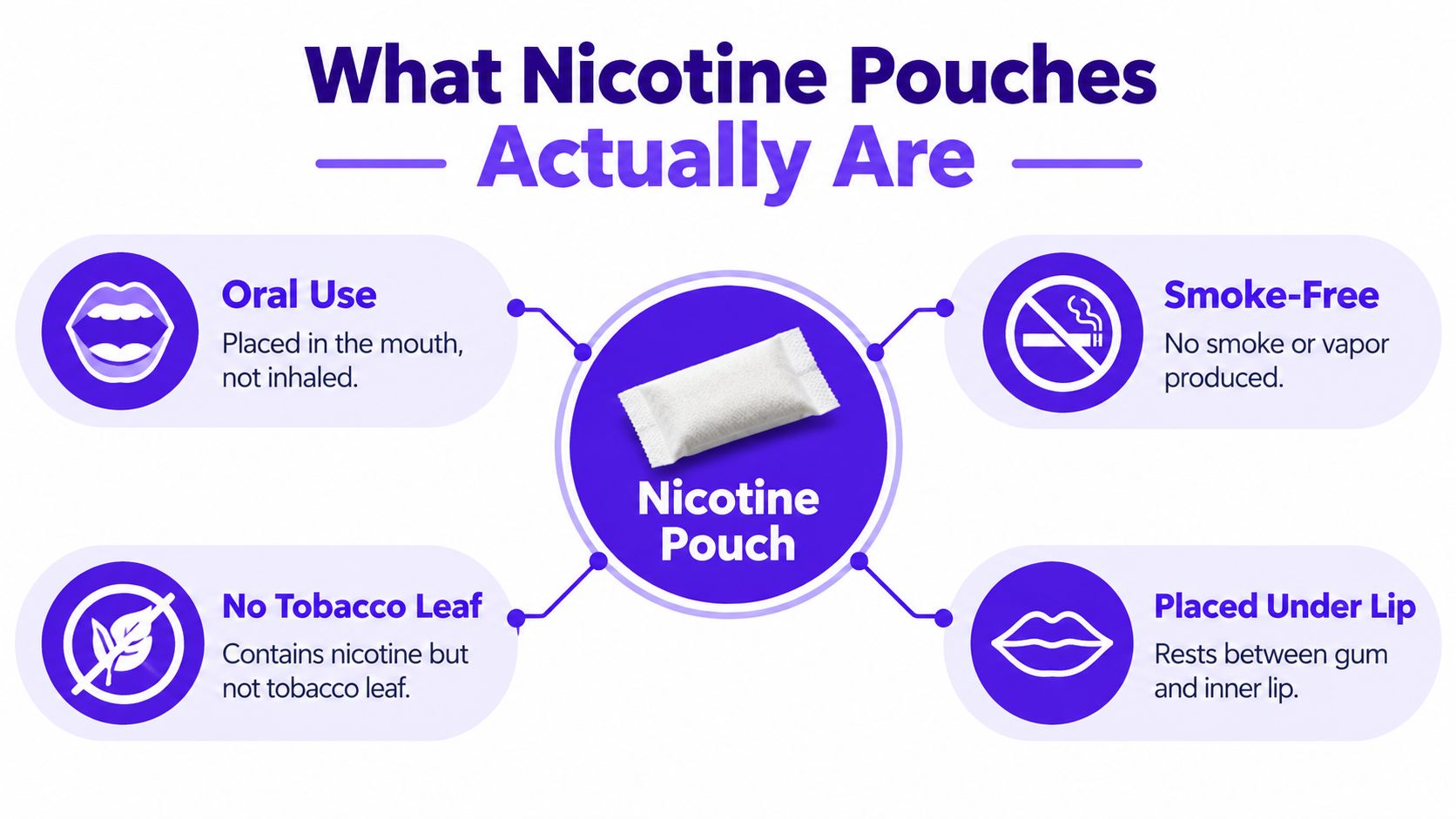
A nicotine pouch is a small oral pouch you place between your gum and upper lip. Its nicotine-containing powder gradually dissolves, and nicotine is absorbed through your gums and the lining of your mouth. You're not burning tobacco, producing smoke, or inhaling anything into your lungs. That difference matters, but it doesn't make the product harmless.
Don't carry over habits from other products. A pouch isn't a cigarette you puff, dip you work around your lower lip, snus you assume behaves the same way, or nicotine gum you chew. You park it, leave it alone, remove it, and throw it away. You don't swallow it, chew it, or reuse it.
This quick visual sums up the basic idea before you open a can.
What Authorization Does and Doesn't Mean
On January 16, 2025, the FDA authorized 20 ZYN nicotine pouch products in flavors including Chill, Cinnamon, Citrus, Coffee, Cool Mint, Menthol, Peppermint, Smooth, Spearmint, and Wintergreen, and U.S. data reported 0.82% of adults had used oral nicotine pouches in the past 30 days, according to CDC guidance on nicotine pouches. Authorization means those products can be legally marketed. It does not mean they're safe, nonaddictive, or FDA approved as quit-smoking medicine.
Smoke-free describes how nicotine is delivered. It does not describe how strong, addictive, or risk-free a pouch is.
Read the label like it matters, because it does. Nicotine is highly addictive, strengths vary substantially, and pouches aren't safe for youth, young adults, pregnant people, or people who don't currently use tobacco. If you don't already use nicotine, my direct advice is simple. Don't start with a pouch just because it's discreet.
The number to respect is the milligrams per pouch, not the flavor name or how confident the branding sounds. Flavor tells you taste. Milligrams, duration, and your own tolerance tell you exposure.
Placement Duration and Removal Routine
Dry hands help. Take one pouch, not two, and tuck it between your upper lip and gum, slightly to one side of center. Rest it flat against the gumline, not on your teeth and not loose in your cheek. Upper placement usually produces less saliva for beginners, so it feels easier to leave alone.
Use this routine visual as your mental map for placement and removal.
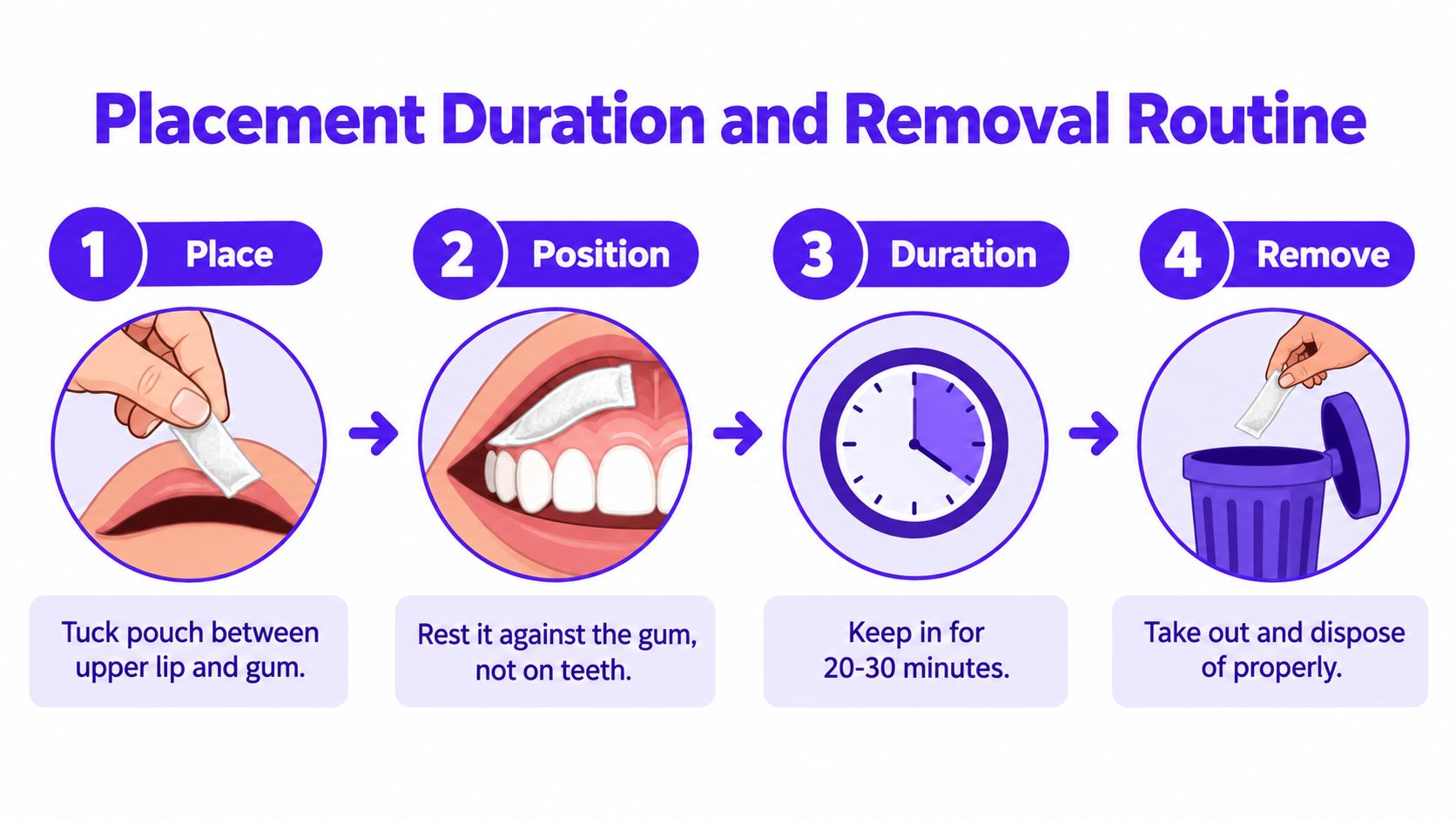
Once it's in, stop fussing with it. Don't chew it, suck on it, bite it, or push it around with your tongue. Moving it increases saliva and irritation and makes accidental swallowing more likely. A mild tingle can happen, but burning pain, nausea, or dizziness isn't something to push through.
How Long to Leave It In
For a controlled first use, keep one pouch in for only 5 to 15 minutes, and remember that one controlled study reported peak nicotine at about 22 to 26 minutes for pouches versus 8.6 minutes for a cigarette, as described in pharmacokinetic research on oral nicotine pouches. That slower rise is the whole trap. You may feel little at first, remove it, and still feel effects building afterward.
- Set a timer: Don't guess your first few times, especially while driving or working.
- Sit or stay put: Learn your response before using one during a meeting, workout, or long drive.
- Skip food juggling: Eating and talking constantly can shift the pouch and increase saliva.
- Remove early if needed: Brief use is a successful test, not a failed session.
Watch the placement demonstrated here, then compare it with the routine you're building.
Removal Without the Mess
Pinch the pouch out with a tissue or clean fingers. Seal it in the can's catch lid if it has one, or wrap it in tissue and put it in a trash bin. Wash your hands afterward so residue doesn't end up on food, your eyes, or anything a child might touch.
Don't swallow a pouch, save a used one for later, or leave it on a dashboard, desk, or tray table. Used means finished. If symptoms hit during use, removal comes first and questions come second.
Choosing a Starting Strength
Most first-time mistakes happen before placement. Someone picks a middle or high strength because a friend uses it, feels nothing in the first few minutes, adds another, and then gets hit all at once. Start with the lowest available strength and treat your first pouch as a test of tolerance, not a target to beat.
Authorized examples include 3 mg and 6 mg products, while other authorized products range from 2 mg to 11 mg per pouch, as listed among nicotine pouch products authorized by the FDA. That range is wide enough that guessing is a bad plan. A label also doesn't guarantee identical delivery across formulations, so your symptoms matter more than brand-to-brand bragging.
Translate Your History Into a Starting Point
If you're nicotine-naive, don't use pouches. That's not hedging, that's the safest recommendation. If you're an adult who occasionally smokes, the lowest strength for a brief window is the only sensible starting point. If you're a regular smoker, that still doesn't justify jumping straight to the top of the range.
Tolerance to inhaled nicotine doesn't map neatly onto oral absorption. A pouch rises more slowly, lasts through the contact period, and can keep building after removal. Starting low gives you information. Starting high only gives you a stronger chance of learning through nausea.
Practical rule: Choose the strength you can remove early and reassess, not the strength you hope will feel impressive.
Use the reference below as a decision aid, not a prescription. If your response lands in the final column, the strength, duration, or frequency is wrong for you.
Nicotine Strength Quick Reference
| Strength | Typical User Profile | Common Effects | Stop Now If |
|---|---|---|---|
| Lowest available range | Adult first-time pouch user or light nicotine user | Mild tingle, gradual nicotine effect | Nausea, dizziness, hiccups, mouth irritation |
| Middle range | Adult regular nicotine user who tolerated the lowest range briefly | Clearer, longer-rising effect | Palpitations, sweating, tremor, headache |
| Higher range | Experienced adult pouch user only, never a starting point | Strong effect with greater adverse-effect risk | Vomiting, confusion, racing pulse, severe irritation |
Escalate only after a clean test. Clean means no nausea, dizziness, palpitations, sweating, tremor, confusion, or lingering mouth irritation during or after the brief use. Change one variable at a time. Don't raise strength and extend duration and shorten the break between pouches in the same day.
If the lowest strength feels like too much when used briefly, that's your answer. Remove it and stop. There's no prize for adapting to a dose your body is rejecting.
Dosing Habits and What to Avoid
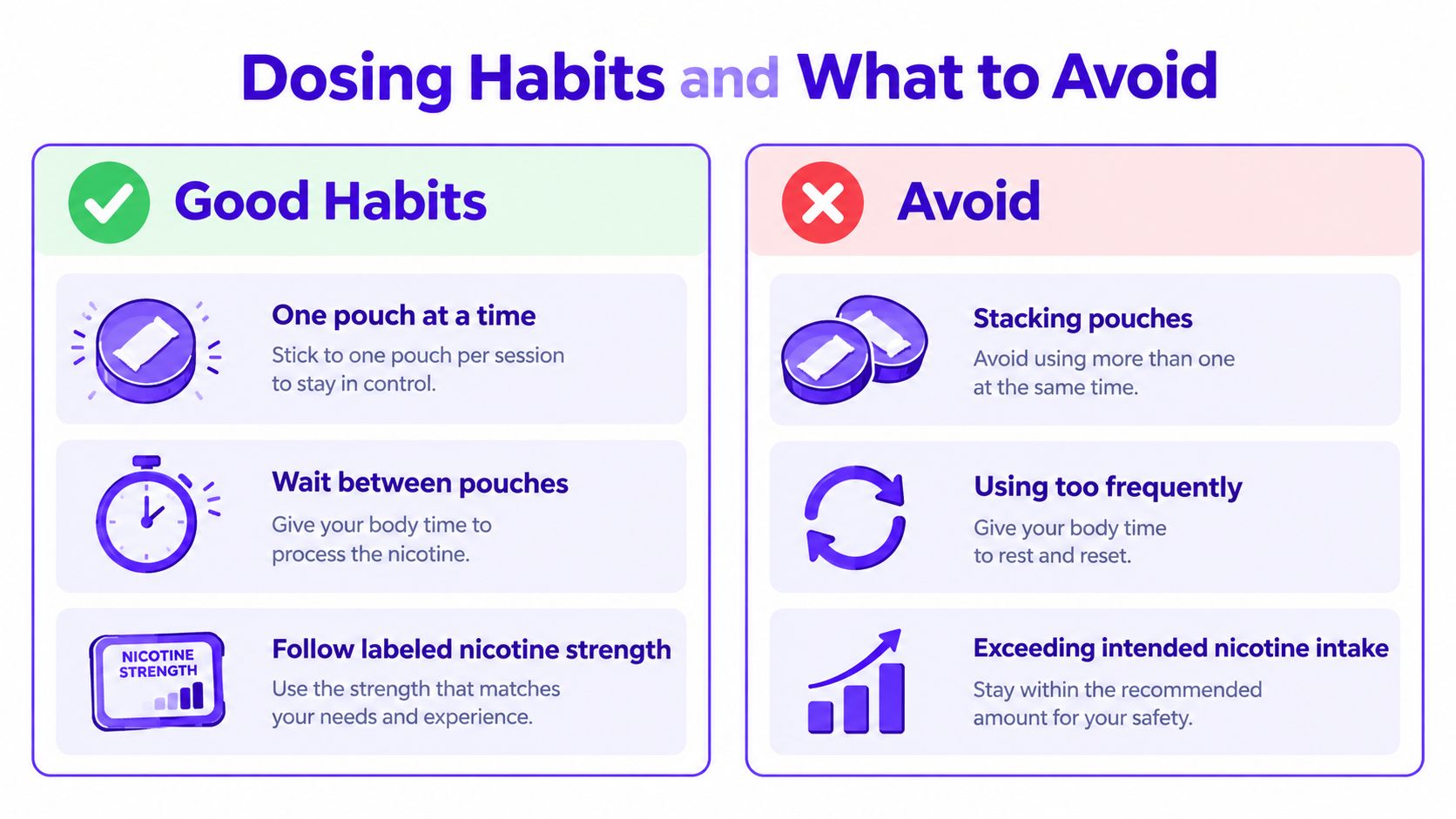
The biggest dosing error is stacking, putting in a second pouch before the first has peaked. Because onset is gradual, impatience looks reasonable right up until both doses overlap. Use one pouch, remove it, wait, and judge the full effect before considering another.
This side-by-side view separates habits that control exposure from habits that raise it.
Don't combine pouches with cigarettes, vaping, gum, lozenges, patches, or other nicotine products unless a clinician has designed that regimen for you. Combining doesn't create a smoother transition by default. It usually creates a larger total dose that's harder to track.
Why Slower Does Not Mean Weaker
A systematic review of seven randomized trials found no statistically significant increase in smoking cessation compared with control, snus, or nicotine gum, and a meta-analysis found a 4 mg pouch produced about 91.73% of a cigarette's total nicotine exposure with a peak around 69.15% of a cigarette's, according to clinical evidence indexed in PubMed. Treat pouches as nicotine delivery products, not proven cessation therapy. If your goal is quitting smoking, talk with a clinician about validated treatment instead of improvising a pouch schedule.
Poison Control guidance not to exceed 60 minutes, plus findings that a 30 mg pouch produced the strongest adverse effects in one comparison and a 9 mg pouch caused nausea, dizziness, and hiccups in a light smoker in another study, are summarized in dental and clinical guidance on oral nicotine pouches. Duration is dose. Keeping a pouch in just because you forgot it is still exposure.
Your Stop Signal List
- Nausea or vomiting: Remove the pouch, sit down, and don't replace it.
- Dizziness or confusion: Stop, avoid driving, and wait until you're fully clear-headed.
- Palpitations, sweating, or tremor: Treat these as too much nicotine, not a strong buzz.
- Hiccups or mouth irritation: Remove it and give the tissue a break.
Be careful around meals and drinks too. Hot, acidic, or alcoholic drinks can make the mouth feel more irritated and can encourage you to move or swallow around the pouch. Keep the routine boring. One pouch, short first window, full wait, honest symptom check.
Storage Disposal and Everyday Etiquette
Store pouches the way you'd store any nicotine product around a real household. Keep the closed can in a cool, dry place, up high or locked away, and out of reach of children and pets. Don't transfer pouches into candy tins, mint containers, coat pockets, or loose bag compartments where someone else can mistake them for something edible.
Keep unused and used pouches separate. A catch lid is for temporary containment until you reach a trash bin, not long-term storage in a hot car. Heat, crushing, and moisture can damage pouches, and a damaged pouch doesn't belong in your mouth.
A Clean Disposal Routine
Remove the pouch with a tissue, seal or wrap it, and put it in a regular trash bin. Wash your hands afterward. Never drop used pouches on pavement, in a rideshare seat pocket, under a restaurant table, in a plant, or in an office drawer. Nothing about being smoke-free makes litter discreet or acceptable.
If there's no bin nearby, keep the wrapped pouch in the catch lid until you find one. Don't flush it, toss it from a car window, or leave it in a shared ashtray. The routine takes seconds, and it keeps nicotine residue away from kids, pets, cleaners, and coworkers.
If you wouldn't leave a used nicotine product on someone's desk, don't leave a pouch there just because it's small and white.
Etiquette in Shared Spaces
Ask before using one in someone else's car, home, or small workspace. Check workplace, airline, venue, and local rules instead of assuming smoke-free automatically means allowed everywhere. In restaurants and meetings, placement and removal should be discreet, and disposal should wait until you can do it properly.
Don't use pouches in front of children or offer them to anyone who doesn't already use nicotine. Don't handle a pouch and then prepare food without washing your hands. Good etiquette is mostly containment. Your pouch, your tissue, your trash bin, your responsibility.
If a child or pet may have swallowed a pouch, don't wait to see how it plays out. Get urgent poison-control or veterinary guidance right away. Storage discipline prevents that scramble better than any apology afterward.
Key Habits to Take Away
Tomorrow morning, the routine should be automatic. Check the milligrams, choose the lowest available strength, place one pouch between your upper lip and gum, and set a short timer. Leave it alone while it's in. Remove it early if your body says stop.
The Short Checklist
- Start lowest: Never make a higher strength your first test.
- Keep it brief: A short first window gives you useful information with less exposure.
- Never stack: Wait for the delayed peak before judging whether the first pouch was enough.
- Don't combine: Avoid adding cigarettes, vapes, gum, lozenges, or patches unless a clinician directed the plan.
- Stop on symptoms: Nausea, dizziness, hiccups, palpitations, sweating, tremor, confusion, or irritation means remove it now.
- Store and trash it right: Closed can, out of reach, used pouch sealed and binned, hands washed.
Change only one variable at a time if you're an adult who already uses nicotine and tolerated a lowest-strength test without symptoms. Strength, duration, and frequency all increase exposure. Adjusting all three tells you nothing except that you overdid it.
Don't treat pouches as interchangeable with nicotine-replacement therapy or as a clinically validated way to quit smoking. They're nicotine products with dependence risk. That distinction should shape how cautiously you use them and whether you use them at all.
Youth, pregnant people, and adults who don't currently use nicotine shouldn't use nicotine pouches. If that's you, the correct how-to is not to start. If you're an adult nicotine user, predictability comes from restraint, not from finding the strongest can you can tolerate.
The habit that protects you most is listening early. Remove the pouch at the first clear too-much signal, give yourself a real break, and let the label guide the next decision. Slow, low, and contained beats strong, stacked, and sloppy every time.
If you're an adult comparing labeled nicotine pouch strengths alongside hookah tobacco, hookahs, charcoal, and accessories, browse the consolidated catalog at Shop Hookah Tobacco and check each product label carefully before you order. Start low, keep your first use brief, and use the symptom checklist above before reaching for anything stronger.