

























Pan Raas Afzal explained: paan-style tasting notes, 50 g to 1 kg sizes, heat tips, hookah setups, mix ideas and labeling checks before you buy.
You're looking at Afzal Pan Raas, and the descriptions don't sound like your usual hookah flavors. There's betel leaf instead of berry, warm spice instead of a straightforward mint finish, and a choice of packs that can make the first purchase harder than it needs to be.
The useful distinction is simple: paan explains the flavor story, not the nicotine content. Understand the taste, verify the exact product you're buying, then choose a pack and setup that let you judge it fairly.
Table of Contents
Afzal Pan Raas Sizes and What Each Pack Costs
If you're choosing between a small trial pack and a bulk purchase, compare the sizes and listed prices first. Pan Raas listings show 50 g and 1 kg packs from Gutkawala, plus 250 g packs from World Hookah Market and Hookah Hutt. Prices below are those displayed in the linked listings, not current quotations.
Afzal Pan Raas pack sizes and cost per gram
| Pack size | Typical buyer | Listed price (seller, year) | Cost per gram |
|---|---|---|---|
| 50 g | Trying the flavor for the first time | AED 15, Gutkawala Dubai listing, year not stated | AED 0.30 |
| 250 g | Regular smoking | $14.00, World Hookah Market, 2024 | $0.056, approximately $0.06 |
| 250 g | Regular smoking | $336.00, Hookah Hutt, 2024 | $1.344 |
| 1 kg | Lounges and high-volume users | AED 130, Gutkawala Dubai listing, year not stated | AED 0.13 |
| 1 kg | Lounges and high-volume users | $1,417.50, Hookah Hutt, 2024 | $1.4175 |
Cost per gram is the listed price divided by the pack's net weight. In Gutkawala's listings, the 1 kg pack costs about 56.7% less per gram than the 50 g pack, before taxes and shipping. That comparison applies to those displayed prices only.
The Hookah Hutt prices are much higher than the other dollar-denominated listing. Before comparing them, check the unit count, currency, product line, and whether the offer is for a case or bundle.
Buying rule: Start with a trial pack if the flavor is unfamiliar. Choose a larger pack once you know you like it and can use it before storage becomes a concern.
Verify Nicotine and Labeling Before You Buy or Serve
Don't infer nicotine status from the flavor name, a package color, or a marketplace headline. Checking those details alone is like judging a medicine by its brand colors rather than its ingredient panel.
A Pan Ras marketplace listing and its customer feedback illustrate the problem: the listing claims no tobacco and no nicotine, while a reviewer reports that the ingredient information appeared to identify tobacco. A review isn't a laboratory test, but that inconsistency is enough to stop a purchase until the seller resolves it.
Use this visual as a reminder to compare the actual product details.
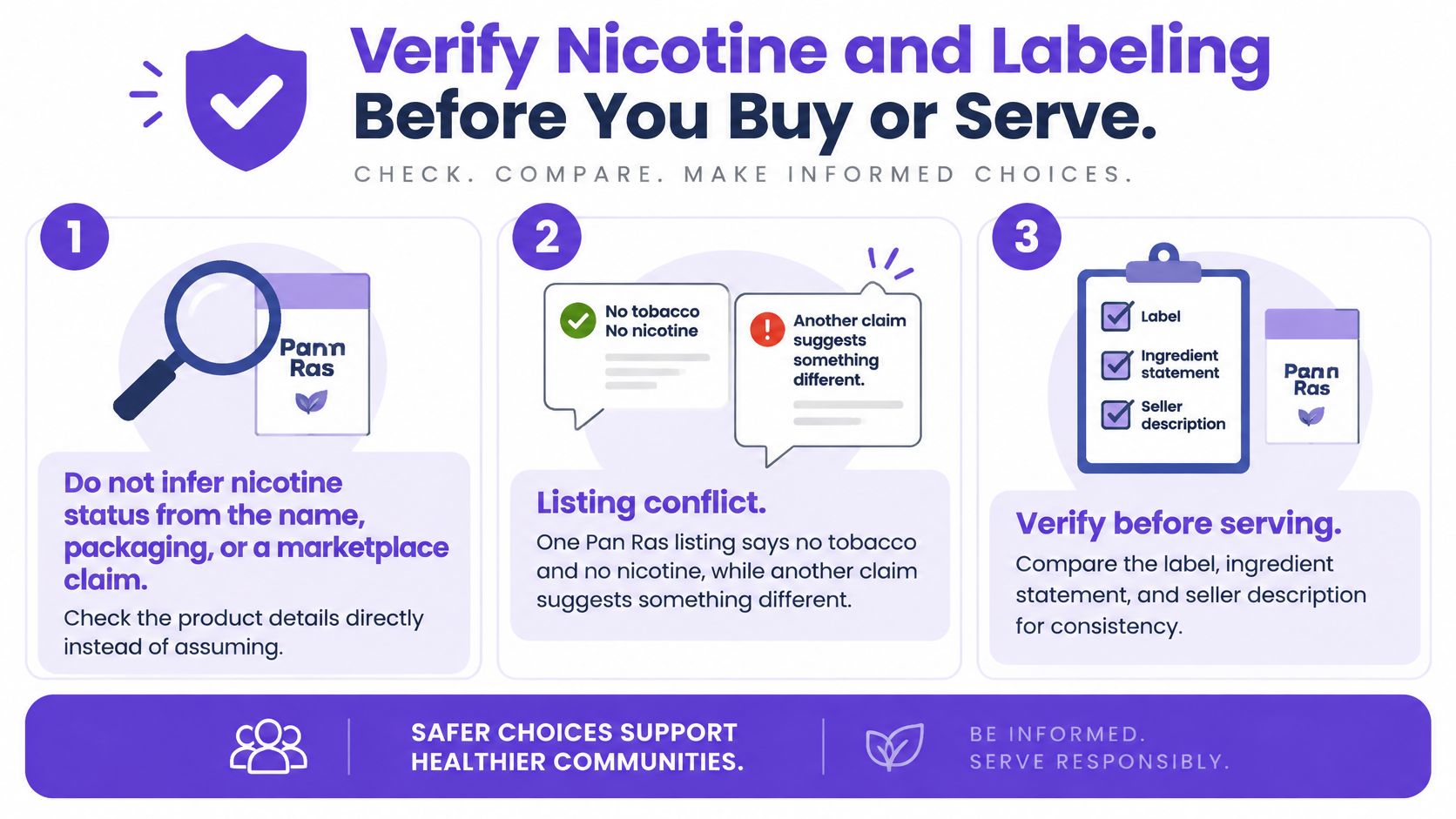
A practical verification checklist
- Match the exact SKU. Confirm the brand, flavor, product line, and package shown in the photographs match the item being supplied.
- Read the ingredient panel. Look for tobacco and any stated nicotine information. Don't treat a seller's category label as an ingredient declaration.
- Inspect the warning statement. If the warning and description conflict, request clear photographs of the actual stock.
- Confirm origin and intended market. Packaging intended for another country may not answer the labeling questions relevant to your purchase.
- Check applicable rules. For a U.S. business, verify federal requirements and the state and local rules governing flavored tobacco, importing, retail sales, and lounge service.
- Keep purchasing records. Retain the supplier's product identification and written clarification with your order documentation.
For retail or lounge use, don't describe an unresolved product as nicotine-free. Treat tobacco-based Pan Raas as a nicotine-containing product, and don't turn descriptions such as light or smooth into claims about nicotine exposure or safety.
Flavor and composition answer different questions. You can understand the paan profile perfectly and still need more information before buying, stocking, or serving a particular package.
What Pan Raas Tastes Like and Why It Stands Apart
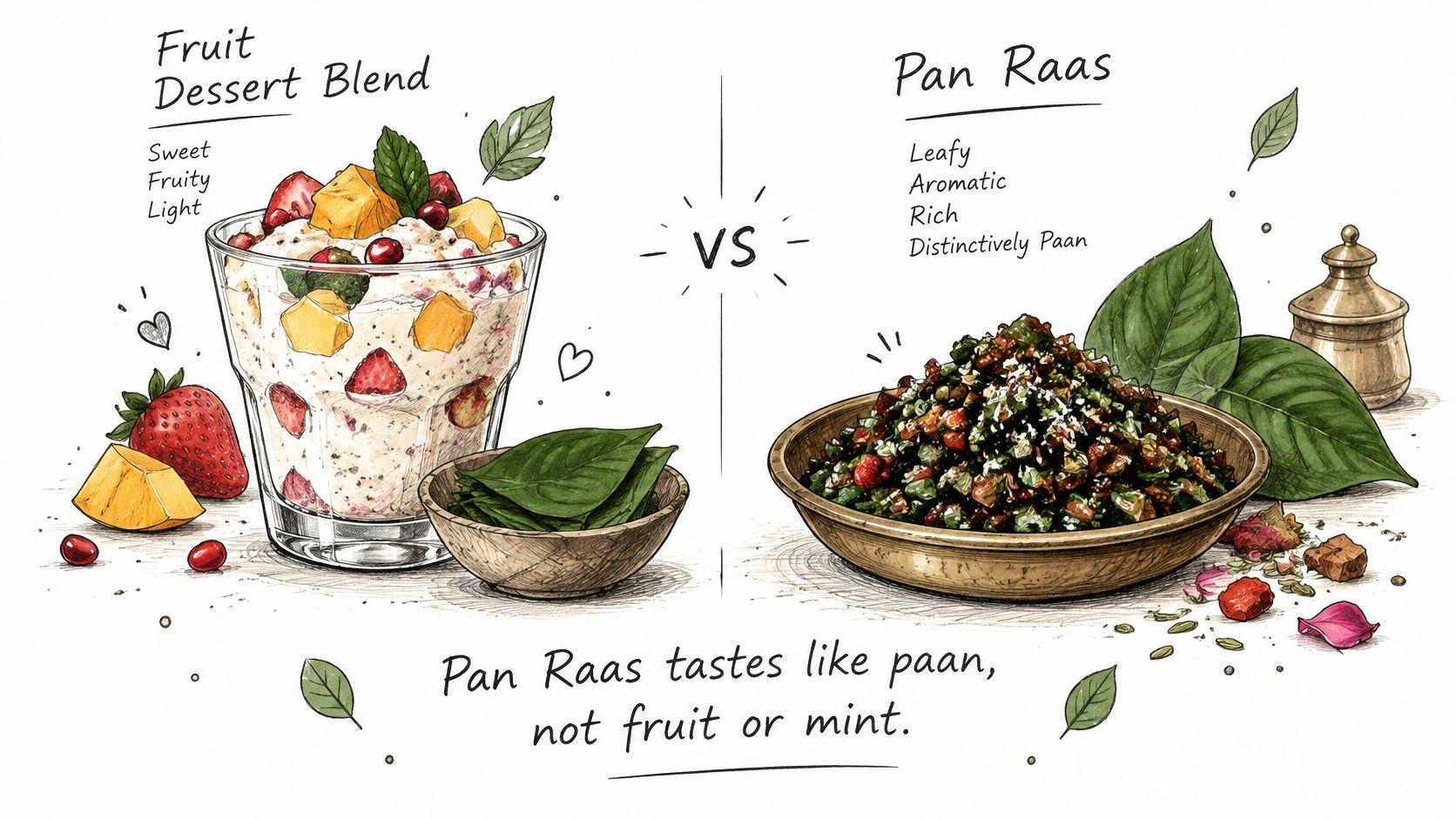
Pan Raas is built around paan, the betel-leaf preparation, rather than a fruit or mint flavor.
As a taste analogy, a fruit blend resembles a dessert, while Pan Raas is closer to an aromatic herbal digestif with a warm finish. That comparison describes its flavor direction, not a digestive benefit or a guarantee of cooling.
The contrast is easier to grasp visually.
The Hookah.com Afzal description identifies a blonde-leaf tobacco blend with molasses, glycerine, and natural or synthetic flavorings, centered on spicy betel leaf and warm spice. Some descriptions also name nutmeg, rose, cardamom, and fennel, but those notes shouldn't be treated as a complete ingredient declaration for every package.
Read the flavor in stages
Think of the tasting process as separate observations rather than a fixed timeline:
- The opening impression. Look for the green, spicy betel-leaf character. Herbal doesn't necessarily mean minty, and spice doesn't necessarily mean a chili-like burn.
- The supporting sweetness. Notice whether sweetness rounds out the herbs or dominates them. Molasses contributes to the blend's sweet character, but the description alone doesn't establish exactly how much sweetness comes from each ingredient.
- The finish. Pay attention to the lingering warm or aromatic notes. You might interpret them as floral, fennel-like, or cardamom-like without being able to identify a specific ingredient.
Molasses and glycerine help retain moisture and support aerosol formation. They're part of how the mixture behaves, not evidence that dense clouds indicate a safer session.
For a visual reference alongside your own observations, the video is embedded below.
Pan Raas may interest adults who find fruit-led blends too confectionery, or who already recognize paan's aromatic character. Familiarity with paan can provide a reference point, but a flavored tobacco product won't reproduce every preparation or family recipe.
For a useful tasting note, record the leading aroma, the sweetness, and the finish once the bowl has settled. Repeat that exercise on another occasion with the same equipment before deciding whether an unusual note belongs to the flavor or your preparation.
Pack, Heat and Choose a Setup for Pan Raas
Start with moderate, controlled heat rather than chasing cloud volume. Excess heat can dry the mixture and turn an aromatic flavor into a sharp one. The objective is a stable setup you can adjust, not the highest temperature your bowl can tolerate.
The Hookah Ministry Pan Raas specifications describe medium heat resistance or sensitivity, compatibility with several bowl styles, and seller-reported sessions of roughly 45 to 60 minutes. Those are operating benchmarks, not standardized laboratory results or guaranteed session lengths.
The preparation sequence below keeps the focus on texture, airflow, and adjustable heat.
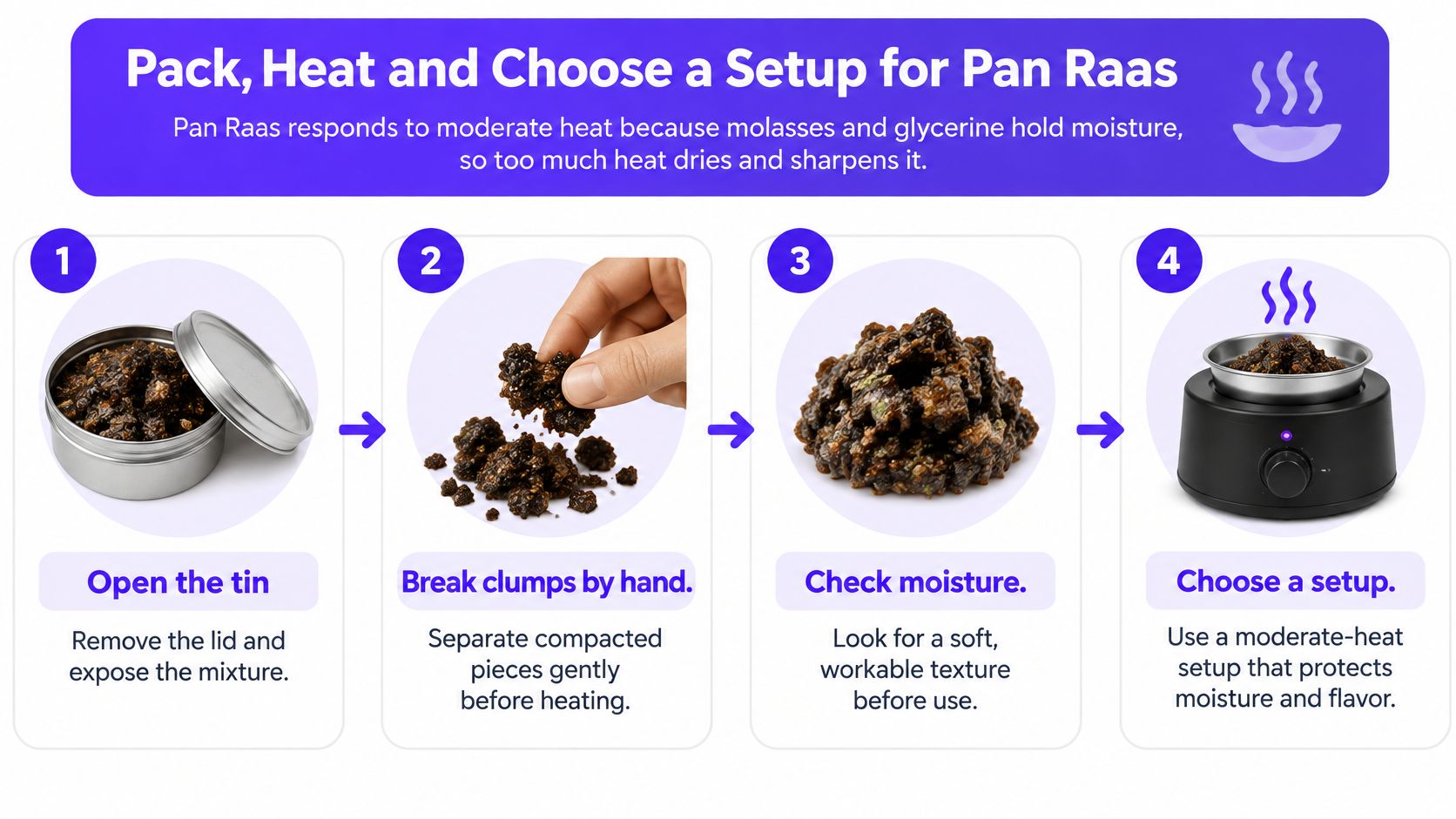
Prepare the leaf and preserve airflow
- Stir before taking a portion. Use a clean fork or tobacco tool to redistribute the mixture gently. Separate compacted clumps without shredding the leaf.
- Inspect its condition. It should be pliable and workable. Don't pre-soak it or add household liquids to compensate for a dried-out pack.
- Place the tobacco loosely. Distribute it evenly rather than pressing it into a dense plug. Keep the air passage clear and leave clearance beneath the foil or heat-management device.
- Fit the heat interface. Stretch foil taut and make evenly distributed small holes, avoiding tears. If you use a heat-management device, follow its fit and clearance instructions instead of assuming every bowl is compatible.
Packing to a consistent level helps you compare sessions, but don't fill tobacco into contact with the heated surface to reach the rim. Bowl geometry matters more than a universal fill line.
Check the hookah before lighting anything. A loose hose connection or poorly seated bowl can make the draw feel weak, and adding heat won't fix an air leak.
Add heat gradually and respond to the bowl
Fully light the charcoal on a suitable burner before placing it on the bowl. Handle it with tongs, keep it away from flammable surfaces, and use appropriate ventilation. Heat control is a preparation technique, not protection from the health risks of tobacco smoke or charcoal emissions.
Start conservatively for your bowl and coal size. Keep charcoal separated from the tobacco by foil or the intended device, and give the bowl time to respond before adding more.
If the draw becomes sharp, move the charcoal toward the edge or reduce the heat input. If the output seems weak, check seals and airflow first, then adjust heat gradually. Constantly changing coal position makes it difficult to tell which adjustment helped.
Hookah setups for Afzal Pan Raas
| Setup | Bowl type | Heat control | Best session fit |
|---|---|---|---|
| Clay bowl with foil | Clay, Egyptian style | Foil with a conservative coal load | Traditional preparation with attentive coal control |
| Silicone bowl with HMD | Silicone | Compatible heat-management device with moderate heat | Convenience-focused sessions and easy cleaning |
| Phunnel with foil | Phunnel | Taut foil with adjustable, moderate heat | Longer sessions where retaining liquid is useful |
| Vortex with HMD | Vortex | Compatible heat-management device with moderate heat | Longer sessions with attention to unobstructed airflow |
These are setup choices, not a ranking of safety or guaranteed performance. A phunnel or vortex can be useful when you want to retain the mixture's liquid, while a familiar clay bowl may make adjustments easier to interpret.
Don't assume silicone automatically makes a bowl forgiving. Device fit, bowl depth, charcoal size, and packing still determine how you should manage heat. Use the setup you can control consistently before buying equipment to solve an unconfirmed problem.
For comparison sessions, keep the bowl, hose arrangement, and preparation method unchanged. Clean components between flavors so residue doesn't interfere with your assessment. After packing, reseal the tobacco container promptly and store it away from sunlight and heat.
Mix Examples for Pan Raas and How to Test Them
Treat Pan Raas as seasoning when you want an accent, not as the main dish.
Its herbal, peppery character gives you a way to change a familiar blend without replacing it completely. The useful question isn't whether a pairing sounds impressive on a menu. It's whether you can still recognize the base flavor after adding Pan Raas.
There's no validated universal mixing ratio established by the available product descriptions. Use a small trial portion rather than treating an online recipe as a specification.
Choose a direction before changing the blend
- Light fruit flavors. A straightforward apple, grape, or similar fruit profile gives you a clear reference. Try a restrained addition and judge whether the herbal note complements the fruit or masks it.
- Dessert-style flavors. A creamy or confectionery base creates contrast with the herbal character. The test is whether you enjoy that contrast, not whether it makes the blend objectively better.
- Mint and cooling flavors. Start cautiously. Cooling sensations can make it harder to distinguish the paan character, particularly if the base is already intense.
- Spice-heavy flavors. A blend already built around cardamom, clove, or other pronounced spices may become crowded. Don't assume related flavor descriptions will automatically combine well.
Say you want to modify a familiar fruit bowl. Set aside a small portion of that fruit tobacco, add a visibly smaller amount of Pan Raas, and weigh both components before combining them. Record the actual weights so you can reproduce the result rather than relying on what a pinch looked like.
Keep the comparison fair
Change only the Pan Raas share during a mixing test. Switching the base flavor, bowl, packing method, and heat at the same time leaves you with no clear explanation for the result.
Write down whether the fruit remains recognizable, whether the finish becomes pleasantly herbal, and whether the spice overwhelms the rest. If the blend is too assertive, reduce the Pan Raas portion in a fresh test rather than trying to rescue it with several additional flavors.
There's also a straightforward purist option: use Pan Raas by itself. Understanding the standalone profile gives you a better reference for deciding what it contributes to a mixture.
Common Problems and How to Fix Them
Start with the symptom, not a new piece of equipment. A sharp draw, weak flavor, and a dry mixture don't necessarily have the same cause. Inspect the bowl and container before making a change.
Pan Raas symptoms, causes and fixes
| Symptom | Likely cause | Fix |
|---|---|---|
| Harsh, sharp hit early on | Excess heat or tobacco contacting the heated surface | Reduce heat; check clearance before the next preparation |
| Burnt or bitter taste | Overheating, a dried mixture, or flavor residue | Stop heating; inspect the tobacco and clean the bowl before retesting |
| Flavor fades unusually early | Heat imbalance, an air leak, or compromised tobacco | Check seals and tobacco condition before changing the coal load |
| Bowl dries sooner than expected | Excessive heat or an uneven, insufficient fill | Reduce heat and prepare an even fill with proper clearance |
| Spice overwhelms the blend | Pan Raas share is too high for your preference | Reduce its share in a fresh mixture |
| Flat, dry taste from an opened tin | Moisture loss during storage | Reseal properly and replace tobacco that has dried substantially |
These are working diagnoses, not proof of a manufacturing fault. Make an adjustment only when the condition you observe supports it. For example, moving charcoal won't restore moisture to tobacco that was already dry before packing.
Use a consistent order of checks
Check heat first when the bowl tastes sharp. Look at charcoal position and whether tobacco has touched the hot interface. Don't keep drawing on a burnt-tasting bowl to see whether it improves.
Check packing and airflow next. An overpacked bowl can restrict the draw, while an uneven fill can produce inconsistent heating. On the next preparation, correct the distribution without simultaneously changing the bowl and charcoal type.
Then assess the mixture itself. If a standalone bowl tastes balanced but a fruit mixture seems aggressively spicy, the sensible adjustment is the blend composition, not an entirely different heating system.
Finally, inspect storage and product condition. Compare the tobacco's texture with how it felt when opened, and examine the closure for trapped leaf or an incomplete seal. Don't add water, flavor extracts, or improvised sweeteners as a repair.
You may notice a response to a heat adjustment during the session, but that doesn't mean every fault can be corrected immediately. A burnt portion or badly dried pack needs a fresh start, not repeated attempts to compensate.
Stop adjusting when the product condition is the problem. Replace a compromised pack rather than using extra heat to chase flavor that's no longer there.
If you suspect contamination or the contents don't match the package description, don't use the product. Keep the packaging and purchase details so the seller can identify the item.
Confirm Your Size and Setup Before You Order
Choose the smallest pack that answers your current question. If you're unsure whether you like betel-leaf flavors, a trial purchase makes more sense than optimizing the bulk price. If you already know the profile, choose a quantity that fits your actual turnover and storage habits.
Apply the same restraint to hardware. A familiar bowl with controllable heat is a better starting point than an unfamiliar device bought on the promise of a longer session. Choose a phunnel or vortex when liquid retention fits your preparation style, or a compatible silicone-and-HMD combination when convenience matters.
Make the purchase specific
- Confirm product identity. Match the exact SKU, product line, flavor, and net pack size.
- Resolve composition questions. Read the ingredient and warning panels, and pause if they contradict the description.
- Check what the price buys. Establish the unit count before comparing cost per gram.
- Confirm purchasing eligibility. Verify the intended market and applicable local flavored-tobacco rules before ordering for personal use or business service.
For a lounge, record the approved product identity so staff don't substitute a similarly named variant without checking it. For home use, keep your first preparation simple enough that you can distinguish personal taste from a setup problem.
At Shop Hookah Tobacco, our pricing disclaimer notes that prices may change and final pricing is confirmed by email before order completion. Check the final quotation rather than relying on an older displayed price.
Test the flavor in a small pack before committing to a larger one.
We offer hookah tobacco, bowls, charcoal, heat-management devices, and replacement parts for home and business buyers. Visit Shop Hookah Tobacco to compare Afzal Pan Raas listings and the equipment for your preferred setup, then confirm pack details, availability, and final pricing before placing your order.