






















Quick light coals ignite with a lighter but produce more carbon monoxide. Learn how they work, how they compare to natural coals, and how to use them safely.
“Just light it, wait until it turns gray, and put it on the bowl” is incomplete advice about quick light coals. It treats ignition as the only decision that matters, when the place you light the charcoal, the condition of the coal, and the air in the room matter too.
Quick light coals solve a real problem: getting a hookah ready without a dedicated charcoal burner. But faster setup doesn't mean lower emissions, and a coal that looks ready can still produce carbon monoxide. The useful question isn't whether these coals are universally good or bad. It's whether their convenience fits your setup and whether you can manage the responsibilities that come with burning charcoal.
Table of Contents
What Quick Light Coals Are and How They Ignite
A quick light coal is defined by how it starts burning, not by a universal shape, tablet size, or recipe. Manufacturers can use different formulations while aiming for the same practical result: charcoal that catches from a small flame without sustained heating on a burner.
The important ingredient is an oxidizer or ignition accelerant, incorporated into the charcoal or applied to its surface. Nitrate-based compounds, particularly potassium nitrate, are common examples. The exact formulation varies, so the product label matters more than assumptions based on appearance.
A built-in starting aid
Think of the design as a matchbook striker built into the fuel. That's an analogy, not a literal description of the ingredients: the tablet carries a starting aid instead of depending entirely on an outside heat source to get going.
The distinction between starting combustion and continuing combustion helps explain what you see. The initial ignition reaction gets the charcoal burning. After that reaction passes, the charcoal continues providing heat for the bowl.
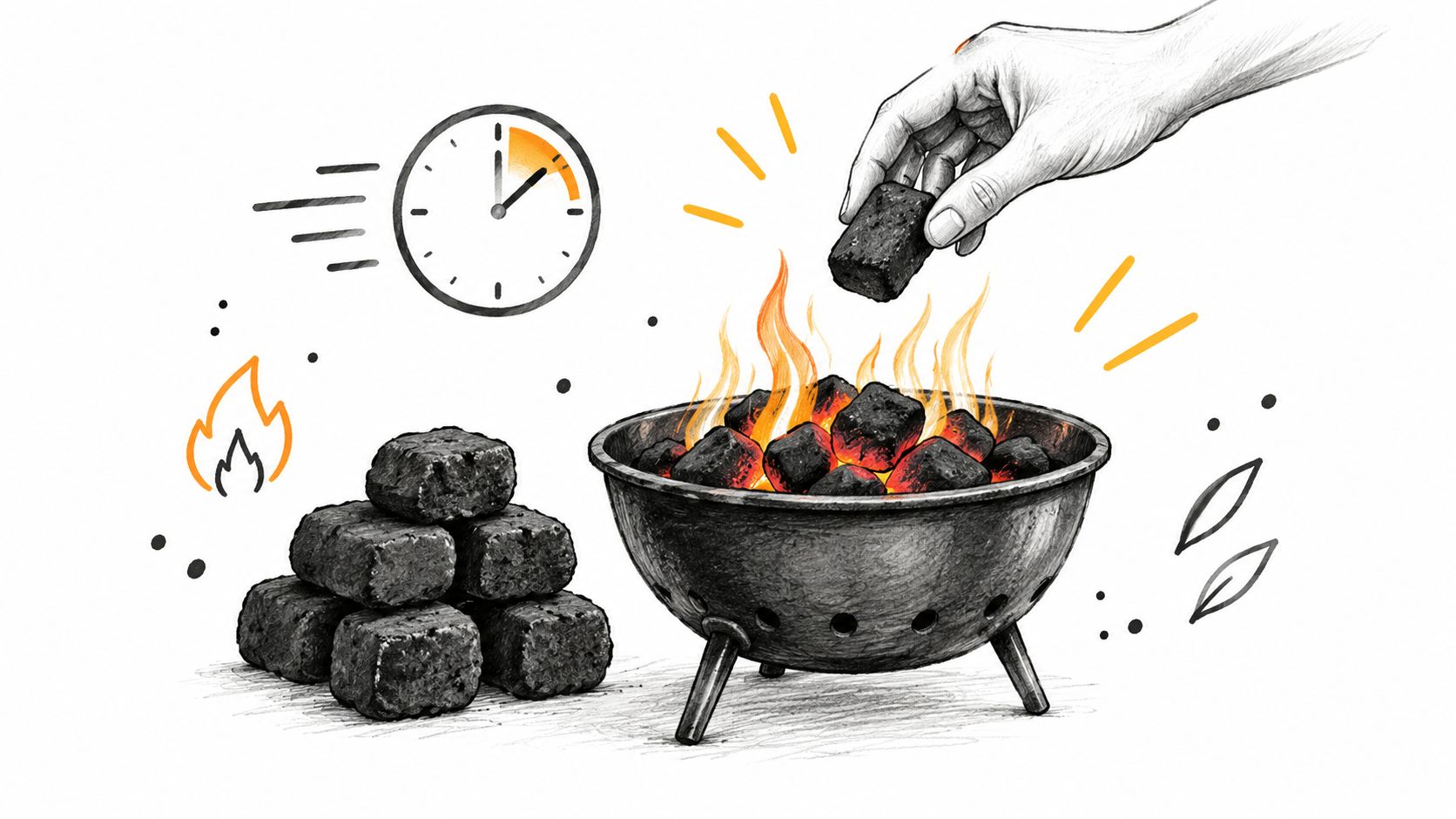
This image illustrates charcoal handling, rather than a hookah-specific lighting procedure.
What the label actually tells you
“Quick light” describes an ignition feature. It doesn't tell you everything about how a particular product should be handled.
- Check the formulation information: Don't assume every brand uses an identical ignition mixture.
- Read the intended-use instructions: A charcoal photograph or familiar tablet shape isn't a substitute for the packaging.
- Separate ignition from readiness: A reaction spreading across the surface means lighting has started, not necessarily that the coal belongs on your bowl.
The burner-free design explains the format's appeal for portable setups, casual home use, hospitality service, and retail multipacks. It removes a piece of preparation equipment from the process. It doesn't remove the need to choose an appropriate lighting location or understand what happens after the flame catches.
Quick Light Coals Versus Natural Coals
The clearest comparison starts with your preparation area. Quick light coals can be ignited with an ordinary lighter; natural coconut charcoal generally needs an electric burner, coil stove, or comparable heat source.
For timing context, the home-hookah guide describes quick-light ignition as generally taking less than 60 seconds, with roughly 20–30 seconds for independent glowing in one description, compared with about 6–15 minutes of external heating for natural charcoal and an approximate 30-minute burn duration for a typical quick-light coal.
Those are preparation and operating estimates, not a universal countdown. Independent glowing describes a coal sustaining combustion. It doesn't certify that every surface is fully ignited or that the surrounding air is safe.
Quick Light Versus Natural Coals at a Glance
| Factor | Quick Light Coals | Natural Coconut Charcoal |
|---|---|---|
| Ignition tool | Ordinary lighter | Electric burner, coil stove, or comparable heat source |
| Time to glow | Rapid ignition with a small flame | Sustained external heating |
| Burn window | Generally shorter | Often longer, depending on the product |
| Preparation priority | Allow the ignition reaction to finish | Allow sufficient heating throughout |
| Equipment trade-off | Less starting equipment | Requires a suitable heating setup |
The convenience advantage is easy to understand. If you don't have a burner available, the quick-light format changes whether you can prepare charcoal at all. If you already have a suitable burner and a settled routine, that advantage may matter much less.
Compare the whole session, not just the start
The shorter operating window is the trade-off people can underestimate. A faster beginning doesn't automatically mean less work over an entire evening, especially if your preferred session outlasts the useful heat from the initial charcoal.
Consider two hypothetical home setups. Someone arranging an occasional session without dedicated equipment may put substantial value on simple ignition. Someone with an established preparation station may care more about maintaining the session without interrupting it for replacement charcoal.
Practical rule: Compare the preparation you save with the handling you may need later.
Neither comparison establishes that a charcoal type is harmless. “Natural” describes the fuel category, not a guarantee about indoor air quality. Likewise, “quick light” describes convenience, not a reduced-risk version of hookah use.
For a home session, start with the equipment and lighting space you have. Then consider session length and replacement handling, rather than choosing solely by the fastest advertised start.
Pros and Cons for Home and Lounge Use
At home, an extra preparation task may be a minor inconvenience. In a lounge, the same task becomes something staff must perform consistently while serving guests. That difference changes how you should weigh quick light coals.
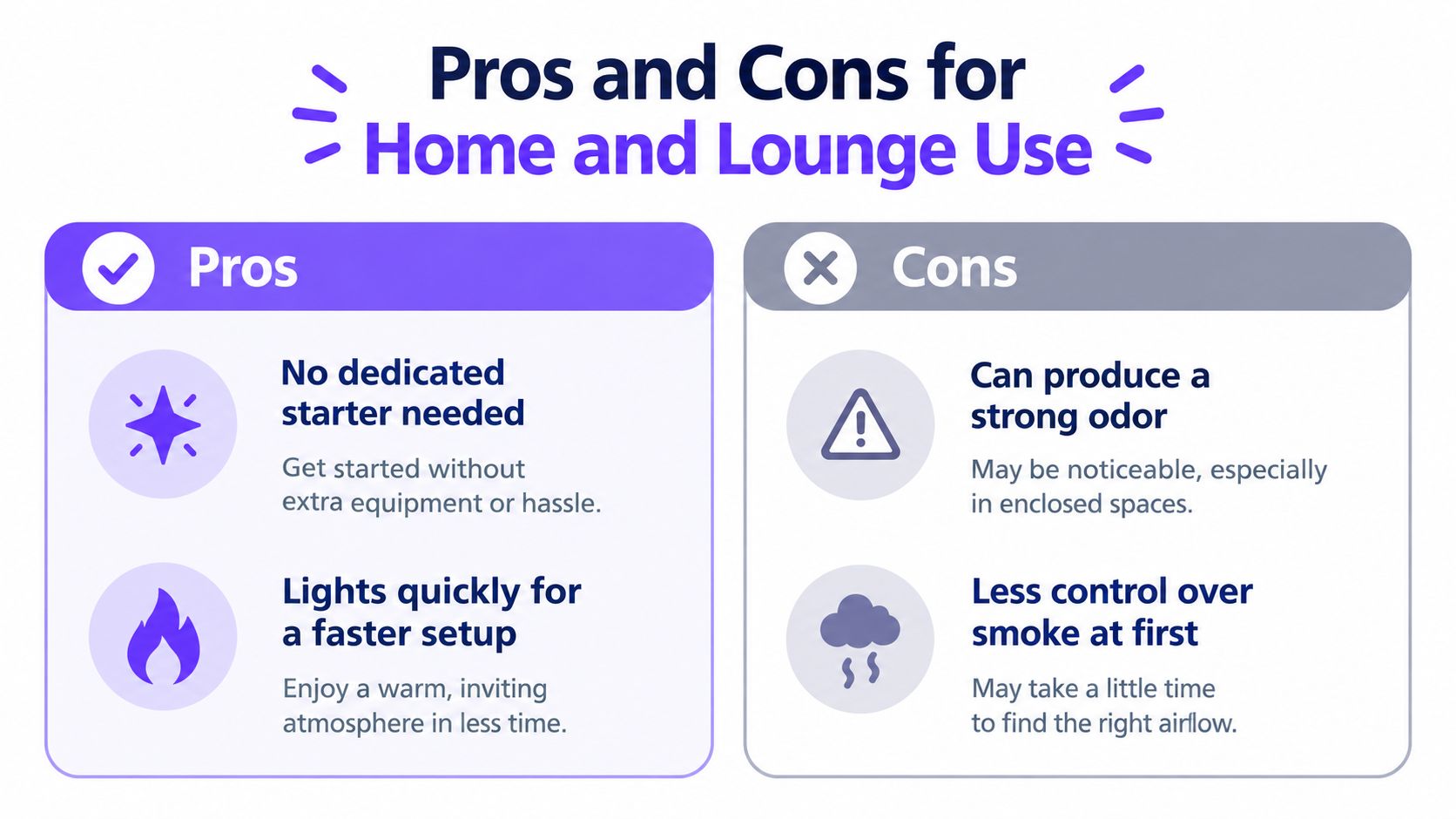
The visual below summarizes familiar convenience and ignition-stage concerns. Treat odor and visible smoke as handling considerations, not measurements of carbon-monoxide exposure.
Where convenience has practical value
The main advantage is straightforward: you don't need to organize a dedicated burner. For an occasional home host, that can simplify the equipment involved. For a retailer, a burner-free format gives customers a distinct option rather than another interchangeable box of charcoal.
Hospitality buyers should distinguish easy to start from easy to manage. A product can simplify ignition equipment while still requiring a designated lighting area, trained handling, and a plan for spent coals. Those responsibilities belong in the purchasing decision, not just in staff instructions after delivery.
- Occasional home use: Judge whether the simpler setup helps your routine.
- Portable preparation: Choose the lighting location before treating portability as an advantage.
- Repeated lounge service: Consider replacement work and staff supervision alongside startup convenience.
Where the drawbacks become important
The shorter operating window described above matters differently in different settings. During a relaxed evening at home, you might accept an interruption. In a lounge serving overlapping sessions, replacement handling becomes an operational task that deserves a consistent procedure.
Full ignition is another essential requirement. A rushed host or busy employee shouldn't interpret a fast-starting coal as permission to skip readiness checks. The measured early-session emissions discussed below add another reason not to judge the product on preparation speed alone.
This accompanying video offers another format for considering the equipment and handling involved.
My practical recommendation is to judge the complete workflow. If avoiding a burner is your main constraint and you have an appropriate handling setup, quick-light convenience may be useful. If your priority is extended, repeated service, give more weight to the work that happens after ignition.
Carbon Monoxide and Health Effects
The most useful evidence isn't whether someone describes a coal as clean-burning. It's what researchers measured under controlled conditions and what those measurements can tell us.
In a controlled Duke University study published in 2015, researchers tested a 9–10 gram briquette, recording carbon monoxide and temperature every three minutes for 90 minutes; mean carbon-monoxide concentration was 3,728 ± 2,028 ppm for quick-light charcoal versus 1,730 ± 501 ppm for natural charcoal, with a statistically significant difference of p = 0.016, while quick-light charcoal peaked at 6,424 ± 1,042 ppm after 27 minutes, compared with natural charcoal's peak of 2,627 ± 422 ppm after approximately six minutes, and sustained high production for roughly 20–30 minutes.
That's a substantial amount of information, but the central finding is simple: the charcoal types had different emissions timelines. Quick-light charcoal didn't merely produce a brief startup event and then immediately settle into the natural-charcoal pattern.
What the measurements mean
These were concentrations measured in an experimental setup. They aren't predictions of the concentration in your living room, a direct measurement of someone's absorbed dose, or a universal result for every commercial product.
Room exposure involves additional conditions, including the amount of charcoal burning, room size, ventilation, and session duration. You can't turn the laboratory reading into a household “safe time” by watching a clock.
The end of visible ignition is a handling milestone, not proof that carbon-monoxide production has ended.
The timing also challenges a common assumption: that the only important exposure happens while the lighter is touching the coal. In the experiment, increased production continued into the period when someone could already be using the hookah.
Who needs to be considered
The World Health Organization's tobacco-control database summarizes this experiment and notes that high charcoal emissions may contribute to severe carbon-monoxide poisoning admissions. That makes the findings relevant beyond comfort, odor, or session quality.
- Smokers: Their decisions include both charcoal preparation and continued use.
- Employees: Their work may involve lighting, carrying, replacing, and disposing of charcoal.
- Guests and other occupants: They don't have to use the hookah to share its indoor environment.
Natural charcoal's lower result in this comparison shouldn't be read as a clean bill of health. The responsible conclusion is narrower: charcoal choice affects emissions, but neither product category removes the need to manage exposure.
Best Practices for Lighting and Using Quick Light Coals
Use a sequence of checks, not a fixed stopwatch rule. The ignition estimates above describe how quickly a coal can start sustaining combustion; they don't establish a universally safe placement time.
The WHO tobacco-control database's summary of the charcoal comparison also highlights an important distinction: natural charcoal reached a higher average temperature despite quick-light charcoal producing more carbon monoxide. Hotter isn't a reliable shortcut for judging the greater CO hazard.
Follow the ignition sequence
- Choose the location before lighting. Prefer outdoors, with an appropriate heat-safe handling area. A highly ventilated preparation space requires deliberate planning, not an assumption that a nearby opening is sufficient.
- Start the coal according to its instructions. Use suitable tongs and a heat-safe support. Don't hold charcoal in your fingers or improvise a support from combustible material.
- Wait through the ignition reaction. Don't place the coal on the hookah while the chemical lighting reaction or visible smoke continues. Don't draw through the hookah to help a partially ignited coal catch.
- Check the coal before transferring it. Look for complete ignition consistent with the manufacturer's directions, rather than relying on elapsed time alone. If it remains partially lit, keep it in the designated lighting area.
- Continue treating it as burning charcoal. Complete ignition doesn't make the coal emission-free. Maintain the room precautions required for continued use.
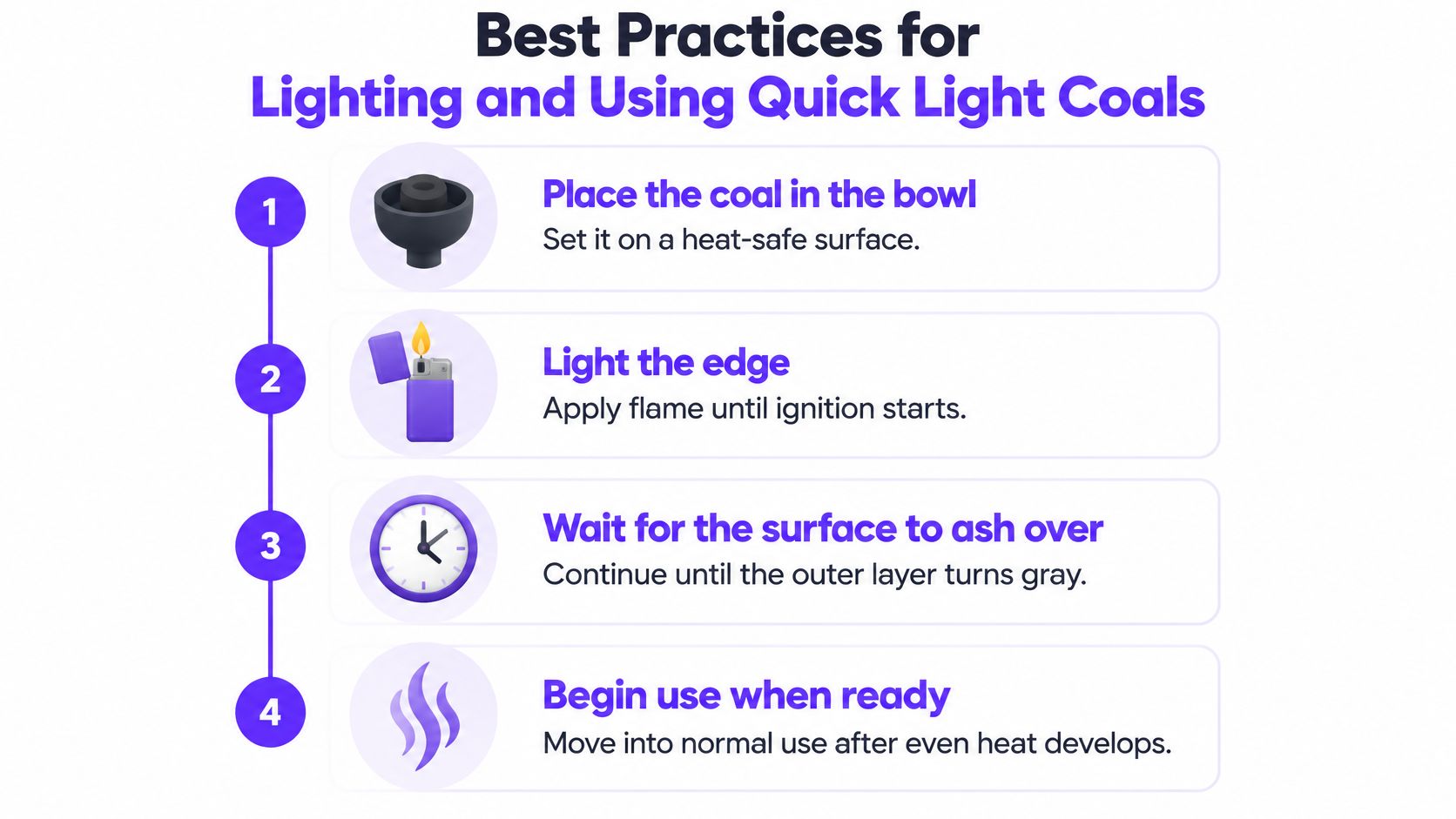
The checklist image is a visual aid, not permission to ignite charcoal on an indoor hookah bowl. Follow the location and readiness precautions above rather than interpreting its placement illustration at face value.
Answer the common readiness questions
How long should you wait? There isn't a single precise duration established by these sources for every product. Wait until the ignition reaction and visible smoke have ended, and confirm full ignition according to the packaging.
Does visible smoke mean the coal is ready? No. During lighting, it's a reason to keep waiting and keep the coal away from the session. The absence of smoke, however, isn't a carbon-monoxide test.
What should you do with a partially lit coal? Keep it under supervision on its appropriate heat-safe support. Don't carry a chemically igniting coal into an enclosed room or place it on the bowl hoping normal use will finish the job.
Readiness check: Don't smoke through the ignition stage, and don't confuse a completed ignition reaction with safe indoor air.
Flavor is a separate question. These sources don't establish a universal flavor ranking, so treat taste preferences as subjective rather than evidence of safety.
Ventilation and Venue Safety Responsibilities
A household carbon-monoxide alarm is a backup warning device, not a system that makes burning charcoal indoors safe. Opening a window is also not proof that a room has adequate air exchange.
The Illinois public-health fact sheet on hookah lounges describes carbon-monoxide accumulation in poorly ventilated venues throughout the year and reports an indoor reading of 130 ppm where an employee became ill, compared with OSHA's 50 ppm permissible exposure limit.
That workplace limit isn't a target for a home session or a universal clearance threshold. The example shows why managers must consider the room, not just the person operating a hookah.
Control the source before relying on a warning
Source control means changing the activity that produces the pollutant. In this setting, that includes limiting simultaneously burning charcoal and moving ignition outside. Ventilation addresses the air exchange needed while the activity continues.
An alarm serves a different purpose: it warns when its triggering conditions are met. It doesn't remove charcoal, improve mechanical ventilation, or decide how many sessions a venue can responsibly operate.
There's no universal window-opening rule or ventilation rate established by the evidence here. A venue needs a qualified assessment for its actual layout and operating load rather than a guess based on whether the room feels fresh.
Put responsibilities in writing
A useful operating checklist gives staff actions they can follow and managers something they can review.
- CO monitoring: Establish an appropriate monitoring plan and make responsibility for responding explicit.
- Ventilation procedures: Document operation and maintenance of mechanical air exchange, including what happens if it fails.
- Staff training: Cover lighting, transport, replacement, and the instruction never to bring actively igniting charcoal into enclosed service areas.
- Storage and disposal: Follow product and local requirements, designate suitable locations, and account for charcoal that may still be burning.
- Emergency escalation: Stop sessions when symptoms or alarms indicate a possible problem, move people to fresh air, and contact emergency services when poisoning is suspected.
Workers and guests deserve consideration even when they aren't smoking. A staff member moving between tables may spend an extended period in the shared environment, so customer behavior alone can't define the safety plan.
For a home host, the scale is smaller but the distinction remains: monitoring supports precautions; it doesn't replace them. Faster ignition is never evidence that a room is safe.
Choosing Quick Light Coals and Your Next Step
Choose charcoal by matching it to your preparation space and service routine, not by brand loyalty alone. Quick light coals offer a specific convenience, but that feature should earn its place in your setup.
Start with whether you can handle the ignition process appropriately. Then consider the session you intend to run and who else will share the space. If the necessary conditions aren't available, postponing the session is a more responsible choice than trying to compensate with a different label.
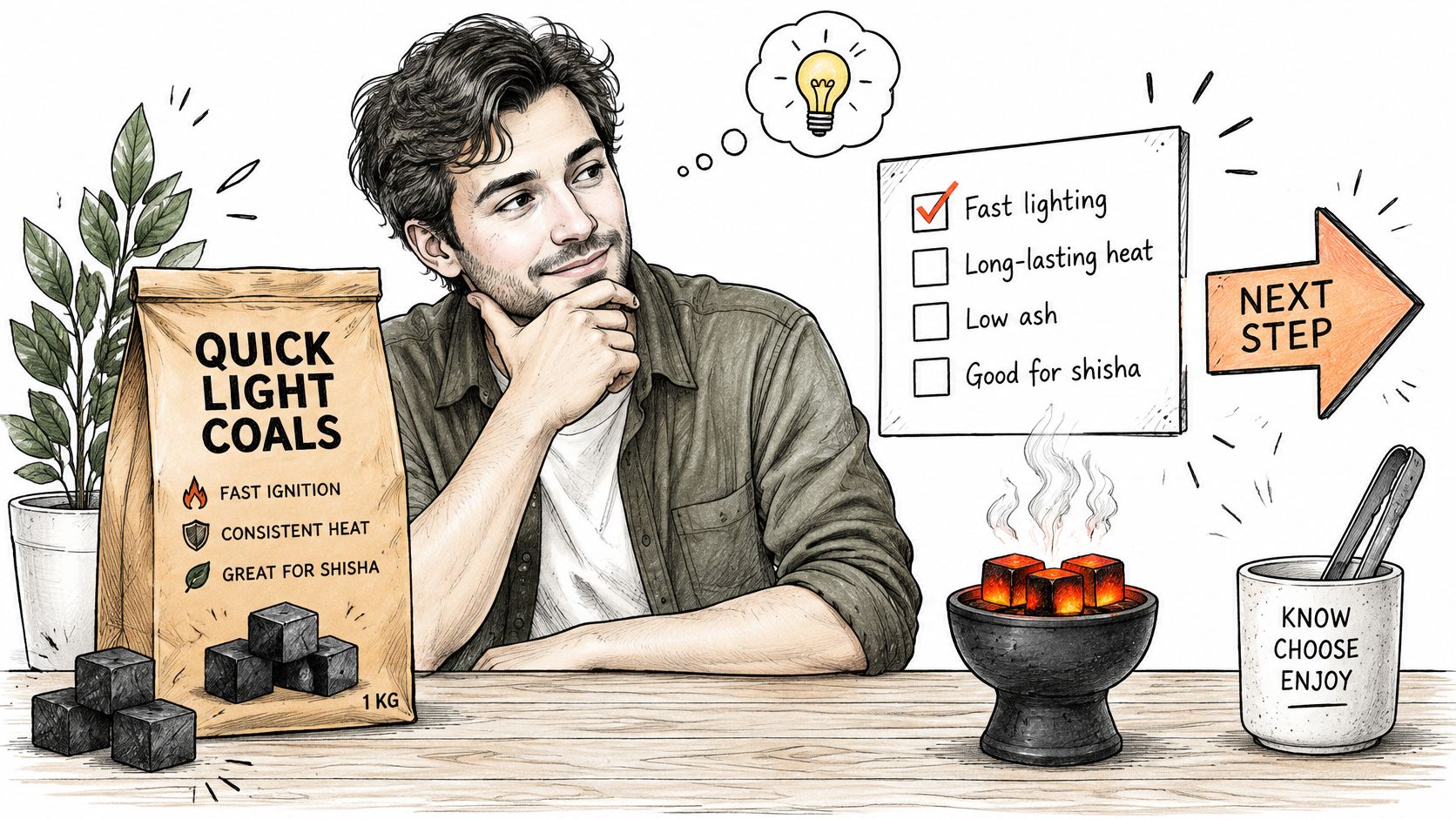
Use a practical buying checklist
- Lighting location: Have an appropriate place ready before buying for convenience.
- Session length: Decide whether the operating window suits your plans or creates unwanted replacement work.
- Equipment need: Be clear about whether avoiding a burner solves a problem for you.
- Other occupants: Account for guests and employees, not just your own preferences.
- Product information: Confirm the listed charcoal type, instructions, and compatibility with your intended setup.
This decision is about the preparation process as much as the package.
Read the product page before ordering
When comparing independent retailers or the publisher's storefront, distinguish the brand name from the listed charcoal type. The publisher organizes its charcoal catalog by brand and type, including Deezer, Starbuzz, Three Kings, Coco Fuego, and Golden River, and carries accessories such as tongs, heat management devices, foil, and bowls.
Check each product page rather than assuming every item under a familiar brand uses the same ignition method. Review availability, use the wishlist to keep track of items, and confirm final pricing by email before completing an order.
Your next step should be a short equipment-and-location check before a purchase. Identify where lighting will happen, which handling tools you need, and whether the room arrangements are appropriate. Then compare products against those answers instead of letting ignition speed make the decision for you.
For a charcoal catalog organized by brand and type, plus tongs, bowls, foil, and heat management accessories, visit Shop Hookah Tobacco. Compare each product's listed details with your lighting setup and session needs, check availability, and confirm final pricing by email before ordering.