






























Master smoking accessories wholesale sourcing. Learn product categories, compatibility, bulk ordering, pricing negotiation, and compliance for your business.
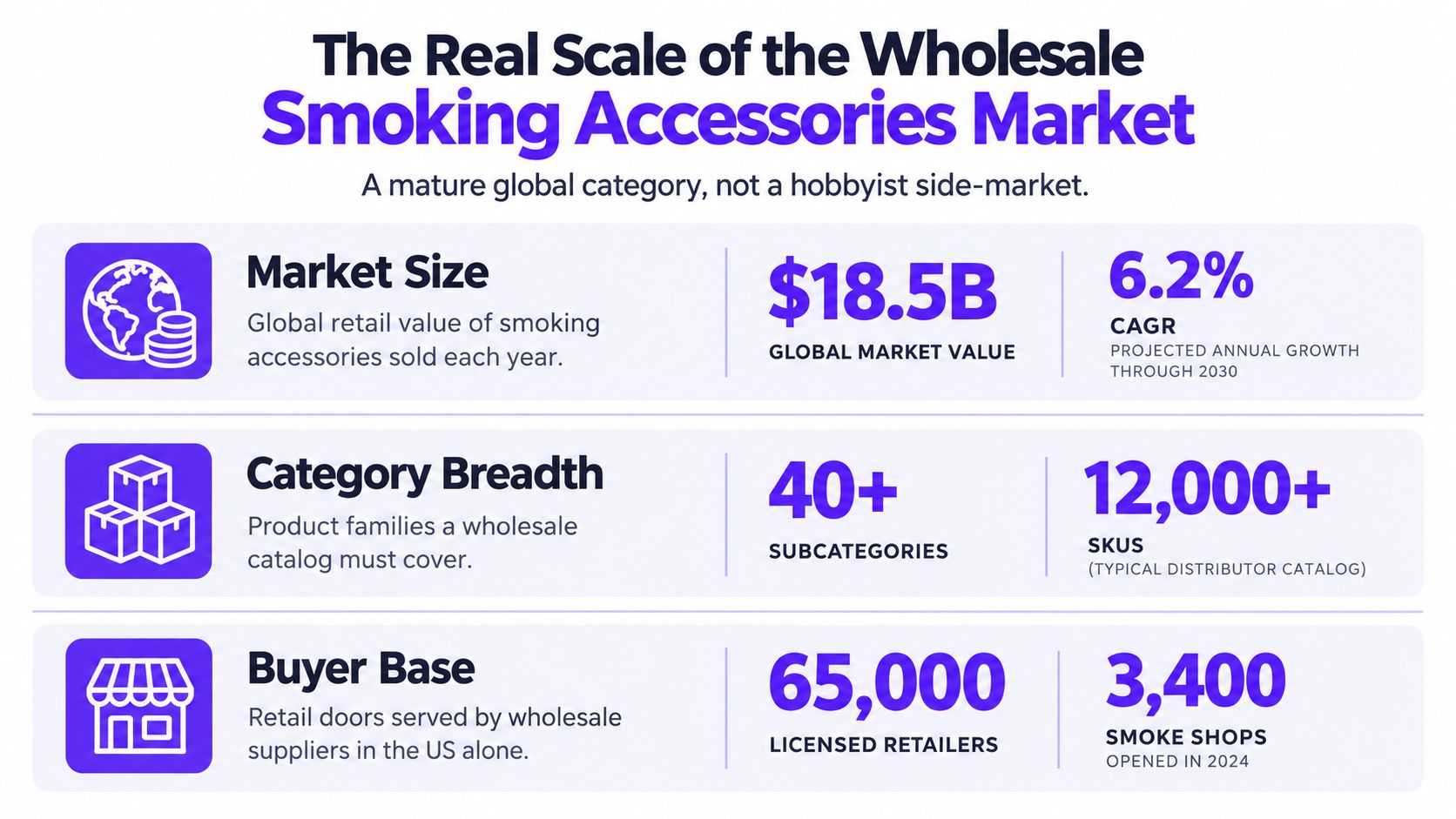
The wholesale smoking accessory market is valued at $3.48 billion in 2025, with North America alone accounting for more than a third of that value. That makes smoking accessories wholesale a serious distribution business, not a small side market for novelty products.
New buyers often make the same mistake. They compare supplier unit prices, fill a cart with attractive SKUs, and discover later that case packs, freight, documentation, and slow-moving inventory have erased the margin. A profitable catalog starts somewhere else: repeat demand, disciplined ordering, and verifiable compliance.
You need products that sell across multiple shopping missions. Papers, filters, and lighters support replenishment. Grinders, trays, storage jars, and hookah hardware add durability and margin. The right assortment also depends on your channel. A smoke shop, hookah lounge, convenience store, and hospitality buyer shouldn't use the same purchasing plan.
Table of Contents
How Large Is the Wholesale Smoking Accessories Market
The specific wholesale channel reached an estimated $3.48 billion in 2025, up from $3.36 billion in 2024, and is projected to approach $5.0 billion by 2035, according to the wholesale smoking accessory market forecast. That scale reflects a B2B market with its own purchasing cycles, regional supply chains, case-pack economics, and replenishment patterns. A distributor is managing a supply operation, not just passing retail demand back to a factory.
North America represented $1.25 billion in 2024 in the same wholesale-focused estimate, placing the region at more than one-third of global wholesale value for that year. Europe and Asia-Pacific also represent major regional markets, with Europe at 27% and Asia-Pacific at 24% of market share in one 2025 outlook, as reported in this global smoking accessories market analysis.
Wholesale is bigger than a single product niche
The broad global smoking accessories market has been estimated at $10.6 billion in 2025 and is projected to reach $20.5 billion by 2035, implying a 6.8% compound annual growth rate from 2026 through 2035, according to the industry market outlook from Global Market Insights. Those figures include retail activity, but they show the size of the product ecosystem served by wholesalers.
The category contains several revenue pools. Papers and filters represented about 38.5% of global revenue in 2025 in one industry forecast. The lighters segment alone is projected at $3.5 billion in 2025, rising to $6.8 billion by 2035, according to the same market coverage. Consumables can support frequent reorders, while hardware gives retailers higher-value products and replacement opportunities.
That mix also creates the main purchasing trap. A supplier may offer an attractive unit price, but the case pack or MOQ can force a buyer to purchase more than one store can sell. Before approving an order, calculate landed cost per unit, storage needs, and the time required to sell the full case. Then confirm that the product documentation supports applicable REACH, RoHS, or FDA requirements for the destination and product type.
Practical rule: Treat wholesale demand as a portfolio of replenishment categories, with compliance and case-pack fit checked before margin.
A new distributor should not represent every accessory. Choose a customer base, then build depth around its buying pattern. A lounge needs hookah parts and service items. A smoke shop needs add-ons around papers, lighters, grinders, and storage. A convenience-led account needs fast-moving products that display easily and require little staff explanation.
Market size gives you room to specialize. It does not justify careless expansion. Scale comes from reliable reorders, accurate stock planning, workable MOQs, and a catalog that fits the retail door.
Which Accessory Categories Drive Margin and Repeat Sales
The strongest assortment combines products that turn quickly with products that stay on the shelf at a healthier margin. Those roles aren't interchangeable. A paper or filter may bring repeat purchasing, while a grinder, tray, jar, or torch gives the retailer a more durable selling opportunity.
Recent wholesale guidance identifies grinders, lighters and torches, rolling trays, scales, storage jars, and display items as durable winners rather than one category controlling all demand, as outlined in this 2026 smoke shop accessory sourcing guide. Build around that pattern instead of betting the opening order on a single product family.
Match the product to its job
| Product group | Commercial role | Buying advice |
|---|---|---|
| Papers and filters | Frequent replenishment and checkout attachment | Carry dependable core options before adding specialty designs |
| Lighters and torches | Practical repeat demand with impulse potential | Separate everyday lighters from premium or high-heat hardware |
| Grinders | Durable accessory with upgrade potential | Stock a proven core range, then add premium materials or finishes |
| Rolling trays | Giftable, visual, and easy to merchandise | Use several sizes and materials without overextending the range |
| Storage jars and cases | Durable organization and presentation | Prioritize seal quality, construction, and clear product use |
| Scales | Functional hardware for a defined customer | Verify accuracy, packaging, and channel suitability before expanding |
| Hookah parts | Replacement demand and setup compatibility | Organize by function and compatibility, not by appearance alone |
Hookah accessories deserve a separate buying decision. Recent market coverage points to hookah and water pipe accessories as a faster-growing end-use segment, while traditional ashtrays and cigarette cases lag, as discussed in this smoke shop product market overview. For lounges and hospitality accounts, HMDs, charcoal tools, hoses, bases, disposable mouth tips, and tongs can support both setup sales and replacement demand.
Don't confuse breadth with strength. A catalog with dozens of weak variations creates inventory noise, complicates reordering, and makes staff training harder. A better approach is depth in a few proven subcategories plus premium tiers. For example, choose a reliable grinder line, a visually distinct premium option, and a practical entry product instead of buying every shape from an untested supplier.
A balanced display should also move customers between price levels. Put low-ticket items near checkout, place durable products where staff can explain their use, and group compatible accessories together. A rolling tray beside storage, or an HMD beside a compatible hookah setup, creates a more coherent buying decision than a random wall of isolated SKUs.
Premiumization matters most in mature markets, where basic commodity accessories face pressure from convenience-led competition. You don't need the most expensive product in every group. You need a credible upgrade path that gives retailers a reason to carry something beyond the lowest available price.
How to Order in Bulk Without Losing Money on Hidden Costs
Unit price is the easiest figure to compare and one of the weakest measures of profitability. Wholesale smoking accessories may arrive as retail packs, inner cartons, master cases, or mixed lots. Comparing one supplier's per-piece quote with another supplier's per-case quote produces a misleading result because the commercial offers are structured differently.
Start with the case pack. One product specification lists 2 wraps per retail pack and 20 packs per wholesale case, as shown in this loose-leaf wrap product specification. Confirm how many retail packs and sellable units each case contains before judging freight, storage requirements, display capacity, or reorder timing.
Build the landed-cost calculation first
Record these figures for every item:
- Supplier cost. Use the price for the quantity you plan to purchase. Ignore a promotional tier that requires more units than your opening order or realistic reorder plan.
- Case conversion. Convert master cases into retail packs and sellable units. Account for damaged or unusable stock only when your receiving records support a realistic allowance.
- Freight and handling. Include shipping, brokerage, duties where applicable, receiving labor, warehouse charges, repacking, and other order-specific fees.
- Landed cost per sellable unit. Divide the complete order cost by the units you can sell, not the units listed on the purchase order.
- Reorder fit. Compare the quantity with observed shelf turn and the time required to sell the stock.
Use this formula:
Landed cost per sellable unit = total product, freight, handling, and import costs ÷ sellable units received
Then test the order against store conditions. A cheap case becomes expensive when it occupies storage for too long, ties up working capital, or requires markdowns. A smaller shipment may carry a higher freight cost per unit, yet remain the better purchase when demand is uncertain and the item can be replenished quickly.
Treat MOQ as a cash-flow decision
Marketplace listings for cigarette cases commonly begin at modest quantities, while larger orders may qualify for deeper discounts. Treat the supplier's minimum order quantity as an inventory-risk decision, not merely a pricing threshold. The relevant question is whether the account can sell the stock before the cash is needed elsewhere.
Before accepting a larger discount, ask:
- Can the product sell through at that quantity? Use reorder history where available, not excitement during a supplier presentation.
- Does the packaging fit the channel? Packaging suited to a large smoke shop may move slowly in a convenience store.
- Can you reorder the winning variant? Confirm that the supplier can maintain the colors, sizes, materials, and pack structure customers choose.
- What happens to landed cost at the next tier? Freight, storage, duties, compliance paperwork, and potential markdowns can erase the unit discount.
- Does the product meet the destination rules? For accessories sold across borders, request material and testing documentation relevant to REACH, RoHS, or FDA requirements before committing to volume. Missing documentation can create delays, relabeling work, rejected shipments, or unusable inventory.
Margin discipline: Never approve a larger MOQ until you know where the excess inventory will sit, who will sell it, and how quickly the account can reorder.
For an opening purchase, buy enough depth to make the display credible and enough variety to learn what the account sells. Keep the assortment controlled so case packs do not create dead stock across too many colors, formats, or materials. The first order should confirm that the supplier, product quality, pack structure, compliance documents, and reorder process work together. A low invoice price is only useful when the complete order remains sellable and compliant.
Negotiating Pricing and Managing Fulfillment Lead Times
Suppliers give their best terms to buyers who make planning easier. A vague request for a discount rarely works. A specific commitment based on a repeatable assortment gives the supplier something they can price, schedule, and reserve.
Start the conversation with a purchasing brief. Identify the product families, target pack sizes, intended sales channel, preferred materials, delivery destination, and expected reorder rhythm. Then request pricing for the actual case quantity, not an abstract unit price. Ask the supplier to separate product cost, freight, duties, customization, and any handling charges.
Negotiate the whole order, not only the invoice
A useful supplier discussion can include:
- Volume commitments: Ask whether a planned range of repeat orders qualifies for better pricing without forcing one oversized opening shipment.
- Mixed-case terms: If permitted, negotiate a case structure that lets you test variants while preserving efficient packing.
- Freight options: Compare delivered pricing with supplier-arranged freight and buyer-managed freight.
- Defect and damage handling: Put replacement, credit, and reporting requirements in writing before the purchase order.
- Price protection: Ask how long a quote remains valid and what triggers a change.
- Reorder continuity: Confirm whether successful SKUs will remain available and how discontinued items are replaced.
Your bargaining position improves when you provide accurate forecasts and reorder on a predictable schedule. It doesn't improve when you threaten to leave over a small difference while repeatedly changing quantities. Suppliers protect capacity for buyers who communicate clearly and pay according to agreed terms.
Make availability visible before demand spikes
International sourcing adds uncertainty around production schedules, consolidation, customs clearance, and local delivery. You need a written status for every important SKU: available, allocated, in production, backordered, or discontinued. Never assume an online stock flag means the same thing across every supplier.
When a product is unavailable, ask for the next realistic ship date and a comparable substitute. Don't accept an unapproved substitution that changes the material, size, finish, or compliance profile. If the supplier offers a wishlist or back-in-stock function, use it to track items that matter, but keep your own purchasing record as the source of truth.
Supplier test: Place a controlled order, inspect the shipment, resolve one routine issue, and attempt a reorder before moving the category to a larger commitment.
Fulfillment quality is part of the wholesale price. A cheap item that arrives late, arrives incomplete, or cannot be reordered forces the retailer to disappoint customers and find emergency stock elsewhere. Choose the supplier that can explain inventory status, confirm changes promptly, and protect continuity on your core products.
Navigating Compliance and Material Safety for International Trade
A low invoice does not protect you from an unsafe product. Importers, distributors, and retailers can all face problems when an accessory uses unsuitable materials, lacks testing records, or fails destination-market requirements. The risk grows when a low MOQ encourages you to combine several unverified products in one order.
Treat compliance as a purchasing requirement, not paperwork to request after delivery. Material selection, testing, labeling, and documentation belong in the buying decision before the purchase order. Confirm the compliance file before accepting the supplier's case pack or committing to its MOQ. A cheaper unit price is irrelevant if the entire lot must be quarantined, relabeled, or destroyed.
Ask what touches heat, air, and the customer
For any product used near heat or inhalation, request a clear material specification. The supplier should identify metals, coatings, plastics, silicone, glass, adhesives, and mixed-material components. “Premium” and “safe” are marketing descriptions, not technical specifications.
Hookah accessory guidance stresses verifying food-grade or non-toxic materials and checking heat-exposed components for resistance around 300°C. Review the supplier's hookah accessory safety guidance, then confirm that the evidence applies to the exact component you plan to buy. Heat requirements vary by part and intended use, so never transfer one generic claim across a mixed catalog.
Create a product file for each imported line. Keep it with the purchase order and update it when the supplier changes materials, factories, or product versions.
- Material declarations: Record the composition of each relevant component and surface treatment.
- Test reports: Match every report to the exact product, material, and revision being purchased.
- Compliance documentation: Request applicable REACH, RoHS, or FDA documentation for the destination and product type.
- Batch traceability: Record the supplier, lot, production date where provided, and purchase order.
- Packaging information: Check warnings, intended-use language, country requirements, and product identification.
REACH, RoHS, and FDA are not interchangeable
REACH and RoHS address different compliance concerns. FDA relevance depends on the product, intended use, materials, and market pathway. Ask the supplier to explain which requirement each document addresses and which SKUs it covers.
A certificate for a metal body does not automatically validate its coating, adhesive, plastic insert, hose, mouth tip, or heat-management surface. Reject a mixed-material lot when test data does not cover every relevant component. The documentation must match the goods you receive, not a similar item elsewhere in the supplier's catalog.
Compliance rule: If the supplier can't identify the material and produce documentation that matches the specific SKU, don't place the order.
Non-compliant goods can face shipment holds, fines, or forced rework. Those costs appear after you commit cash and may be difficult to recover from an overseas supplier. Require certificates before payment where possible, especially for larger case packs or higher MOQs, and set receiving controls before the shipment arrives.
Photograph packaging, compare markings with the approved sample, and quarantine questionable items instead of sending them to retail accounts. Compliance must follow material changes, supplier changes, and new product versions.
Building a Resilient Wholesale Accessory Strategy
A durable catalog isn't the one with the most SKUs. It's the one that gives each product a clear commercial job, a workable case structure, a dependable supplier, and a compliance file that can withstand scrutiny.
Use depth before breadth. Establish reliable core lines in papers, filters, lighters, grinders, trays, storage, and the hookah components your channel uses. Add premium tiers where customers can see a meaningful difference in construction, finish, function, or presentation. Keep experimental products controlled until their reorder behavior earns more space.
Your channel should determine the mix:
- Smoke shops need add-on products that staff can demonstrate and attach to larger purchases.
- Hookah lounges need dependable replacement parts, HMDs, hoses, charcoal tools, mouth tips, and compatible setup components.
- Convenience-led retailers need compact products with clear use and straightforward replenishment.
- Hospitality buyers need durability, compatibility, and predictable service more than novelty.
The broader market is being shaped by premiumization, online retail expansion, regulatory pressure, and adjacent categories such as disposable vapes and nicotine pouches. That doesn't mean you should chase every new product. It means you should protect the categories that remain useful, replenishable, and compliant while reviewing weaker lines before they consume cash.
Use a simple buying review for every proposed SKU: Who buys it, how often does it reorder, what is the landed cost, what is the case requirement, and where is the compliance evidence? If you can't answer those questions, the product isn't ready for your core assortment.
The best smoking accessories wholesale strategy balances recurring consumables with durable hardware, practical price points with premium options, and supplier convenience with documented safety. That balance gives retailers a catalog that can adapt without becoming bloated.
Shop Hookah Tobacco offers hookah tobacco, hookahs, charcoal, HMDs, hoses, bases, bowls, mouth tips, rolling papers, nicotine pouches, and related replacement parts, with master-case information and a Business Accounts pathway for wholesale purchasing. Review the available assortment and wholesale options at Shop Hookah Tobacco before planning your next compliant, channel-specific order.