

































Learn how to buy tobacco wholesale online with confidence. Covers licenses, case sizes, pricing, shipping, taxes, and vetting reliable U.S. suppliers.
If you're trying to buy tobacco wholesale online, the first surprise is that the product page isn't the hard part. The hard part is getting a clean order through licensing, age checks, tax handling, shipping rules, and receiving without putting your buyer account or retail license at risk.
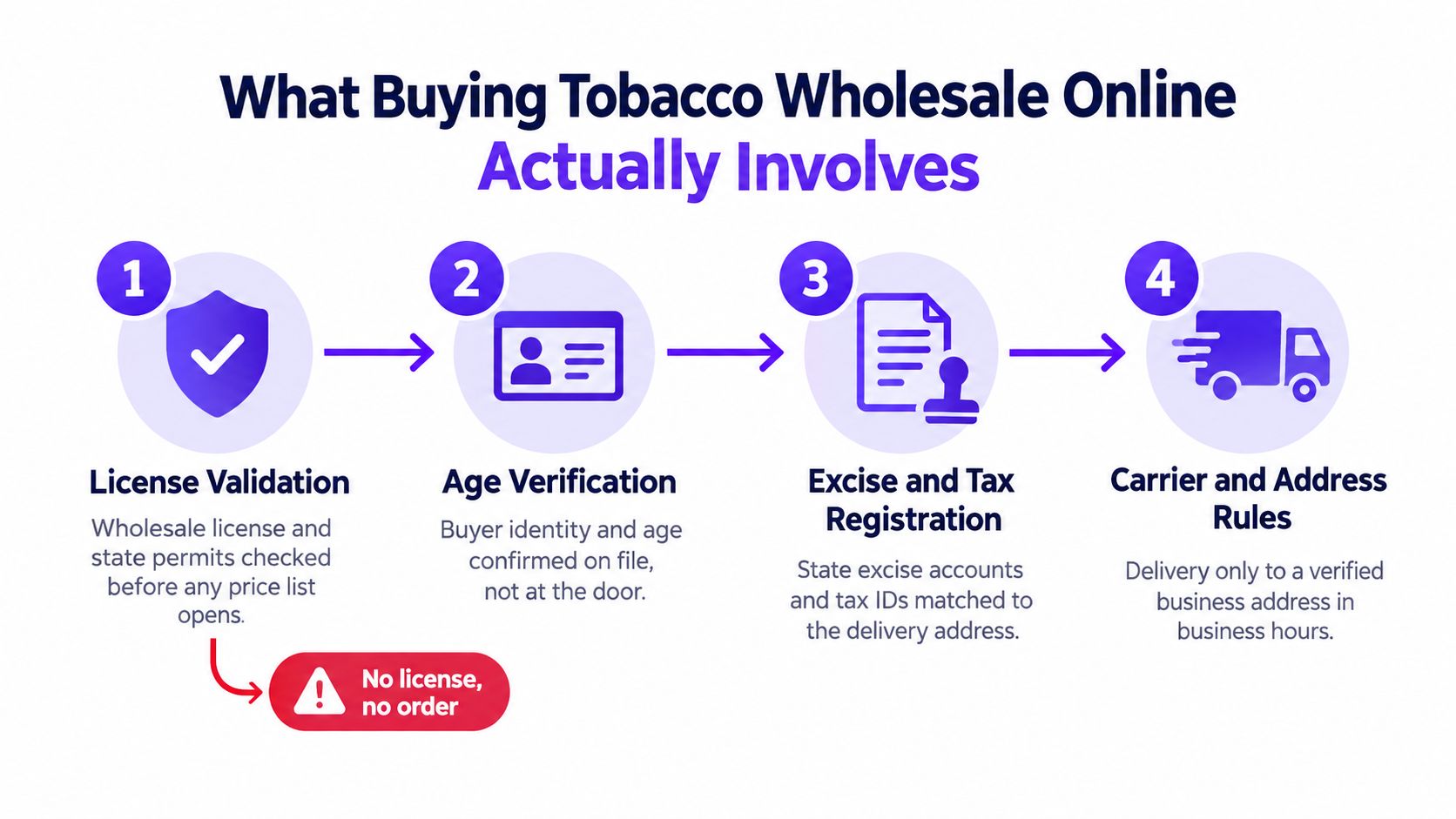
Table of Contents
What Buying Tobacco Wholesale Online Actually Involves
A wholesale tobacco order works more like a controlled release than a normal ecommerce checkout. Before anyone talks about flavor lists or case discounts, the buyer has to clear license validation, age verification, case-quantity math, and landed-cost checks, because the wrong document or the wrong address can stop the shipment before it ever leaves the dock.
That's the part most first-time buyers miss. Lounges usually care about steady shisha rotation and predictable replenishment. Smoke shops and convenience stores care more about fast-moving SKUs, receipt-ready paperwork, and the ability to reconcile every carton or tin against inventory. Online resellers have their own rhythm, but they still need the same basic controls, especially when shipping across state lines.
Practical rule: treat the cart like a compliance packet, not a basket. If the supplier can't tie the order to your license, your verified business address, and the right tax setup, the price on the screen doesn't matter.
The supply chain also behaves differently from retail because tobacco wholesalers often ship in case units, not single units. Payment terms, adult-signature delivery, and carrier restrictions shape what you can buy, when you can receive it, and whether the order lands during business hours when someone is there to sign.
Online tobacco distribution has been a compliance issue for years because digital channels broaden reach and complicate tax collection, a pattern the National Academies review tied to early Internet cigarette sales and the policy response that followed National Academies review of Internet tobacco sales. The practical lesson for buyers is simple, build the process first, then compare pricing.
Verifying Your Business Can Legally Buy Wholesale
A lounge can have a valid business license and still fail a tobacco supplier's review because its destination state requires a separate permit or tax registration. Before requesting case pricing, assemble the documents that prove who is buying, where the shipment is going, and which rules apply at that address.
That file usually includes a state tobacco license where required, a resale or exemption certificate, a federal employer ID if the business uses one, and destination-state registrations connected to tobacco shipments. Remote sales must comply with applicable state, local, and tribal licensing and excise-tax rules. California and North Carolina also specify monthly reporting expectations for covered tobacco sales and dispositions, as described in the ATF PACT Act guidance.
Match the account application to the documents
A supplier is approving a traceable shipment, not only creating a customer login. If the account uses one business name while the tax certificate uses another, or the delivery address falls outside the license record, expect a hold until the mismatch is explained.
Use this order before submitting the application:
- Start with the license set: collect the state tobacco permit, resale certificate, and local registrations before asking for a quote.
- Confirm buyer identity: match the legal business name, operating address, tax records, and delivery location across every document.
- Check product class by destination: cigarettes, smokeless products, and hookah or waterpipe tobacco may receive different treatment under Tobacco 21 and PACT-related rules. FDA also conducts undercover online purchase investigations, as covered in its FDA tobacco retail sales guidance.
- Document age controls: for applicable sales, verify that the purchaser is 21 or older and retain the evidence required by the supplier, carrier, or destination jurisdiction.
Keep a copy of the submitted file, the approval email, and any state-specific instructions. Ask the supplier which documents they need before fulfillment, whether each shipment requires adult signature, and whether the delivery address must appear on the license. Those checks expose gaps before inventory is paid for, shipped, or held at the dock.
Reading the Catalog Without Getting Burned
A case arrives with fewer sellable units than expected, or the shisha weight differs from the listing. The margin problem began before checkout. A B2B tobacco catalog can show a single tin, inner pack, master case, or locked carton under what appears to be one SKU, so verify the package hierarchy before comparing prices.
Start by opening the product specification, not the promotion banner. Confirm these details:
- Unit format: whether the SKU is sold as a carton, tin, pouch, or another pack type.
- Master case size: the number of sellable units inside the outer case.
- Inner pack count: the quantity in each inner pack when the supplier permits breakage or partial-case movement.
- Weight or fill quantity: the actual amount for shisha, where one brand may ship in different gram sizes.
- Rotation status: whether the item is regular inventory or a short promotion run.
A missing lot code, hidden weight, or SKU that disappears after a promotion warrants a supplier question before payment. Ask whether the product is current inventory, whether the listed configuration is still shipping, and how partial cases are handled.
Case size should match your expected sales, storage space, and replenishment pattern. A 50-unit shisha case and a 10-pack cigar carton require different stock planning, even when their markup percentages appear similar. Buying the larger case may lower the unit price while leaving cash tied up in slow flavors or aging product.
| Catalog Decode: Wholesale Tobacco SKU Anatomy | Typical Inner Pack | Master Case Size | What to Verify |
|---|---|---|---|
| Shisha | Varies by brand and weight | Often case-based | Weight, flavor rotation, lot code |
| Cigars | Carton or multi-pack | Case or tray | Carton count, freshness, pack status |
| Smokeless tobacco | Can, pouch, or tub | Master case | Unit count, warning labels, rotation |
| Accessories | Single item or bundle | Box or bulk carton | Compatibility, bundle contents, returnability |
Before adding a SKU to the cart, record the MSRP, units per case, weight, and rotation status in your buying sheet. Match those fields against the supplier's confirmation or invoice. If the four details do not align, the apparent discount can disappear when you restock, price individual units, or write off inventory that cannot move.
Calculating the True Landed Cost Per Case
A case priced at $1,190 can cost more than a $1,240 case once freight and delivery requirements enter the worksheet. Compare the amount received at your door, then divide it by sellable units to set a defensible margin.
Build the comparison around the case, not the listing
Start with the catalog's tier break. A discount may apply to each line, a master case, or the full order total. Confirm which threshold applies before comparing suppliers. Otherwise, the displayed price may not be the price you can buy.
Add every charge that follows the shipment. Federal excise tax, applicable state or local sales tax, freight, adult-signature fees, drop-ship charges, residential surcharges, and fuel adjustments all belong in the calculation. Keep sales tax separate when the amount depends on your account, destination, or exemption status.
| Landed Cost Worksheet Per Master Case | Supplier A ($) | Supplier B ($) |
|---|---|---|
| Case price | 1,240 | 1,190 |
| Excise tax | 85 | 85 |
| Sales tax | Add if applicable | Add if applicable |
| Freight allocated by case | 45 | 78 |
| Adult-signature fee | 12 | 12 |
| Total landed cost, before applicable sales tax | 1,382 | 1,365 |
This example shows why the lowest case price does not automatically produce the better buy. Supplier B is lower on the listed case price and still has the lower illustrated landed cost, but the result changes if its freight varies by order size or if its packing creates more damage or shortages. Replace the figures with your actual quotes, then divide each total by the number of sellable units per case to compare unit cost and retail margin.
Use the same worksheet for every quote. Research on Internet purchasing found that taxable cigarette sales became more sensitive to state tax rates as online access grew, a pattern relevant to buyers comparing jurisdictions and sales channels FDA regulatory analysis and related economic discussion. Consistent landed-cost math keeps tax differences from making one supplier appear cheaper than it is.
Shipping, Age Verification, and Recordkeeping in Practice
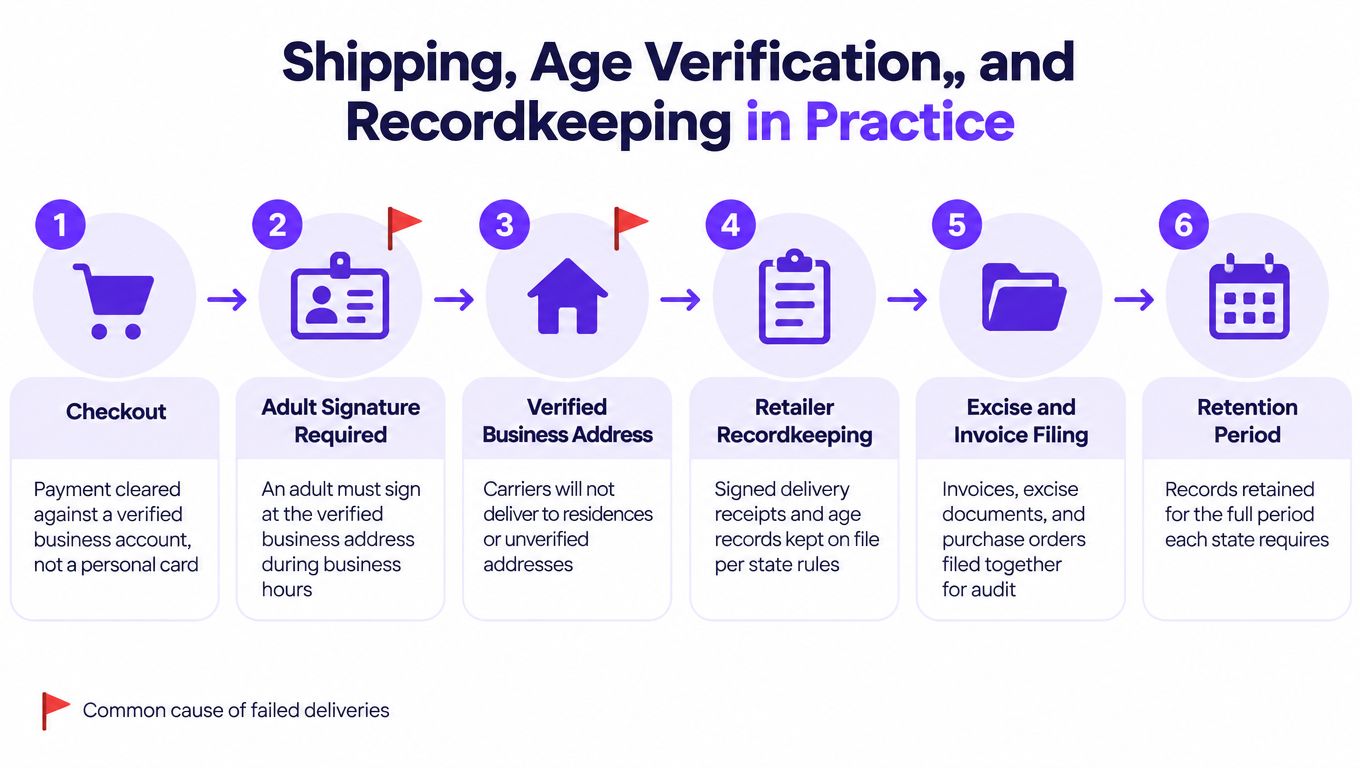
A shipment can be paid, packed, and still create a compliance problem. The weak points usually appear at delivery or later, when a buyer needs to prove that the order was received, checked, and released under the right controls.
Make the receiving desk part of compliance
Tobacco carriers generally require a verified business address and an adult signature. A missed signature can create return freight and delay replenishment, so assign someone to receive the order during business hours. Do not rely on a driver making a second attempt at a convenient time.
The receiving process should be deliberate. Before the cases enter storage:
- Count the cases first: compare the master cases with the packing slip before putting anything away.
- Check the SKU mix: verify every item against the invoice, including flavor, size, and case quantity.
- Photograph damage immediately: record broken seals, crushed corners, or wet cartons before the driver leaves.
- Log lot or batch numbers: preserve traceability for recalls, shortages, and invoice disputes.
A clean signed receipt protects you more than a fast handoff ever will.
Recordkeeping continues after delivery. Store invoices, excise documents, signed delivery records, and purchase orders together. That file should show what was ordered, what arrived, who accepted it, and how discrepancies were handled. Federal distribution guidance identifies record-retention requirements for certain distributors above specified thresholds, including five-year retention and electronic access for ATF on U.S.-based premises or qualifying hosted infrastructure FDA tobacco products compliance and enforcement overview.
Age verification needs the same discipline. Set a zero-release rule: no order proceeds until the verification result is recorded as a pass. An uncertain result goes to trained review rather than automatic approval. Keep the verification record with the order so staff can show why the shipment was accepted and released.
That documentation also gives the buyer a defensible record when a carrier, regulator, or internal manager questions the transaction. Price savings are useful only if the shipment arrives at the right address, reaches an authorized recipient, and leaves an audit trail.
Vetting Suppliers Before You Place a Pallet Order
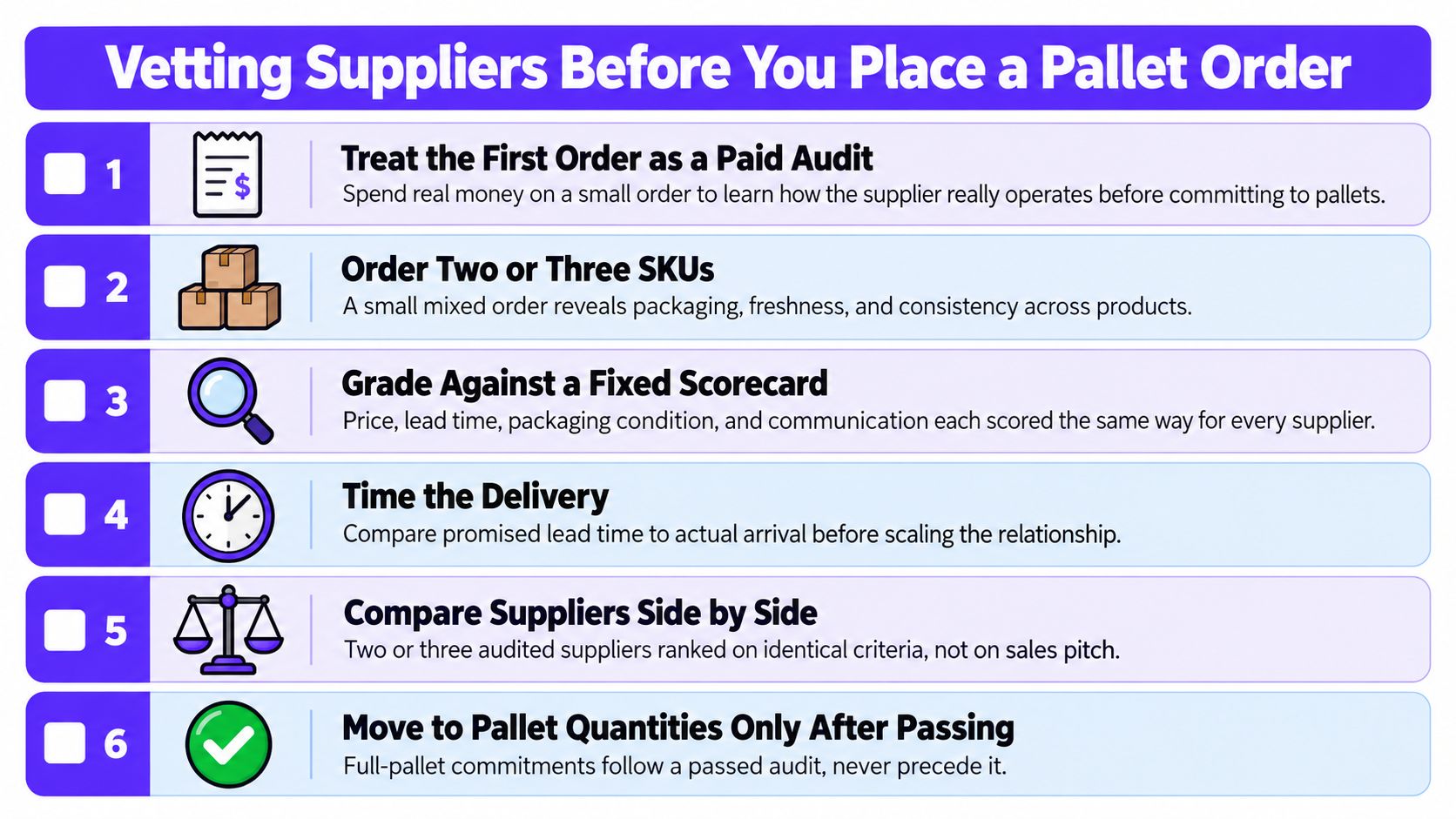
The first small order is an audit of the supplier's operating habits. A vendor that cannot process a mixed test order cleanly may create larger problems with a pallet, a replacement shipment, or a discrepancy that affects your license and cash flow.
Score the supplier on operational proof
Ask for evidence before discussing pallet volume. A practical scorecard covers the supplier's paperwork, actual inventory, case rules, and response speed. Vague “in stock” language, missing licensing documents, or unclear adult-signature procedures should pause the order.
Use the test order to check four areas:
- Documentation: request the current wholesale license, tobacco registration, and insurance documents when applicable.
- Inventory signals: confirm that high-rotation SKUs are available rather than repeatedly back-ordered.
- Case flexibility: ask whether the supplier accepts a mixed opening order or requires fixed case builds.
- Support responsiveness: ask how returns, short-date product, and shipping exceptions are handled, then record how promptly and clearly the supplier responds.
Review seller comments from buyers in your state, and compare the offered terms. Payment conditions, return handling, and explanations of PACT requirements or shipment restrictions reveal how the account will function after the sale. A polished catalog cannot answer those questions.
One option is Shop Hookah Tobacco, which publishes a hookah-focused catalog and offers wholesale accounts with pricing tied to account approval and order volume. Confirm that the supplier can process your paperwork, ship to your destination, and preserve a clear transaction trail before increasing the order size.
The decision should rest on documented performance from the test order, not the promise of a lower pallet price.
Planning Your First Order and Replenishment Rhythm
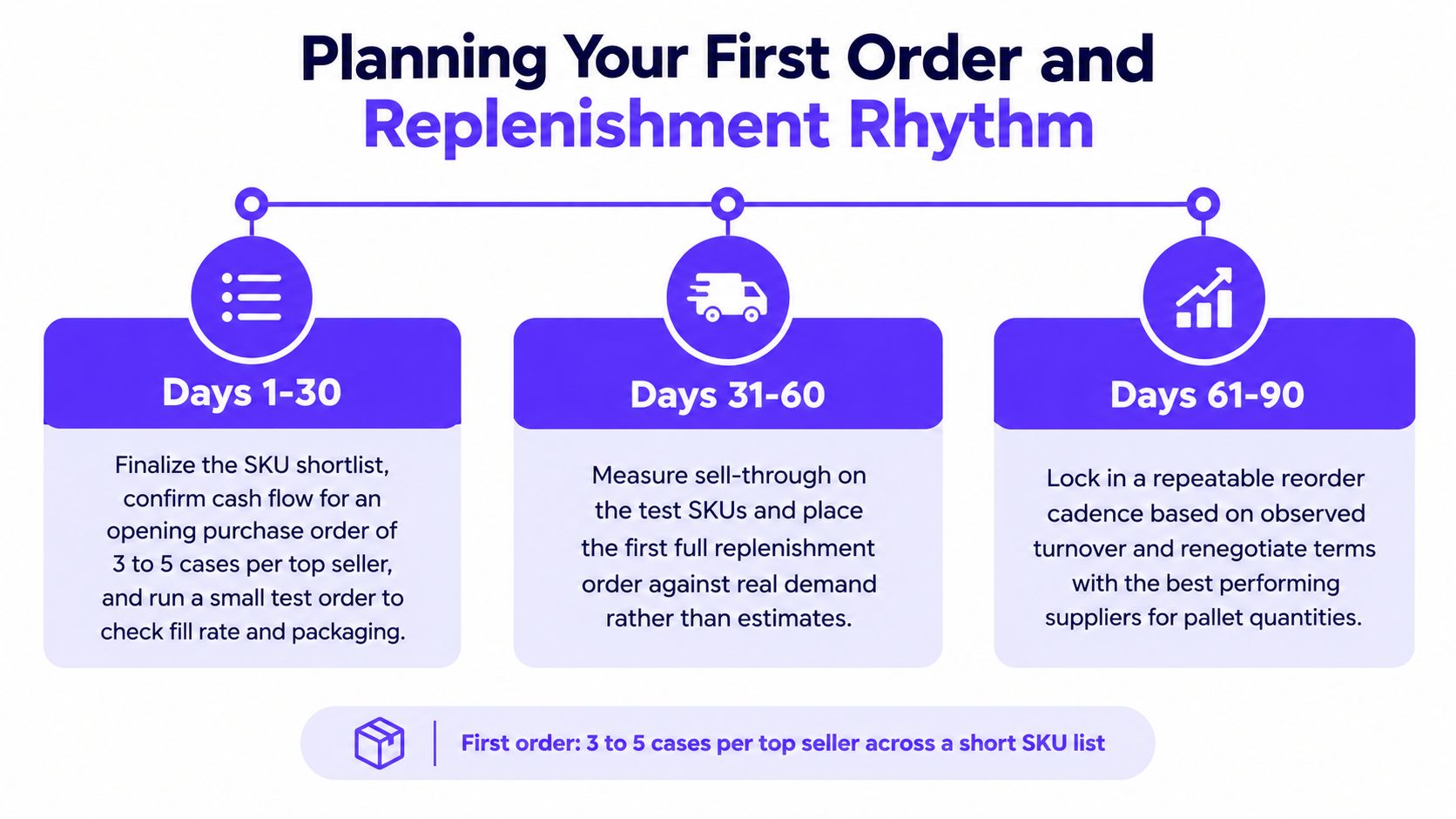
The first 90 days should feel like a controlled rollout, not a buying spree. If you can't repeat the order cleanly, you don't have a replenishment system yet, you have a one-off purchase.
Build the rhythm before the volume
In the first month, narrow the SKU list and fund a modest opening PO focused on your top sellers. In the second month, use sell-through to identify what moves, then set a reorder trigger before you run too lean. By the third month, negotiate around proven performers instead of guessing at what the market might want.
That cadence works because tobacco replenishment is tied to actual velocity, not theory. Hookah lounges, smoke shops, and convenience stores all see different movement patterns, and flavor rotation can change what stays on the shelf longer than expected.
A simple desk checklist keeps the process honest.
- Confirm the reorder point: don't wait until the shelf is empty.
- Track weekly movement: use real sales, not gut feel.
- Keep a backup supplier: one missed shipment shouldn't stall the counter.
- Align with pickup windows: if the carrier only moves certain days, reorder earlier.
The best first order is the one you can explain line by line three months later. If the invoice, the receiving log, the tax file, and the sell-through report all tell the same story, the next order gets easier.
If you're building a tobacco wholesale online program and want a catalog that's organized for case buying, shop accounts, and hookah-focused inventory, visit Shop Hookah Tobacco. Their wholesale setup fits buyers who need a practical starting point for shisha, hardware, charcoal, and related accessories, and it's worth reviewing alongside your own license and landing-cost checklist before you place the first order.