































Explore ZYN Pouches Wintergreen strengths, flavor, ingredients, use, storage, legal notes, availability, and alternatives in this practical guide.
You're looking at ZYN Wintergreen cans, trying to decide whether the nicotine strength or the flavor name should guide your choice. Start with the nicotine label, not the promise of a cooling taste. A flavor preference doesn't tell you how much nicotine you want, whether your gums will tolerate the pouch, or whether a retailer's listing matches the product you expect.
Table of Contents
Start With the ZYN Wintergreen Decision
ZYN Wintergreen is a tobacco-leaf-free, spit-free oral nicotine pouch, not loose tobacco and not a smoking-cessation medicine. It's placed between the upper lip and gum. FDA's scientific review of ZYN products documents the product format and its development in the U.S. market.
For an adult who already uses nicotine, the sensible starting point is product identification. Confirm that you're looking at Wintergreen, identify the nicotine strength, and check the package instructions before considering taste or availability. If you don't currently use nicotine, my recommendation is not to start for the flavor.
Separate preference from exposure
A shopper can like a wintergreen taste without wanting a higher nicotine strength. Conversely, familiarity with nicotine doesn't establish that a particular flavor or pouch will feel comfortable against the gums.
Keep these decisions separate:
- Product identity: Confirm the brand, flavor, and intended U.S. product.
- Nicotine choice: Read the strength rather than inferring it from color, flavor language, or popularity.
- Personal tolerance: Don't treat discomfort as proof that a pouch is working.
- Purchase details: Verify package quantity, condition, stock, and final pricing.
Practical rule: Choose nicotine strength deliberately. Treat flavor as a separate preference, never as a dosing guide.
The distinction also matters when reading product claims. A manufacturer's ingredient description establishes what it lists in the formulation. Regulatory authorization establishes a marketing status. Broader nicotine-pouch research raises questions about the category, but it doesn't automatically establish a finding about ZYN Wintergreen.
Keep those categories separate, and the purchase becomes easier to assess without confusing convenience, taste, or legal availability with safety.
Navigate the ZYN Wintergreen Reference
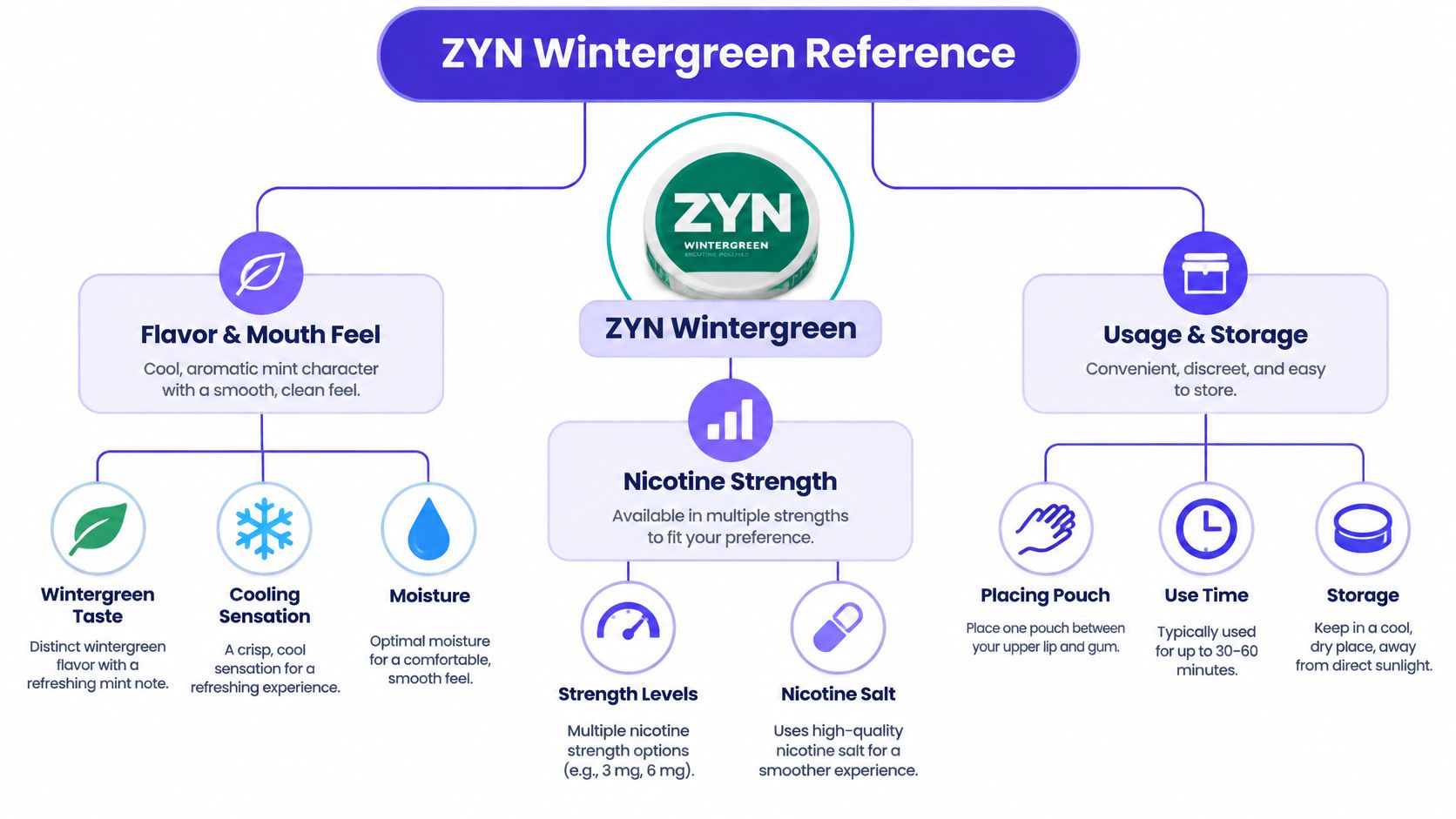
The most useful way to assess a pouch is by the question you need answered, not by a promotional list of features. Someone asking whether Wintergreen tastes more noticeable needs a different answer from someone checking whether a shipment contains the intended nicotine strength.
Match the question to the evidence
| Your question | What to examine | What not to assume |
|---|---|---|
| Will I like the taste? | Flavor description and your own preference | Cooling means higher nicotine |
| Which strength is listed? | Nicotine amount on the can | Similar packaging means identical contents |
| What's in the pouch? | Manufacturer's formulation information | Leaf-free means chemical-free |
| How should I handle it? | Package directions and storage guidance | A used pouch can be refreshed |
| Can this product be marketed? | Applicable authorization and local requirements | Authorization means harmless |
| Is this order current? | Stock status, selling unit, and final confirmation | A saved listing guarantees availability |
An adult asking for stronger flavor should first clarify whether they mean more aroma, more cooling, or more nicotine. Those aren't interchangeable requests, and choosing a higher nicotine version won't resolve every sensory preference.
A buyer checking stock has another job entirely. They need to confirm the exact item, selling unit, and availability. A person opening a can should instead examine the label and package condition.
Use the right evidence for the right decision. A product photograph can help identify a listing, but it can't establish personal tolerance. A retailer's availability indicator can help with replenishment, but it doesn't replace checking the delivered can.
For business buyers, keep those checks separate in purchasing and receiving records. That makes it easier to identify whether a discrepancy concerns the product, the order quantity, or the condition of the goods.
Explore the Wintergreen Flavor Profile
Wintergreen is a flavor description, not a strength category. Think of it as a cool, aromatic member of the broad mint-oriented flavor family. That description is a sensory reference, not a promise that every adult will perceive the same cooling, sweetness, or intensity.

A botanical illustration shouldn't be mistaken for an ingredient declaration. Don't infer from berries or leaves in an image that the pouch contains those plants, a particular essential oil, or an independently established concentration of a flavor chemical.
When comparing taste descriptions, be precise about what you want to change. A more noticeable aroma isn't necessarily a stronger cooling sensation. Neither establishes how much nicotine a person absorbs.
Popularity doesn't settle the choice
Mint-oriented products have a substantial commercial presence. A U.S. nicotine-pouch channel summary reported that mint flavors represented 59% of nicotine-pouch volume in the cited industry data, while ZYN Wintergreen 6 mg ranked first among listed products in a retailer-platform report covering 2024.
Those figures describe specific commercial channels, not worldwide sales or a complete national market-share estimate. They don't tell you which product you should choose.
- If you want a different taste: Compare flavor descriptions without automatically changing nicotine strength.
- If you want less nicotine: Use the labeled nicotine amount, not a milder-sounding flavor name.
- If you dislike the mouth feel: Identify whether the problem is cooling, flavor, pouch contact, or discomfort before buying another can.
A preferred taste is subjective. Product strength is a label fact. Keep those judgments separate, even when reviews use the same word, such as “strong,” for both.
Persistent gum pain shouldn't be reframed as an intense flavor experience. The mouth-effects guidance below addresses that distinction more directly, but the purchasing implication is simple: don't select a flavor on the assumption that you should learn to tolerate pain.
Compare 3 mg and 6 mg Strengths
The U.S. Wintergreen versions are labeled 3 mg or 6 mg of nicotine per pouch, as identified in the FDA's authorized-product announcement. Those amounts describe nicotine content, not a guaranteed amount absorbed or a predictable subjective effect.
ZYN Wintergreen Strength Choices
| Product detail | 3 mg version | 6 mg version |
|---|---|---|
| Product name | ZYN Wintergreen, lower labeled option | ZYN Wintergreen, higher labeled option |
| What the number means | Nicotine content per pouch | Nicotine content per pouch |
| Flavor identity | Wintergreen | Wintergreen |
| What to verify on the can | Exact strength, product name, directions, package integrity | Exact strength, product name, directions, package integrity |
| What the label doesn't establish | Your personal tolerance or absorbed dose | Your personal tolerance or absorbed dose |
The table's strength values refer to the FDA listing cited above. Neither version should be described as universally suitable, harmless, or medically appropriate for a particular adult.
Don't choose upward by default
My recommendation is straightforward: don't move to the higher labeled strength because it's available, popular, or described as more satisfying. Ask whether you're deliberately seeking more nicotine or merely expecting a different taste.
For an adult already familiar with a particular Wintergreen strength, the task may be continuity. Compare the listing with the can you normally purchase, then check the delivered product rather than relying on a familiar image.
An adult trying pouches for the first time should slow the decision down. Experience with another nicotine product doesn't provide an exact pouch-strength conversion, and this reference doesn't offer one.
A stronger flavor impression isn't a reason to increase nicotine content. Change the variable you actually mean to change.
Don't use the lower labeled option as a safety claim, either. Less labeled nicotine doesn't turn the product into a risk-free choice, and choosing it doesn't establish that your mouth will tolerate the flavoring or pouch contact.
If your real goal is to stop using nicotine or quit smoking, don't turn this comparison into a self-designed treatment plan. Ask a healthcare professional about cessation support rather than treating a retail strength choice as medical guidance.
Review Ingredients and Mouth Effects
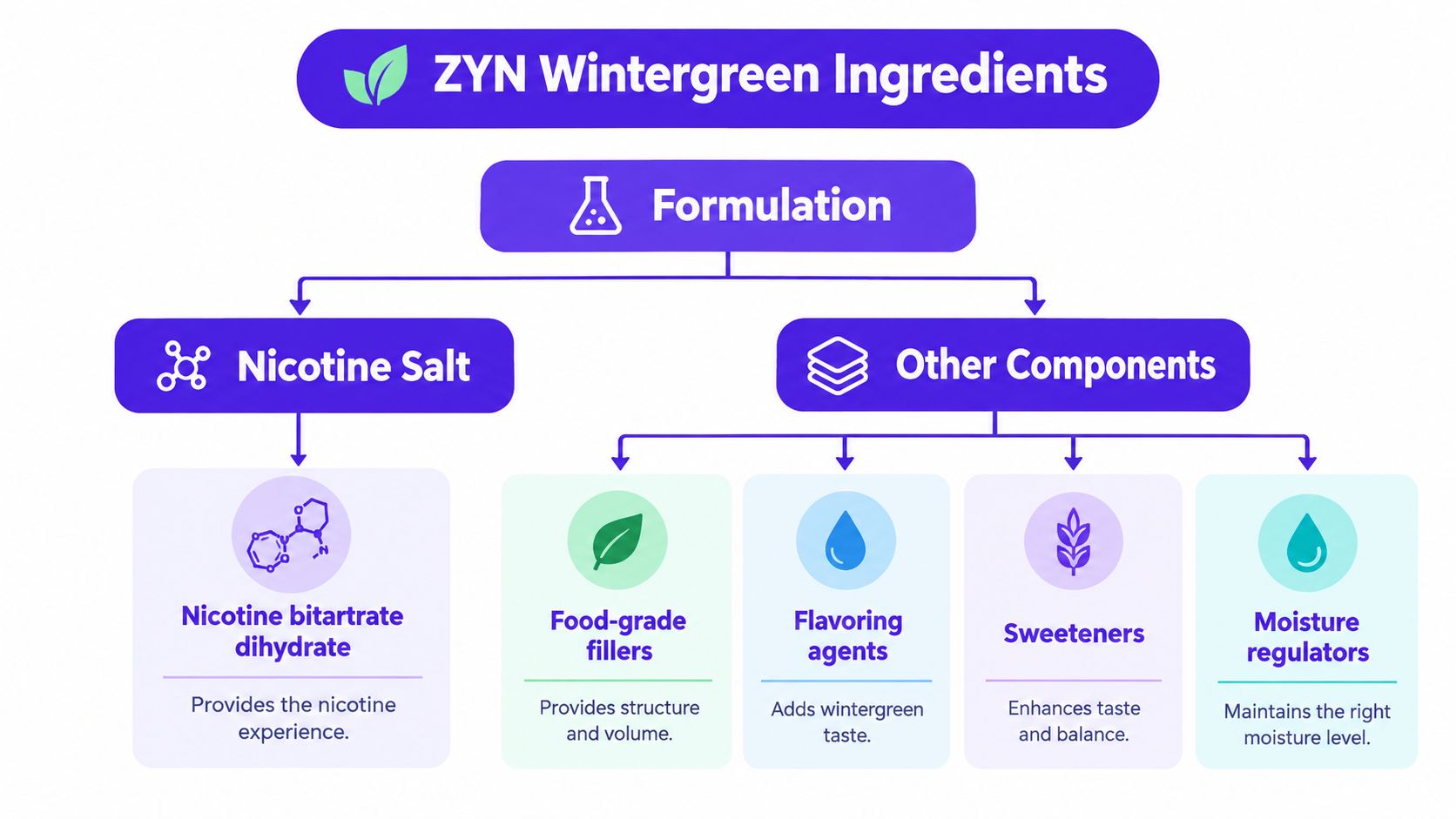
“Tobacco-leaf-free” describes an important product distinction, but it doesn't mean “chemical-free.” ZYN's manufacturer formulation information identifies nicotine bitartrate dihydrate, a nicotine salt, alongside ingredients used for consistency, filling, pH adjustment, sweetness, and flavor.
Read the formulation by function
The manufacturer's written formulation is the useful reference for ingredient roles:
- Nicotine salt: Nicotine bitartrate dihydrate supplies the nicotine component.
- Consistency agent: Hydroxypropyl cellulose contributes to consistency.
- Fillers: Microcrystalline cellulose, maltitol, and gum arabic form part of the pouch contents.
- pH adjusters: Sodium carbonate and sodium bicarbonate serve this formulation role.
- Sweetener and flavorings: Acesulfame K provides sweetness, with flavorings also included.
A technical ingredient name doesn't establish that an ingredient is unusually dangerous, unusually mild, or responsible for a particular sensation. Equally, familiar-sounding ingredients don't establish that prolonged contact will be comfortable for everyone.
The public ingredient description isn't a complete answer to Wintergreen flavor chemistry. Don't infer an exact flavor molecule, concentration, or mechanism from the flavor name alone.
Separate mouth sensations from injury concerns
Questions about burning, tingling, gum sensitivity, and ulcer-like irritation deserve more attention than a simple taste rating. The FDA's product-review materials provide product-specific regulatory context, but they aren't a guarantee that every user will tolerate the flavoring or gum contact.
A brief sensory change and persistent pain are different observations. However, that distinction isn't permission to label any tingling “normal” or to diagnose the cause yourself.
Remove the pouch if use causes pain or concerning irritation. Don't repeatedly place another pouch against the same sore area to test whether the sensation returns. Rotating placement shouldn't become a workaround for ongoing symptoms.
Seek medical or dental evaluation for persistent pain, lesions, or symptoms that don't resolve after stopping use. A clinician can assess the affected area; a flavor review can't.
Broader nicotine-pouch chemical findings also require careful boundaries. Findings from other products or mixed product samples shouldn't be presented as laboratory results for ZYN Wintergreen. Without product-specific evidence, attributing a broader finding to this exact formulation would overstate what's known.
The responsible conclusion isn't that every ingredient is harmless or that every uncomfortable sensation proves injury. It's that leaf-free wording doesn't replace ingredient scrutiny, and a pleasant taste doesn't establish tolerability.
Use and Store the Pouch Safely
A can of ZYN Wintergreen left in a hot car, or an open can drying out beside a sink, covers most of what goes wrong with handling. The rest is discipline: follow the package directions, treat each pouch as single-use, and keep storage boring.
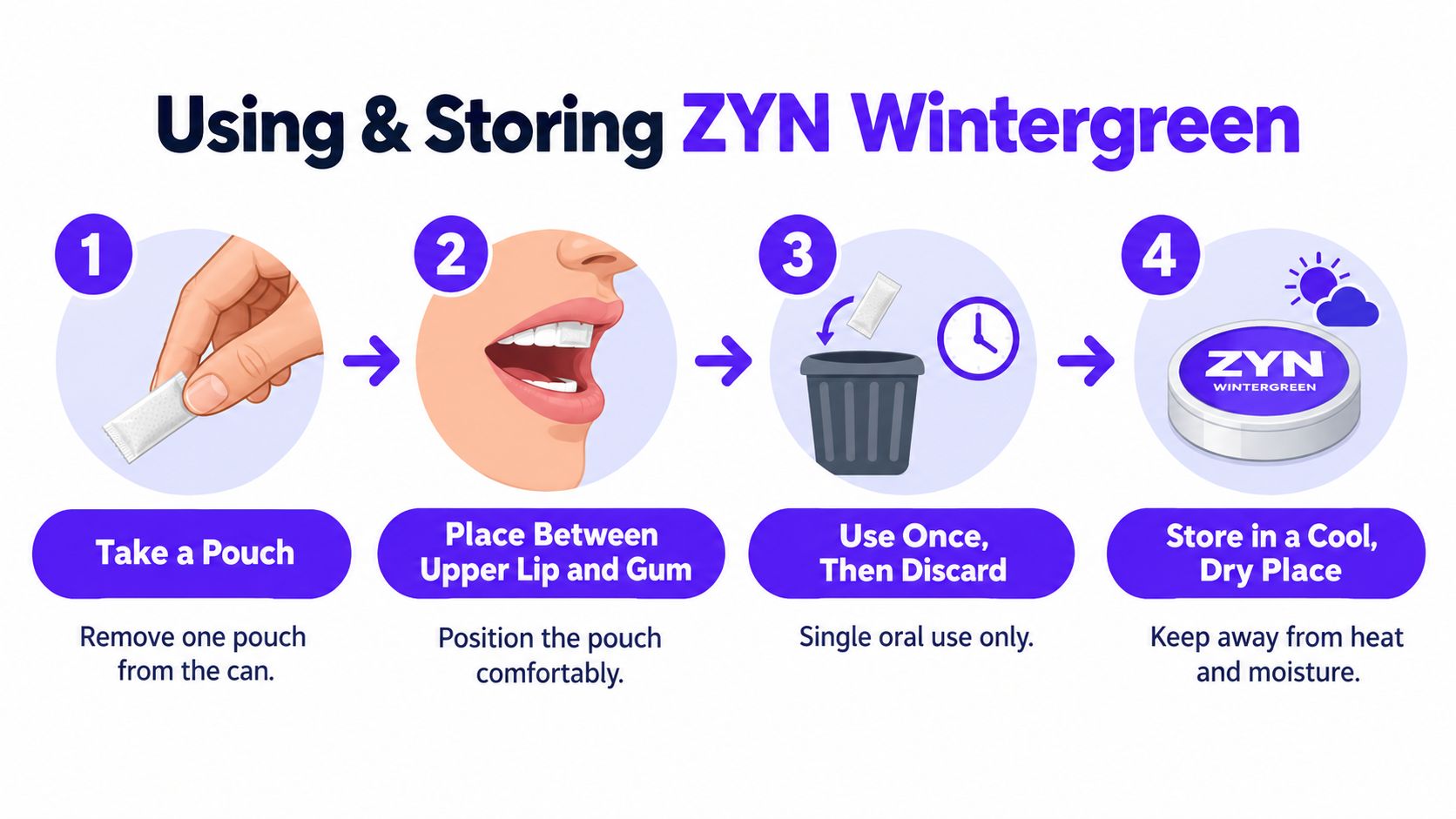
The intended placement is between the upper lip and gum, as identified earlier. Confirm the product identity and inspect the can's condition before opening, follow the current package instructions rather than improvising around another person's routine, and discard each pouch after use. The manufacturer specifies single oral use, so a used pouch goes in the trash, not back in the can or saved for later.
Flavor is not a timer. A fading wintergreen taste doesn't tell you to add another pouch, and a noticeable one doesn't establish how much nicotine you've absorbed. No universal use duration applies here, so read the directions on the actual package. If contact causes pain or concerning irritation, follow the symptom guidance above rather than enduring it.
Storage is where adults tend to overthink. The manufacturer FAQ cited in the ingredient reference advises sealed cans at normal room temperature and humidity. Refrigeration is unnecessary. What matters:
| Situation | Effect | What to do |
|---|---|---|
| Sealed can, dry indoor shelf | Maintains product performance | Store as-is, can closed |
| Refrigeration | Unnecessary | Skip it |
| Prolonged high heat or humidity | Can reduce product performance | Move cans to a controlled location |
| Open can near a sink or in a vehicle | Moisture exposure and heat swings | Keep cans closed and indoors |
For retailers and wholesale buyers, the same logic scales up: lot-level inventory rotation, dry ambient conditions across receiving, back-room storage, and display, plus placement that keeps products away from children. Don't mix loose pouches from different cans or discard identifying packaging before resolving an inventory discrepancy. Keeping the original product identity available is a practical way to avoid confusion during handling.
Disposal closes the loop. Choose a method that keeps used pouches inaccessible to children, and don't leave them on counters, tables, or in an open container.
Understand the U.S. Legal and Age Notes
A listing that says “FDA authorized” can still be misread three different ways before checkout. For ZYN pouches Wintergreen, the accurate claim is narrow: specified ZYN products received marketing authorization through the premarket tobacco application pathway. That permits legal marketing of the authorized products. It does not make them safe, risk-free, approved as medicine, or cleared for every item sold under the same brand name.
Keep the ZYN-specific finding separate from broader nicotine-pouch research. A study about cravings, biomarkers, or pouch use across brands may inform risk discussion, but it does not expand which ZYN product was authorized or turn authorization into a health endorsement.
Use language that survives an edit, a product page, and a compliance review. Say the applicable product is FDA-authorized for marketing. Do not imply FDA approved it as a cessation treatment, certified it as harmless, or guaranteed a good experience for every user. The agency's position remains that all tobacco products are harmful and potentially addictive; removing tobacco leaf does not remove nicotine dependence or move the product outside tobacco regulation.
Age and access are operational checks, not assumptions. Buyers must meet applicable age, identity, local sales, delivery, and labeling requirements. Seeing Wintergreen in an online catalog does not prove it can be sold to that visitor or shipped to that address. For business buyers, item authorization and transaction compliance are different controls: confirm the exact product identity first, then confirm the seller, buyer, jurisdiction, and handoff all satisfy the rules that apply.
Children should never access pouches in any state: sealed, opened, used, or waiting for disposal. Packaging that looks secure is not a substitute for storage and cleanup discipline.
Legal status also settles less than shoppers think. A legally marketed product can still be wrong for an individual user. Authorization cannot excuse mouth pain, justify unwanted nicotine exposure, or override a clinician's advice.
Check Availability and Product Details
A listing shows a familiar can design, the word Wintergreen twice in the description, and a price that beats every other result. What it never states is which strength is pictured or whether that price covers a single can or a multipack. This is common with pouch listings, which is why the listing itself is a claim to verify, not a substitute for the physical package.
Treat verification as a sequence. Confirm the name and flavor say ZYN pouches Wintergreen rather than a similarly presented item. Match the listed strength to the one you selected in the comparison above. Check that the listing corresponds to the applicable authorized U.S. product. Establish the selling unit before comparing prices, since a can, a multipack, and a case sit at very different price points. Review the stated package condition and current stock status last, once the item itself checks out.
Never assume a universal pouch count, pack size, or case configuration. Confirm it on the listing, confirm it again on the order confirmation, and compare both against what arrives.
The checks split by buyer type. An adult purchasing a can needs a straight answer on contents and availability. A business buyer also needs the same item identity to appear on the purchase order, the invoice, and the receiving record, because mismatched identifiers turn a routine delivery into a dispute.
Retailer tools have limits. Stock alerts and wishlist functions help monitor replenishment, but neither reserves an item unless the retailer says so in writing, and a saved product page can carry a stale description for weeks. Confirm final pricing before completing the order: where a retailer warns that prices may change or sends a confirmation email, the confirmed amount is the one that counts.
One last check belongs at the door. Inspect the cans before they go into use or inventory. If the product identity, strength, quantity, or package condition differs from the order, raise the discrepancy with the seller instead of accepting a familiar brand name as proof that everything is correct.
Consider Wintergreen Alternatives
Choose an alternative by identifying what you want to change. Disliking Wintergreen's taste, wanting less nicotine, and experiencing gum pain are different reasons to reconsider a product.
A random list of pouch brands won't resolve those differences. Neither will a ranking based on sales or enthusiastic reviews.
Change the relevant feature
| Reason for reconsidering | What to compare | What not to infer |
|---|---|---|
| You dislike the flavor | Another mint-oriented or non-Wintergreen profile | Different taste means lower risk |
| You want different nicotine content | The alternative's exact label | Familiar flavor means equivalent strength |
| You dislike pouch contact | Format and intended use pattern | A different format is automatically safer |
| You want no nicotine | An explicit nicotine-free declaration | Tobacco-leaf-free means nicotine-free |
| You want to quit smoking | Professional cessation guidance | A retail pouch is an approved treatment |
For a flavor-led decision, keep the nicotine question separate. You might prefer a different aromatic profile without seeking more nicotine, so don't let a bundled flavor-and-strength change obscure the choice.
For a strength-led decision, avoid translating numbers across unfamiliar products as though they guarantee identical experiences. Check the alternative's own labeling and directions.
Choose an alternative to solve a clearly identified problem, not because its packaging sounds milder.
Don't shop around an unresolved symptom
If gum contact is painful, stop and address that problem before testing another flavor against the same area. Switching products isn't a diagnostic method, and a less noticeable taste doesn't establish that an irritated area has recovered.
The wording on alternatives also needs scrutiny. Tobacco-leaf-free, nicotine-free, and different flavor are separate claims. Each needs its own verification.
If the objective is cessation rather than a different consumer experience, change the category of advice you seek. A healthcare professional can discuss approved treatment options and an appropriate plan.
The same adult-access, label-checking, storage, and disposal responsibilities apply when comparing alternatives. A new flavor name or pouch format doesn't erase those responsibilities, and there's no reason to invent a universal winner without product-specific evidence.
Use the Quick Reference Checklist
Use this checklist when reviewing a listing or opening a newly purchased can. It brings the earlier decisions together without replacing the package directions.
Before purchase and during handling
- Confirm the format: Make sure you intend to purchase the tobacco-leaf-free, spit-free oral pouch described at the start.
- Read the strength: Use the strength comparison, not flavor intensity or package color.
- Separate taste from exposure: Decide whether you want a different flavor or a different nicotine amount.
- Check the ingredients: Refer to the formulation discussion rather than assuming leaf-free means chemical-free.
- Inspect the order: Verify the selling unit, current stock, final price, and delivered package condition.
- Follow single-use handling: Use the disposal guidance rather than saving a pouch for reuse.
- Store appropriately: Follow the room-temperature, closed-can guidance and prevent child access.
- Use precise legal language: Marketing authorization isn't safety approval or treatment approval.
Follow the path that matches your decision
Choosing between the labeled strengths: Start with the comparison table, identify whether you're seeking more nicotine, and check the actual can. Don't use a stronger flavor preference as the reason to increase nicotine content.
Checking whether a retailer listing is current: Confirm product identity and stock, clarify the selling unit, and obtain any required final-price confirmation. Compare the delivered order with those details before accepting it into use or inventory.
Persistent pain, lesions, or unresolved symptoms require medical or dental evaluation. Don't let a completed purchasing checklist overrule a concerning physical response.
For repeat business orders, retain the confirmed item description. That gives receiving staff a concrete reference instead of asking them to identify products from memory.
Answer Common Wintergreen Questions
Is Wintergreen stronger than other flavors?
The flavor name doesn't establish nicotine strength. Use the labeled amount and the strength comparison above, not a review's description of an intense taste.
Does more cooling mean more nicotine?
No reliable dose judgment follows from cooling alone. Flavor intensity isn't a substitute for reading the label, and it doesn't establish absorbed nicotine.
What should I do about persistent gum irritation?
Remove the pouch and stop using it against the affected area. Seek medical or dental evaluation for ongoing pain, lesions, or symptoms that don't resolve, as discussed under ingredients and mouth effects.
What if a child accidentally accesses a pouch?
Seek prompt professional advice from a poison-control service or emergency medical service. Don't use flavor, package appearance, or an absence of immediate symptoms to decide that exposure is harmless.
Is it a smoking-cessation treatment?
No. The legal discussion distinguishes marketing authorization from approved treatment. Revisit the strength, ingredients, handling, and quick-reference guidance for product decisions; seek professional cessation support when quitting is your goal.
Shop Hookah Tobacco offers a nicotine-pouch catalog alongside tobacco, hardware, and accessories, with inventory indicators and wishlist support for checking availability. Visit Shop Hookah Tobacco to review current Wintergreen listings, verify the labeled strength and selling unit, and confirm final pricing by email before completing an order.